
SQL Injection Warning Signs: Detecting Data Breaches Early
Silent database errors often hide successful SQL injection attempts long before any data exfiltration becomes visible to standard monitoring tools.
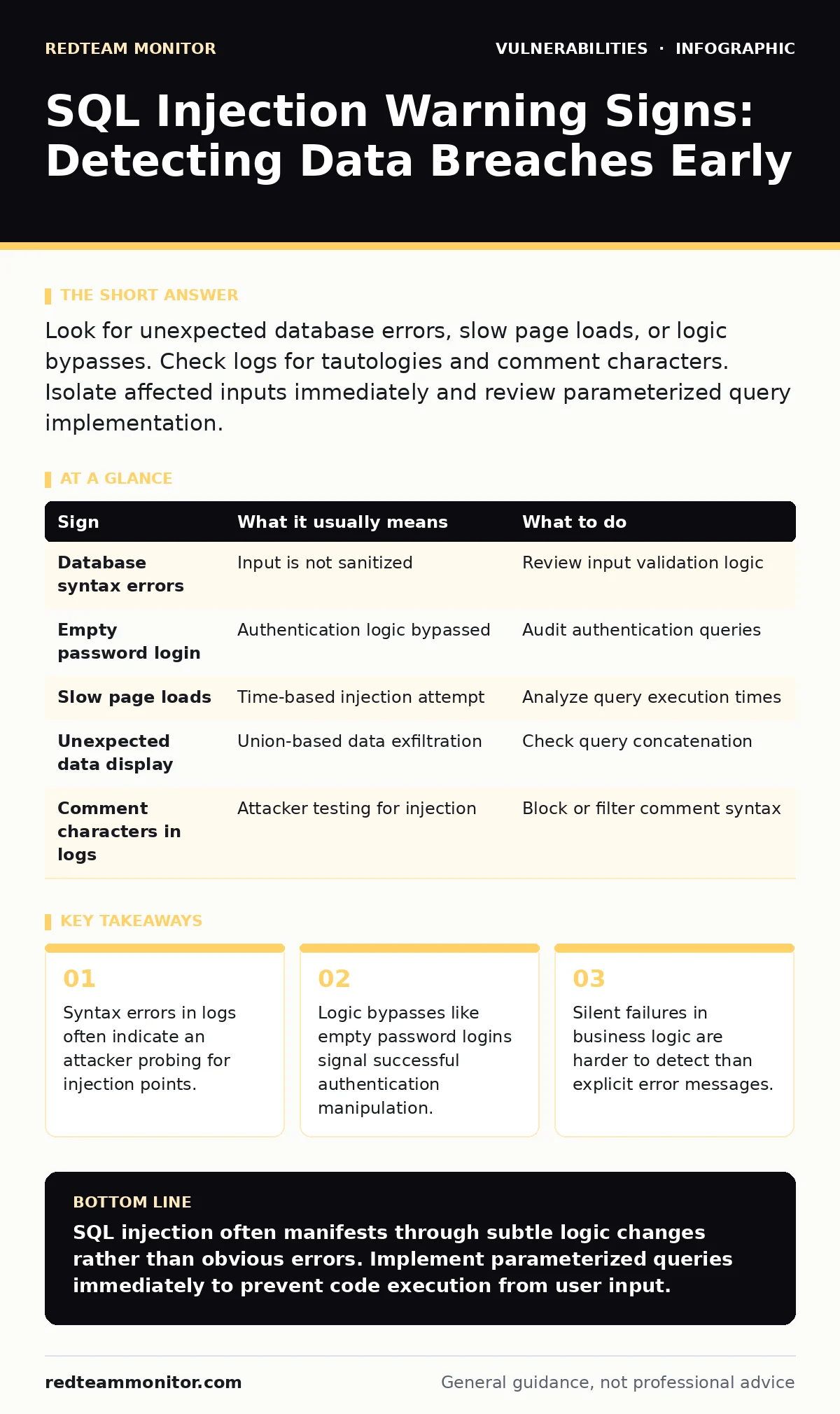
Look for unexpected database errors, slow page loads, or logic bypasses. Check logs for tautologies and comment characters. Isolate affected inputs immediately and review parameterized query implementation.
The Obvious Error Messages
The first sign of SQL injection is often a database error displayed directly on the screen. When an application fails to sanitize input, the database engine may return its internal error message to the browser. These messages reveal the structure of the underlying query.
Look for messages mentioning "syntax error," "unclosed quotation," or "conversion failed." These indicate that the database received malformed SQL. A well-configured application should never show these raw errors to end users.
If you see these errors in production, the application is likely vulnerable. The attacker can use this feedback to refine their payload. This is known as error-based injection. It provides immediate confirmation that the input field is executable as code.
Logic Bypasses and Authentication Failures
A more subtle sign involves changes in application behavior rather than errors. Suppose a user enters a single quote followed by a comment character into a login field. If the application grants access without a valid password, SQL injection is occurring.
This happens because the input alters the logical condition of the query. The database might interpret the input as a statement that is always true. This allows the attacker to bypass authentication entirely.
Check for accounts that log in with empty credentials or impossible combinations. Review access logs for successful logins that lack corresponding password verification steps. This is a critical indicator of compromised input validation.
Performance Degradation as a Signal
SQL injection does not always break the application; sometimes it slows it down. Time-based blind injection is a technique where the attacker sends a query that forces the database to wait.
If a page load time spikes significantly for specific inputs, investigate further. The attacker might be injecting a command that delays execution. This confirms the presence of an injection point without returning visible data.
Monitor average response times for dynamic endpoints. Sudden, unexplained latency on specific form submissions warrants immediate review. This metric is often overlooked in favor of error logs.
Silent Data Manipulation
The most dangerous sign is the one you do not see. Union-based injection allows attackers to append their own queries to legitimate ones. They can retrieve data from other tables without triggering errors.
Look for unexpected data in user profiles or search results. If a user sees information that belongs to another account, the query boundary has been breached. This indicates that the application is concatenating untrusted input into SQL statements.
Review database audit logs for unusual query patterns. Look for SELECT statements that reference tables unrelated to the current operation. This requires deep log analysis but reveals hidden exfiltration.
Detecting the Hidden Indicators
| Sign | What it usually means | What to do |
|---|---|---|
| Database syntax errors | Input is not sanitized | Review input validation logic |
| Empty password login | Authentication logic bypassed | Audit authentication queries |
| Slow page loads | Time-based injection attempt | Analyze query execution times |
| Unexpected data display | Union-based data exfiltration | Check query concatenation |
| Comment characters in logs | Attacker testing for injection | Block or filter comment syntax |
Immediate Response Steps
When you identify a potential SQL injection, act quickly to contain the risk. First, isolate the affected input field. Disable it if possible to prevent further exploitation.
Next, review the source code for that specific endpoint. Look for string concatenation in SQL queries. Replace these with parameterized queries or prepared statements. This ensures the database treats input as data, not code.
Do not rely on input filtering alone. Blacklisting specific characters is easily bypassed. Focus on structural changes to how queries are built. This approach is more durable against evolving attack techniques.
Long-Term Prevention Strategies
Preventing SQL injection requires a shift in development practices. Adopt parameterized queries as the standard for all database interactions. This technique separates code from data at the protocol level.
Implement strict input validation. Define expected formats for all user inputs. Reject anything that does not match the defined pattern. This reduces the attack surface significantly.
Regularly review your codebase for legacy patterns. Older applications may still use vulnerable concatenation methods. Update these components to modern standards. Refer to the OWASP Top 10 for current best practices.
Consider using web application firewalls as an additional layer. These tools can detect and block common injection patterns. However, they are not a substitute for secure coding. They provide defense in depth, not complete protection.
Key takeaways
- Syntax errors in logs often indicate an attacker probing for injection points.
- Logic bypasses like empty password logins signal successful authentication manipulation.
- Silent failures in business logic are harder to detect than explicit error messages.
SQL injection often manifests through subtle logic changes rather than obvious errors. Implement parameterized queries immediately to prevent code execution from user input.
Frequently asked questions
How do I know if my application is vulnerable to SQL injection?
Test input fields with special characters like quotes and comment symbols. If the application errors or behaves unexpectedly, it may be vulnerable.
Can web application firewalls stop all SQL injection attacks?
No. They can block known patterns but may miss novel or obfuscated payloads. Secure coding is the primary defense.
What is the difference between parameterized queries and input validation?
Parameterized queries separate code from data, preventing execution. Input validation checks format but does not prevent injection if the query structure is flawed.
Should I use stored procedures to prevent SQL injection?
Stored procedures can help, but they are not immune. If they accept dynamic SQL or are called with concatenated strings, they remain vulnerable.
How this guide was produced: written by the RedTeam Monitor editorial team with AI assistance, checked against the public references listed below, and reviewed when the facts change. See our editorial policy or report an error.