
Integer Overflow Vulnerabilities: 7 Mistakes That Break Your Code
Integer overflow errors allow attackers to bypass security checks by wrapping arithmetic values, turning valid inputs into unauthorized memory access or logic failures.
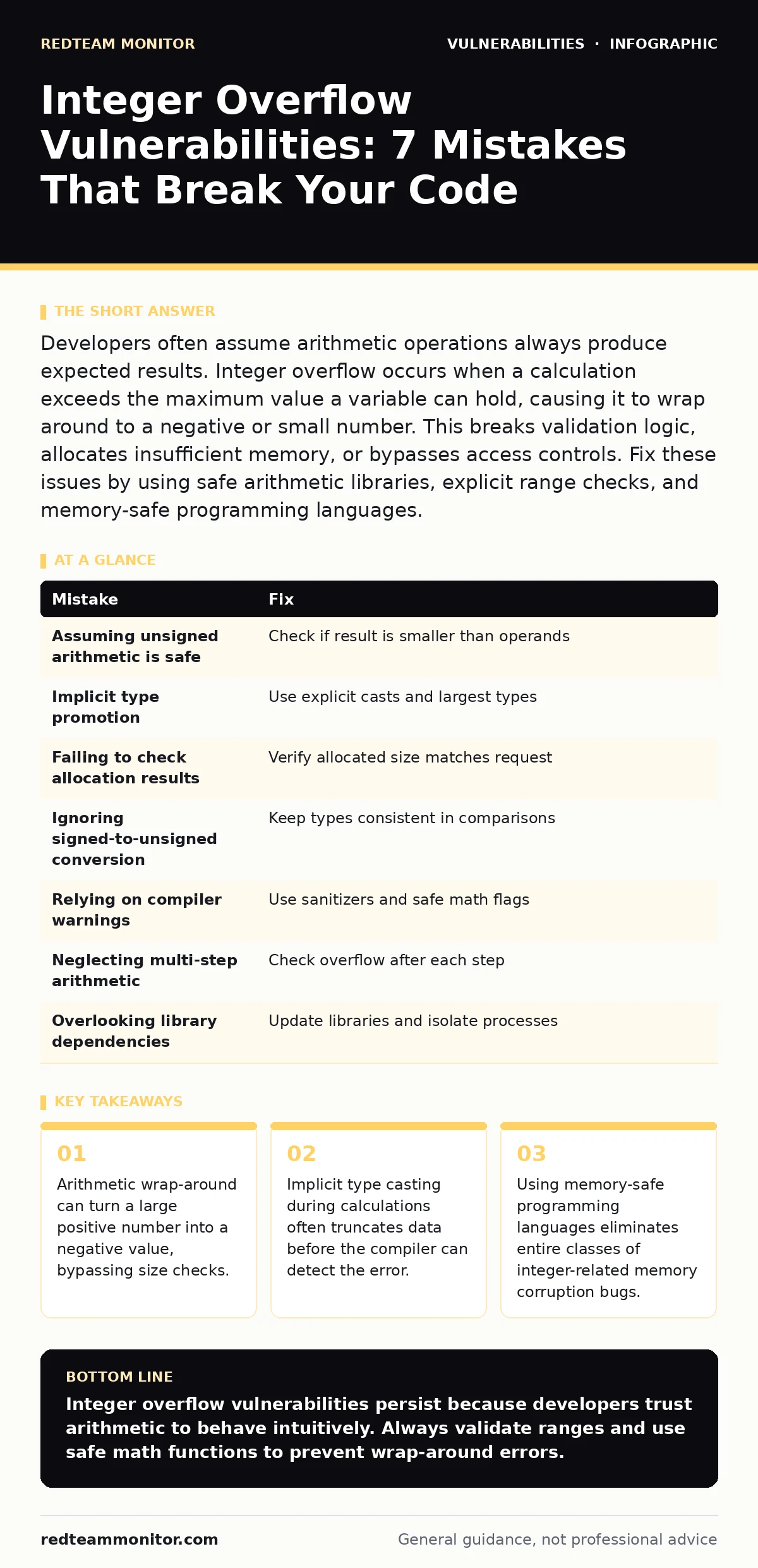
Developers often assume arithmetic operations always produce expected results. Integer overflow occurs when a calculation exceeds the maximum value a variable can hold, causing it to wrap around to a negative or small number. This breaks validation logic, allocates insufficient memory, or bypasses access controls. Fix these issues by using safe arithmetic libraries, explicit range checks, and memory-safe programming languages.
Mistake 1: Assuming Unsigned Arithmetic Is Safe
Developers frequently believe that using unsigned integers prevents overflow because the value cannot become negative. This assumption fails when an unsigned calculation wraps around its maximum limit. An unsigned 32-bit integer that reaches its maximum value and adds one becomes zero. This wrap-around behavior is deterministic and predictable to an attacker.
Why it hurts:
Security checks often rely on positive values to represent sizes or offsets. If an overflow turns a large size into zero, a subsequent check for "greater than zero" passes. The system then allocates zero bytes or accesses memory at offset zero. This creates a condition where the application believes it has handled valid data, but it has actually prepared an empty buffer. An attacker can write data into this empty space, overwriting adjacent memory structures.
The fix:
Never rely on the sign of an integer to detect errors. Explicitly check if the result of an addition is smaller than either operand. If (a + b) < a, an overflow has occurred. Use dedicated safe math functions that return a boolean status or throw an exception instead of silently wrapping. Treat unsigned arithmetic with the same suspicion as signed arithmetic in security-critical paths.
Mistake 2: Implicit Type Promotion During Calculations
Code often mixes different integer sizes, such as adding a 16-bit value to a 32-bit value. Compilers promote the smaller type to match the larger one before performing the operation. However, if the intermediate result is cast back to a smaller type, data loss occurs. This truncation happens silently at the machine instruction level. The final variable holds a value that bears no mathematical relation to the input.
Why it hurts:
Truncation discards the most significant bits of a calculation. A large memory offset might become a small, valid pointer. This allows an attacker to specify a huge size in a request, which gets truncated to a tiny number during processing. The application then allocates a small buffer based on the truncated value but processes the original large input. This mismatch leads to a heap buffer overflow. The attacker writes beyond the allocated memory, potentially executing arbitrary code.
The fix:
Use explicit casts only when you have verified the result fits in the target type. Prefer using the largest reasonable integer type for intermediate calculations. Define clear boundaries for all inputs before any arithmetic occurs. Validate that the final result matches the expected range before using it for memory allocation or indexing. Avoid relying on compiler defaults for type promotion in security-sensitive logic.
Mistake 3: Failing to Check Allocation Results
Developers often calculate a size and pass it directly to a memory allocation function. They assume the allocation succeeds because the size is positive. They rarely check if the allocation actually returned the requested amount of memory. When an integer overflow reduces a large request to a small number, the allocator succeeds. The program receives a tiny buffer but continues processing as if it were large.
Why it hurts:
The application writes data into the small buffer using the original, large size value. This immediate overflow corrupts the heap. The damage occurs before any subsequent validation can catch the error. This pattern is particularly dangerous in network services that handle variable-length packets. The attacker controls the length field, triggering the overflow and the subsequent write. The result is reliable remote code execution or denial of service.
The fix:
Always verify the return value of memory allocation functions. Compare the allocated size against the expected size. If the allocation is smaller than expected, treat it as a fatal error. Do not proceed with data processing. Use safe allocation wrappers that fail loudly if the underlying system cannot provide the requested memory. This stops the exploit chain at the allocation step, preventing the write overflow.
Mistake 4: Ignoring Signed-to-Unsigned Conversion
Comparing a signed integer with an unsigned integer triggers implicit conversion in many languages. The signed value is converted to unsigned before the comparison. If the signed value is negative, it becomes a very large positive number. A check intended to ensure a value is within bounds will pass incorrectly. The logic assumes the value is small, but the comparison sees it as massive.
Why it hurts:
This conversion error bypasses boundary checks. An attacker sends a negative index or size. The code checks if this value is less than a maximum limit. The negative value converts to a huge unsigned number, which might still be less than the maximum if the limit is also large, or it might fail the check in an unexpected way. More commonly, the negative value is used as an array index. It converts to a large positive index, accessing memory far outside the array bounds.
The fix:
Avoid mixing signed and unsigned types in comparisons. Cast explicitly to the same type after validating the range. If a value must be non-negative, declare it as unsigned from the start. If it can be negative, keep it signed and validate the range before any arithmetic or comparison. Use static analysis tools to detect mixed-type comparisons. These tools flag potential conversion errors before the code runs.
Mistake 5: Relying on Compiler Warnings Alone
Developers often enable compiler warnings and assume that catching overflow warnings is sufficient. Modern compilers optimize code aggressively. They may assume certain operations do not overflow to simplify logic. If the compiler assumes no overflow, it might remove your custom checks. This optimization eliminates the safety net you built. The code runs faster but loses its security guarantees.
Why it hurts:
Optimization can reorder operations or eliminate branches that the compiler deems unreachable. If the compiler determines an overflow is impossible due to input constraints it inferred, it removes the handling code. An attacker provides input that violates those inferred constraints. The missing code fails to handle the edge case. The application crashes or behaves unpredictably. This makes the bug hard to reproduce in testing but easy to exploit in production.
The fix:
Use compiler flags that treat overflow as undefined behavior or force safe arithmetic. Do not rely on default optimization levels for security. Test with different optimization settings to ensure behavior remains consistent. Use undefined behavior sanitizers during development. These tools detect overflow at runtime and halt execution, alerting you to the issue. Combine this with code reviews that specifically look for arithmetic logic.
Mistake 6: Neglecting Multi-Step Arithmetic Chains
Complex calculations often involve multiple steps: multiplication, addition, and division. Developers check the result of each step individually but miss the cumulative effect. An intermediate value might fit in the variable, but the final result does not. Alternatively, an intermediate overflow might cancel out with a subsequent operation, hiding the error. The final value looks correct, but the path to get there was flawed.
Why it hurts:
Hidden overflows in intermediate steps can alter the final result in subtle ways. A multiplication might overflow, wrapping to a small number. A subsequent addition brings it back into a plausible range. The final check passes. However, the logic behind the calculation is broken. This often affects financial calculations or cryptographic key generation. The output is mathematically invalid, leading to incorrect decisions or weakened security.
The fix:
Break down complex calculations into single operations. Check for overflow after each step. Use wide integer types for intermediate results to prevent premature truncation. Document the expected range of each variable. Validate inputs against these ranges before starting the calculation. This approach ensures that each step is safe. It prevents cumulative errors from masking individual failures.
Mistake 7: Overlooking Library Dependencies
Applications rarely write all their own math. They use third-party libraries for parsing, compression, or encryption. These libraries may contain integer overflow vulnerabilities. Developers assume the library is secure because it is widely used. They do not audit the library's arithmetic logic. When a vulnerability is discovered in the library, the application inherits the risk.
Why it hurts:
You cannot patch a third-party library's source code directly. You must update the library version. Until you do, your application remains vulnerable. Attackers target popular libraries because a single exploit affects many applications. The complexity of the library makes manual auditing difficult. You might miss a subtle overflow in a deep parsing routine. This expands your attack surface management responsibilities.
The fix:
Keep dependencies updated. Subscribe to security advisories for all libraries you use. Use software composition analysis tools to track known vulnerabilities. Consider replacing complex libraries with simpler, audited alternatives where possible. If you must use a complex library, isolate it in a separate process. This limits the damage if an overflow leads to code execution. Isolation contains the breach.
| Mistake | Fix |
|---|---|
| Assuming unsigned arithmetic is safe | Check if result is smaller than operands |
| Implicit type promotion | Use explicit casts and largest types |
| Failing to check allocation results | Verify allocated size matches request |
| Ignoring signed-to-unsigned conversion | Keep types consistent in comparisons |
| Relying on compiler warnings | Use sanitizers and safe math flags |
| Neglecting multi-step arithmetic | Check overflow after each step |
| Overlooking library dependencies | Update libraries and isolate processes |
Key takeaways
- Arithmetic wrap-around can turn a large positive number into a negative value, bypassing size checks.
- Implicit type casting during calculations often truncates data before the compiler can detect the error.
- Using memory-safe programming languages eliminates entire classes of integer-related memory corruption bugs.
Integer overflow vulnerabilities persist because developers trust arithmetic to behave intuitively. Always validate ranges and use safe math functions to prevent wrap-around errors.
Frequently asked questions
Does using a 64-bit system prevent integer overflow?
No, 64-bit systems use larger integers, but they can still overflow. The maximum value is higher, but the wrap-around behavior remains the same for any fixed-size integer type.
Can static analysis tools find all integer overflows?
Static analysis tools can find many common patterns, but they cannot detect all logical errors. They miss complex multi-step arithmetic and dependency issues. Combine tools with manual code review.
How do I test for integer overflow in my application?
Use fuzz testing to generate random inputs that trigger edge cases. This method explores unexpected input combinations that manual testing might miss. It helps uncover hidden arithmetic errors.
Is integer overflow a client-side or server-side issue?
It is a code issue that can affect both sides. Server-side overflows allow remote code execution. Client-side overflows might allow local privilege escalation or data corruption. Both require careful arithmetic handling.
How this guide was produced: written by the RedTeam Monitor editorial team with AI assistance, checked against the public references listed below, and reviewed when the facts change. See our editorial policy or report an error.