
Attack Surface Management Checklist: Find Hidden Exposure
Most organizations track only known assets, leaving shadow IT and third-party dependencies as the primary entry points for attackers.
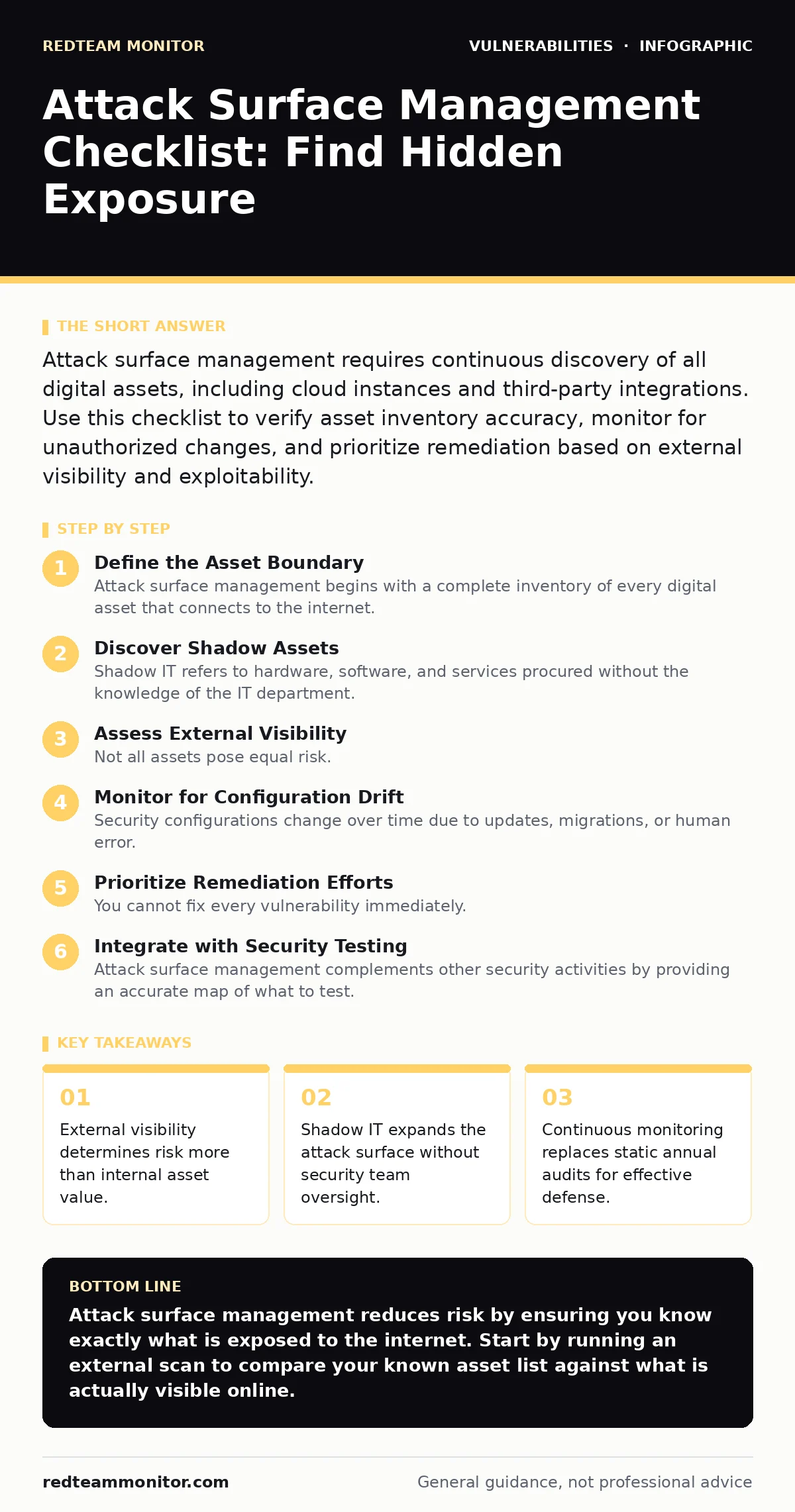
Attack surface management requires continuous discovery of all digital assets, including cloud instances and third-party integrations. Use this checklist to verify asset inventory accuracy, monitor for unauthorized changes, and prioritize remediation based on external visibility and exploitability.
Define the Asset Boundary
Attack surface management begins with a complete inventory of every digital asset that connects to the internet. You cannot protect what you do not know exists. Many teams focus solely on servers and workstations, ignoring IoT devices, development environments, and temporary cloud instances. This blind spot creates entry points that adversaries exploit before security teams are aware of the asset's existence.
- Catalog all internet-facing IP addresses: Unknown IPs often belong to decommissioned systems or test environments that lack patches.
- Register all subdomains and DNS records: Unregistered subdomains can be hijacked or used for phishing campaigns against your users.
- List all cloud storage buckets: Publicly accessible storage often contains sensitive data due to misconfigured permissions.
- Identify all third-party API endpoints: External integrations introduce dependencies that you do not control but must trust.
Discover Shadow Assets
Shadow IT refers to hardware, software, and services procured without the knowledge of the IT department. These assets bypass standard security controls and often run outdated software. Developers may spin up temporary environments for testing and forget to tear them down, leaving vulnerable systems exposed to the public internet. Continuous discovery tools scan the internet for your organization's digital footprint, revealing these hidden assets.
- Scan for unmanaged cloud instances: Temporary development servers often lack firewalls and run with default credentials.
- Monitor for unauthorized SSL certificates: New certificates indicate new web services that may not have undergone security review.
- Track employee-owned devices accessing corporate data: Personal devices often lack endpoint protection and operate on unsecured networks.
- Identify deprecated services still running: Old services may contain known vulnerabilities that no longer receive security patches.
Assess External Visibility
Not all assets pose equal risk. An internal database server poses minimal threat if it is not reachable from the internet. Attack surface management prioritizes assets based on their external visibility and the sensitivity of the data they hold. You must distinguish between assets that are intentionally public and those that are exposed by accident. This distinction guides remediation efforts toward the most critical exposures.
- Map open ports to specific services: Closed ports reduce the attack surface by limiting the number of exploitable entry points.
- Verify SSL/TLS configurations: Weak encryption protocols allow attackers to intercept data in transit or downgrade security.
- Check for exposed administrative interfaces: Publicly accessible login pages are primary targets for brute-force attacks.
- Assess data exposure on public pages: Accidental disclosure of PII or credentials in public files aids attacker reconnaissance.
Monitor for Configuration Drift
Security configurations change over time due to updates, migrations, or human error. A system that was secure at deployment may become vulnerable due to a misconfiguration introduced during a routine maintenance window. Continuous monitoring detects these changes in real time, allowing you to respond before attackers discover the new weakness. Static snapshots provide false confidence because they do not reflect the current state of your infrastructure.
- Alert on new open ports: Sudden port openings may indicate malware activity or unauthorized service deployment.
- Detect changes in SSL certificate validity: Expired or self-signed certificates break trust and signal potential compromise.
- Monitor for changes in cloud bucket permissions: A single click can accidentally make private data public to the entire internet.
- Track modifications to firewall rules: Broadened rules may inadvertently expose internal networks to external threats.
Prioritize Remediation Efforts
You cannot fix every vulnerability immediately. Prioritization based on exploitability and impact ensures that security teams address the most dangerous exposures first. Assets that are both externally visible and running vulnerable software require immediate attention. This approach maximizes security impact while respecting limited operational resources.
- Rank assets by external reachability: Internally facing assets pose lower immediate risk than those accessible from the internet.
- Cross-reference with known vulnerability databases: Assets running software with known exploits should be patched or isolated first.
- Evaluate business criticality: Systems handling core transactions or sensitive data warrant faster remediation cycles.
- Consider attacker motivation: High-value targets like executive email accounts or financial data attract more sophisticated attacks.
Integrate with Security Testing
Attack surface management complements other security activities by providing an accurate map of what to test. Penetration testing becomes more effective when testers have a complete list of external assets to probe. Similarly, vulnerability scanning focuses on active, reachable systems rather than hypothetical threats. This integration ensures that security testing covers the actual attack surface rather than a sanitized subset.
- Align scanning schedules with asset discovery: New assets should be scanned immediately after detection to identify initial weaknesses.
- Use findings to update penetration test scopes: Testers should focus on newly discovered or changed assets for maximum impact.
- Validate web application firewalls against real traffic: Ensure WAF rules protect the actual endpoints in use.
- Review firmware updates for IoT devices: Many IoT vulnerabilities stem from outdated firmware that manufacturers rarely patch.
Automate Continuous Discovery
Manual inventory processes fail at scale. Automation ensures that new assets are detected and classified quickly, reducing the window of exposure. Tools that continuously scan the internet for your organization's digital footprint provide real-time visibility into changes in your attack surface. This automation allows security teams to focus on analysis and remediation rather than data collection.
- Deploy automated external scanners: Continuous scanning reveals new assets and changes faster than manual reviews.
- Integrate with cloud provider APIs: Direct API access ensures accurate tracking of cloud resource creation and deletion.
- Set up alerts for critical changes: Immediate notification of high-risk changes enables rapid response to potential exposures.
- Regularly verify asset retirement: Decommissioned assets must be fully removed from the internet to prevent lingering exposure.
Key takeaways
- External visibility determines risk more than internal asset value.
- Shadow IT expands the attack surface without security team oversight.
- Continuous monitoring replaces static annual audits for effective defense.
Attack surface management reduces risk by ensuring you know exactly what is exposed to the internet. Start by running an external scan to compare your known asset list against what is actually visible online.
Frequently asked questions
How often should I perform attack surface mapping?
Continuous monitoring is required because new assets and changes occur daily. Static annual scans leave long windows of exposure.
What is the difference between attack surface management and vulnerability management?
Attack surface management focuses on identifying and monitoring external exposure, while vulnerability management focuses on finding and fixing weaknesses in known assets.
Can I automate attack surface management completely?
Automation handles discovery and monitoring, but human analysis is needed to prioritize remediation and assess business context.
Does attack surface management cover internal networks?
It primarily focuses on external-facing assets. Internal network security requires separate segmentation and monitoring strategies.
How this guide was produced: written by the RedTeam Monitor editorial team with AI assistance, checked against the public references listed below, and reviewed when the facts change. See our editorial policy or report an error.