
Penetration Testing Misconceptions: What Security Teams Actually Miss
Most organizations confuse penetration testing with vulnerability scanning, missing the strategic value of simulating attacker logic and chaining low-severity flaws into critical breaches.
Penetration testing is not a vulnerability scan or a compliance checkbox. It is an authorized simulation of an attacker’s logic to find how separate weaknesses chain together. You must define scope, accept risk, and use findings to improve detection, not just to patch individual bugs.
Misreading: Penetration testing is a vulnerability scan
Correct reading: A vulnerability scanner is an automated tool that checks for known flaws using a database of signatures. It reports what is present, not how it can be exploited. Penetration testing is a manual or semi-manual process that attempts to exploit those flaws to achieve a specific goal, such as accessing a database or escalating privileges.
A scanner might report 200 low-severity issues. A tester might find that 3 of those issues, when combined, allow full system compromise. The scanner sees the parts; the tester sees the whole. Relying on scanning alone leaves you blind to logic errors and chained attacks that automated tools cannot recognize. You must treat scanning as inventory and testing as validation of risk.
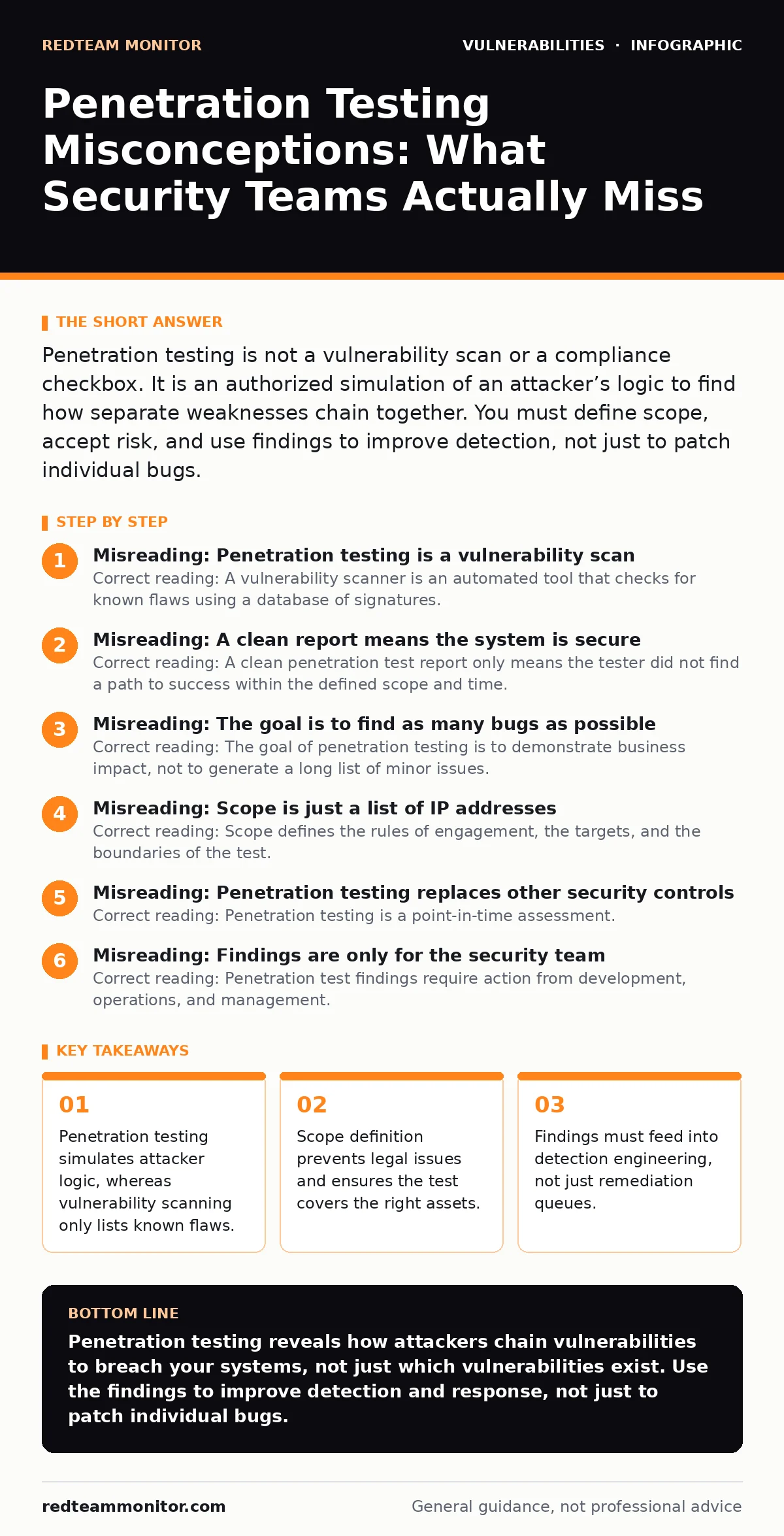
Misreading: A clean report means the system is secure
Correct reading: A clean penetration test report only means the tester did not find a path to success within the defined scope and time. It does not prove the absence of vulnerabilities. Attackers have unlimited time and may use techniques the tester was prohibited from using. Imagine a tester who focuses on web application flaws but ignores physical security.
They may report a clean web environment while an attacker walks in through an unlocked door and plugs a device into the internal network. Security is a state of continuous risk management, not a binary pass or fail. A clean report is a snapshot of resilience against a specific set of techniques at a specific moment. It provides confidence, not certainty. You must pair testing with continuous monitoring and threat intelligence to maintain that confidence.
Misreading: The goal is to find as many bugs as possible
Correct reading: The goal of penetration testing is to demonstrate business impact, not to generate a long list of minor issues. Finding 50 low-severity bugs is less valuable than finding 1 critical path that allows data exfiltration. Testers prioritize depth over breadth. They follow a single thread of compromise to understand how an attacker moves laterally. This approach reveals the true cost of a breach.
It shows whether your detection controls trigger when an attacker moves from a web server to a database server. If you only count bugs, you miss the narrative of the attack. You need to understand the attacker’s path to improve your detection and response capabilities. Focus on the chain of events, not the count of vulnerabilities. This shifts the value from remediation lists to strategic improvement.
Misreading: Scope is just a list of IP addresses
Correct reading: Scope defines the rules of engagement, the targets, and the boundaries of the test. It includes what the tester is allowed to do, what they are prohibited from doing, and which systems are off-limits. A simple list of IP addresses is insufficient. It must specify whether social engineering is allowed, whether denial-of-service attacks are permitted, and what hours the testing can occur.
Poorly defined scope leads to legal risks and operational disruption. Imagine a tester who accidentally shuts down a production database because the scope did not explicitly prohibit destructive actions. Clear scope protects both the organization and the tester. It ensures the test is safe, legal, and relevant to your business risks. You must review the scope document carefully before signing off. Ensure it aligns with your operational constraints and security goals.
Misreading: Penetration testing replaces other security controls
Correct reading: Penetration testing is a point-in-time assessment. It does not replace continuous security controls like firewalls, intrusion detection systems, or secure coding practices. It validates those controls. If your firewall blocks external access, a penetration test can confirm that it works against known attack vectors. It cannot guarantee it will block unknown future threats.
You still need automatic software updates to patch known vulnerabilities. You still need web application firewalls to filter malicious traffic. You still need hardening a self-hosted GitLab server to reduce the attack surface. Testing reveals gaps in your defense-in-depth strategy. It shows where your controls fail to detect or stop an attacker. Use testing to improve your controls, not to replace them. Security is a layered approach, and testing is one layer of validation.
See also: WordPress Plugin Vulnerability Prevention Checklist · Vulnerability Scanning in Cyber Security: What It Misses and How to Fix It
Misreading: Findings are only for the security team
Correct reading: Penetration test findings require action from development, operations, and management. A security team cannot fix a flawed authentication logic in an application. Developers must rewrite the code. Operations must adjust server configurations. Management must approve budget for new tools or staff. Siloing findings in the security team creates a bottleneck. It delays remediation and leaves vulnerabilities open.
Share findings with the teams that own the assets. Provide clear, actionable recommendations. Explain the business risk, not just the technical detail. This ensures ownership and accountability. Use the findings to improve your development lifecycle. Integrate security checks earlier in the process. Reduce the need for frequent large-scale testing. Collaboration turns findings into improvements. It builds a culture of security that extends beyond the security team.
Misreading: Black-box testing is always better
Correct reading: Black-box testing simulates an external attacker with no prior knowledge of the system. It is valuable for assessing perimeter defenses. However, it often misses internal logic flaws and complex business logic errors. White-box testing provides the tester with source code, architecture diagrams, and credentials. It allows for deeper analysis and more thorough coverage. Gray-box testing combines both approaches.
It simulates an attacker with some insider knowledge. The choice depends on your goals. If you want to test your detection capabilities, black-box is appropriate. If you want to find deep code flaws, white-box is better. Do not assume one method is superior. Use the method that aligns with your risk profile. Consider using multiple approaches over time to cover different attack surfaces. This provides a more complete picture of your security posture.
Misreading: Penetration testing is a one-time event
Correct reading: Software changes constantly. New vulnerabilities are discovered daily. A penetration test from six months ago is likely outdated. You need a continuous approach to security testing. Integrate fuzz testing into your development pipeline to catch bugs early. Use attack surface management to monitor for new assets and exposures. Regularly review default credentials and ensure they are changed.
Perform targeted penetration tests after major changes or releases. This reduces the window of exposure. It keeps your security posture aligned with your current state. Treat testing as a continuous process, not an annual audit. This approach is more efficient and effective. It allows you to address issues before they become breaches. You build resilience over time, rather than reacting to crises.
Key takeaways
- Penetration testing simulates attacker logic, whereas vulnerability scanning only lists known flaws.
- Scope definition prevents legal issues and ensures the test covers the right assets.
- Findings must feed into detection engineering, not just remediation queues.
Penetration testing reveals how attackers chain vulnerabilities to breach your systems, not just which vulnerabilities exist. Use the findings to improve detection and response, not just to patch individual bugs.
Frequently asked questions
How often should we perform penetration testing?
Perform testing after significant changes to your infrastructure or applications. Annual testing is a baseline, but quarterly or bi-annual tests provide better coverage for dynamic environments.
What is the difference between penetration testing and red teaming?
Penetration testing focuses on finding and exploiting vulnerabilities in specific systems. Red teaming simulates a full adversary campaign, including social engineering and physical attacks, to test organizational response.
Can we do penetration testing in-house?
In-house testing is possible but may lack objectivity. External testers bring fresh perspectives and specialized expertise. Consider a hybrid approach for maximum benefit.
How do we choose a penetration testing provider?
Look for providers with relevant certifications and experience in your industry. Review their methodology and reporting style. Ensure they communicate clearly and provide actionable recommendations.
How this guide was produced: written by the RedTeam Monitor editorial team with AI assistance, checked against the public references listed below, and reviewed when the facts change. See our editorial policy or report an error.