
What Does Red Teaming Mean: A Practical Breakdown
Red teaming reveals hidden gaps by simulating full adversary campaigns, exposing how small weaknesses chain together to bypass layered security controls.
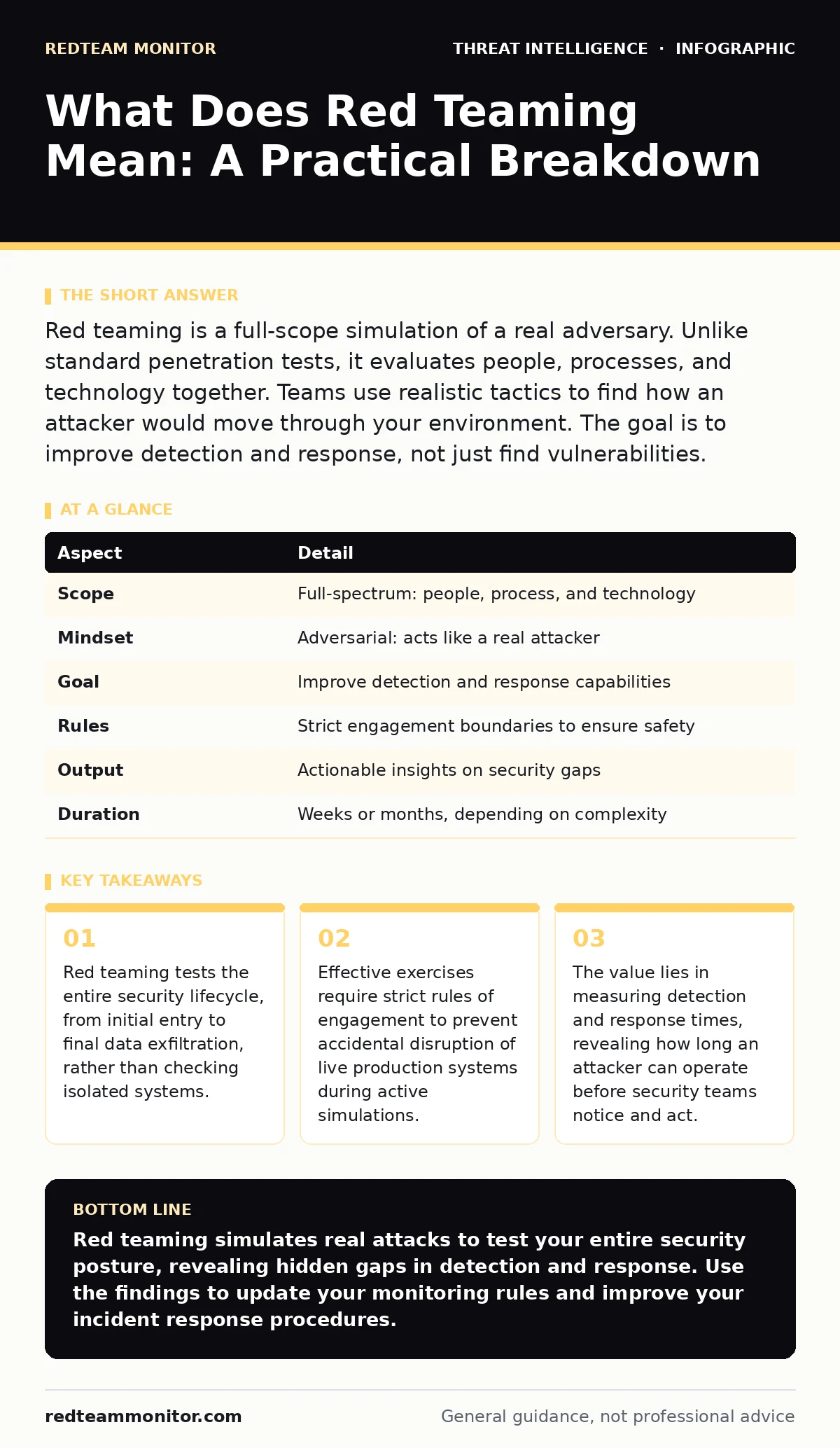
Red teaming is a full-scope simulation of a real adversary. Unlike standard penetration tests, it evaluates people, processes, and technology together. Teams use realistic tactics to find how an attacker would move through your environment. The goal is to improve detection and response, not just find vulnerabilities.
What Does Red Teaming Mean
Red teaming is an authorized, adversarial simulation that tests an organization’s defenses by mimicking the tactics, techniques, and procedures of real-world attackers. It differs from a standard penetration test, which usually focuses on finding technical vulnerabilities in a specific system or application. Red teaming evaluates the entire security posture, including human behavior, physical security, and incident response capabilities.
The primary goal is not to break into the system for the sake of breaking it. The goal is to determine whether existing security controls detect and stop an adversary. You want to know if your defenses work when faced with a determined opponent who adapts to obstacles. This approach reveals how well your security operations team can identify and neutralize a threat that behaves like a real criminal.
| Aspect | Detail |
|---|---|
| Scope | Full-spectrum: people, process, and technology |
| Mindset | Adversarial: acts like a real attacker |
| Goal | Improve detection and response capabilities |
| Rules | Strict engagement boundaries to ensure safety |
| Output | Actionable insights on security gaps |
| Duration | Weeks or months, depending on complexity |
How Red Teaming Works in Practice
A red team exercise begins with detailed planning and strict rules of engagement. These rules define what the team can and cannot do, ensuring the simulation does not disrupt critical business operations. The team then adopts the persona of a specific threat actor, selecting tools and methods that match that actor’s typical behavior. This ensures the test reflects realistic threats rather than hypothetical scenarios.
The execution phase involves multiple stages of an attack lifecycle. The team attempts to gain initial access through methods like phishing emails or exploiting public-facing services. Once inside, they move laterally across the network, escalating privileges to reach high-value targets. Throughout this process, they use techniques that generate minimal noise, aiming to avoid detection by standard security monitoring tools.
During the exercise, the red team documents every step they take, including which controls stopped them and which ones failed. They also record how long it took to bypass each layer of defense. This data provides a clear picture of the organization’s security effectiveness. The team does not exploit every vulnerability they find; they stop once they have demonstrated their objective, such as accessing a specific database or file server.
Who Red Teaming Affects and Why
Red teaming impacts the entire organization, not just the security department. Security operations teams face the pressure of detecting and responding to realistic threats in real time. They must triage alerts, investigate suspicious activity, and coordinate with other teams to contain the simulated breach. This stress test reveals gaps in their monitoring tools and response procedures.
Network engineers and system administrators also feel the impact. They may see unusual traffic patterns or configuration changes that they did not authorize. This forces them to validate their access controls and ensure that their systems are properly hardened. Physical security teams might deal with attempts to bypass building entry systems or tailgating policies.
Executive leadership needs to understand the results. The findings often reveal that small, overlooked weaknesses can lead to significant risk. For example, a weak password policy combined with poor monitoring can allow an attacker to move freely through the network. Leaders must decide how to allocate resources to fix these gaps, balancing security needs with business requirements.
Common Mistakes in Red Teaming
Many organizations misunderstand the purpose of red teaming, leading to ineffective exercises. One common error is treating it like a penetration test. Teams focus on finding as many vulnerabilities as possible, rather than evaluating the overall security posture. This misses the point of testing detection and response capabilities.
Another mistake is lacking clear objectives. Without specific goals, the red team may wander through the network, testing random systems. This wastes time and provides little value. Objectives should align with business priorities, such as protecting customer data or intellectual property. The team should focus on paths that lead to those high-value assets.
Poor communication between the red team and the security operations team can also cause issues. If the blue team, which is the defensive security team, does not know when the exercise starts, they may treat the simulation as a real breach and take drastic actions. This can disrupt business operations and create unnecessary panic. Clear communication channels are necessary to ensure everyone understands the context.
Integrating Threat Intelligence and Frameworks
Effective red teaming relies on accurate threat intelligence feeds to ensure the simulated attacks reflect current adversary behavior. By using recent data on how attackers operate, the red team can mimic realistic tactics. This makes the exercise more valuable because it tests defenses against actual threats, not outdated scenarios.
Teams often use the MITRE ATT&CK Navigator to plan their exercises. This framework provides a comprehensive map of adversary tactics and techniques. The red team selects specific techniques from the framework to test different aspects of the security posture. This structured approach ensures coverage of various attack vectors and helps in measuring progress against industry standards.
Integrating open-source intelligence (OSINT) helps the red team understand what information is publicly available about the organization. This includes employee profiles, technology stacks, and configuration details. Attackers often use this information to tailor their attacks, making them more effective. The red team replicates this process to test how well the organization protects its public-facing information.
See also: Stop Denial-of-Wallet Attacks: Response and Recovery Steps
Improving Detection and Response
The ultimate goal of red teaming is to improve the organization’s ability to detect and respond to attacks. By simulating realistic threats, the security operations team can identify gaps in their monitoring tools. They can adjust their detection rules to catch the specific techniques used by the red team. This reduces the attacker dwell time, which is the amount of time an attacker remains in the network before being detected.
Teams can also use canary tokens during the exercise. These are decoy files or credentials that trigger an alert when accessed. If the red team touches a canary token, it immediately notifies the security team. This helps measure how quickly the team responds to specific types of activity. It also validates that the monitoring tools are correctly configured and functioning.
Post-exercise analysis is critical for continuous improvement. The red team and blue team should review the results together. They discuss what worked, what failed, and why. This collaborative approach fosters a culture of learning and improvement. It also helps build trust between the teams, ensuring that future exercises are more effective and less disruptive.
What to Do About Red Teaming Results
After the exercise, the organization must act on the findings. This involves prioritizing remediation efforts based on the severity and likelihood of the identified risks. Not all gaps need immediate fixing; some may be acceptable risks. However, critical vulnerabilities that allow easy access to high-value assets must be addressed quickly.
Updating security policies and procedures is often necessary. The exercise may reveal that existing policies are not being followed or are ineffective. For example, if the red team easily bypassed multi-factor authentication, the organization may need to enforce stricter authentication requirements. Training employees on new procedures can also help close human-based gaps.
Continuous monitoring and testing are essential for maintaining security. Threats evolve, and so must defenses. Regular red teaming exercises help ensure that the organization stays ahead of attackers. They provide ongoing feedback on the effectiveness of security controls and help identify new risks as the organization changes.
Key takeaways
- Red teaming tests the entire security lifecycle, from initial entry to final data exfiltration, rather than checking isolated systems.
- Effective exercises require strict rules of engagement to prevent accidental disruption of live production systems during active simulations.
- The value lies in measuring detection and response times, revealing how long an attacker can operate before security teams notice and act.
Red teaming simulates real attacks to test your entire security posture, revealing hidden gaps in detection and response. Use the findings to update your monitoring rules and improve your incident response procedures.
Frequently asked questions
How is red teaming different from a penetration test?
Penetration testing focuses on finding technical vulnerabilities in specific systems, while red teaming evaluates the entire security posture, including people, processes, and technology, by simulating a full adversary campaign.
How long does a typical red team exercise last?
Red team exercises can last from a few weeks to several months, depending on the scope, complexity, and objectives of the simulation. Longer exercises allow for more thorough testing of lateral movement and persistence techniques.
Is red teaming legal?
Yes, red teaming is legal when conducted with proper authorization and within defined rules of engagement. Organizations must ensure that all participants have written permission to perform the simulation and understand the boundaries of the exercise.
Can small organizations benefit from red teaming?
Yes, small organizations can benefit from scaled-down red teaming exercises. These can focus on critical assets and essential security controls, providing valuable insights without the cost and complexity of large-scale simulations.
How this guide was produced: written by the RedTeam Monitor editorial team with AI assistance, checked against the public references listed below, and reviewed when the facts change. See our editorial policy or report an error.