
Indicators of Compromise Examples and How to Use Them
Static IOCs miss modern threats that leave no files, so you must pair them with behavioral detection to catch living-off-the-land attacks before data exfiltration begins.
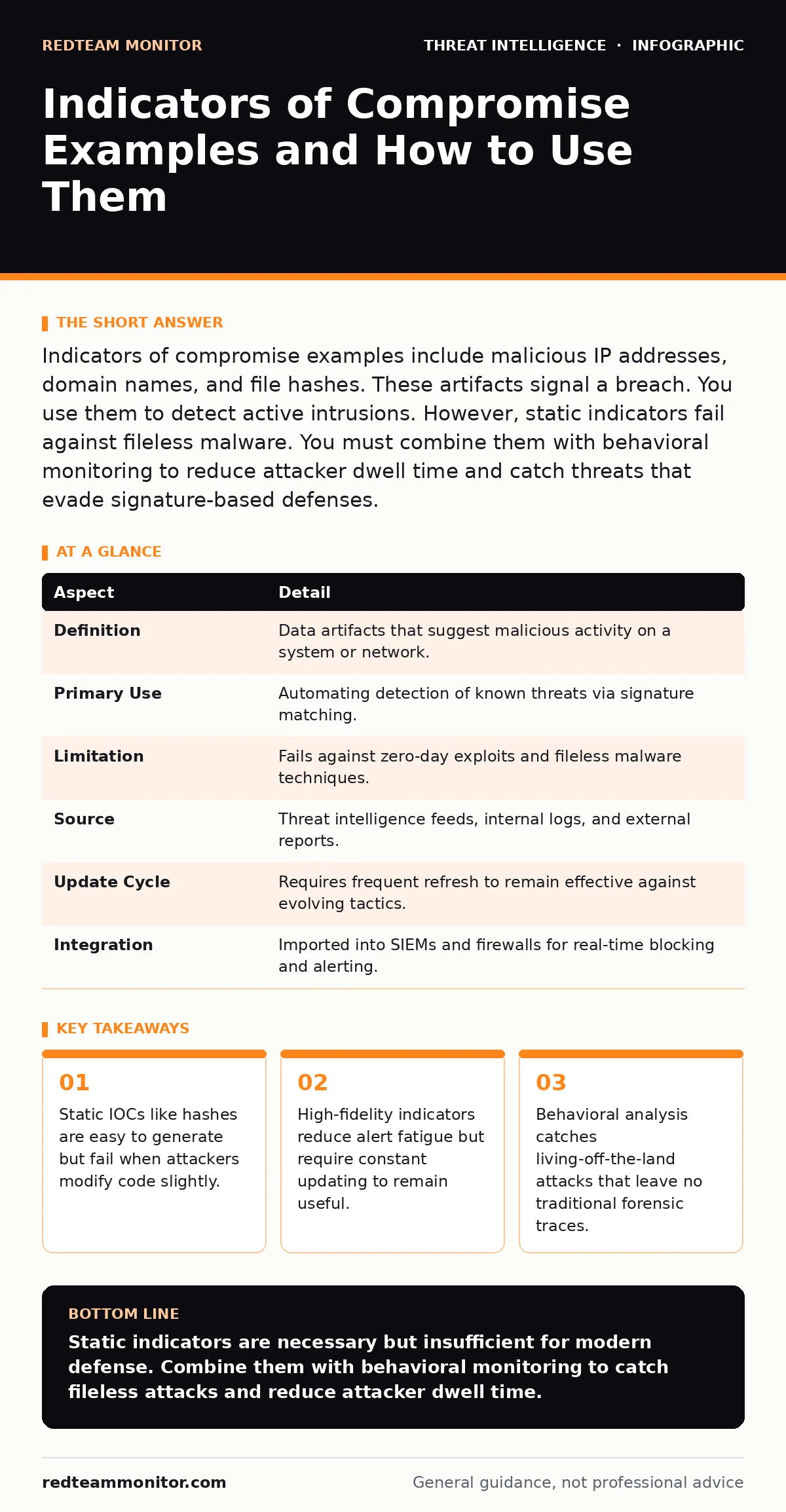
Indicators of compromise examples include malicious IP addresses, domain names, and file hashes. These artifacts signal a breach. You use them to detect active intrusions. However, static indicators fail against fileless malware. You must combine them with behavioral monitoring to reduce attacker dwell time and catch threats that evade signature-based defenses.
What indicators of compromise actually mean
Indicators of compromise are specific data points that signal a system may be compromised. They act as digital fingerprints left behind by malicious activity. An attacker rarely enters a network without leaving some trace. These traces form the basis of your detection strategy. You look for these artifacts to confirm whether a breach has occurred. This process differs from prevention, which stops entry. Detection relies on recognizing patterns that deviate from normal operations.
Indicators serve as the primary input for automated security tools. They allow systems to scan traffic and logs for known bad actors. Without them, security operations would rely entirely on manual review. This manual process is too slow for modern threats. You need a mechanism to automate the initial triage. Indicators provide that automation. They transform raw data into actionable intelligence. This transformation is the core of modern threat detection.
| Aspect | Detail |
|---|---|
| Definition | Data artifacts that suggest malicious activity on a system or network. |
| Primary Use | Automating detection of known threats via signature matching. |
| Limitation | Fails against zero-day exploits and fileless malware techniques. |
| Source | Threat intelligence feeds, internal logs, and external reports. |
| Update Cycle | Requires frequent refresh to remain effective against evolving tactics. |
| Integration | Imported into SIEMs and firewalls for real-time blocking and alerting. |
Common indicators of compromise examples
You encounter several standard types of indicators. Network indicators appear in traffic logs. These include IP addresses and domain names. If a server contacts a known command-and-control domain, that domain becomes an indicator. You can block this domain at the firewall. This stops further communication. Another network indicator is the Autonomous System Number (ASNs) in threat intelligence. Attackers often route traffic through specific ASN ranges. Monitoring these ranges helps identify suspicious traffic origins.
Host-based indicators live on the endpoint. File hashes are the most common example. A hash is a unique string representing a file's content. If a file's hash matches a known malware hash, you have a match. This method is precise but brittle. Attackers change the file slightly to change the hash. Registry keys also serve as indicators. Malware often modifies registry settings to ensure persistence. You can monitor for these specific changes. File paths and creation times also provide clues. Unusual file locations suggest malicious intent.
Why static indicators fail silently
Static indicators have a critical flaw. They rely on prior knowledge. If an attacker has not been seen before, they leave no static indicator. This is the zero-day problem. You cannot detect what you do not know. Even known attackers change their tactics. They use polymorphic code that changes its appearance. Each variant has a different hash. Your old indicators become useless. This creates a detection gap.
Living-off-the-land attacks exploit this gap. These attacks use legitimate system tools. The attacker runs PowerShell scripts or uses WMI. These tools are trusted by the system. They leave no malicious files. There are no bad hashes to check. The only evidence is the behavior. The command structure looks unusual. The timing is off. Static indicators cannot catch this. You need behavioral analysis. This approach looks at what the tool does, not what it is. It is harder to implement but necessary.
The cost of false positives
Too many indicators create noise. This is the false positive problem. An indicator might be valid for malware but also used by legitimate software. If you block all traffic to a flagged IP, you might break business operations. This causes alert fatigue. Analysts stop trusting the alerts. They ignore genuine threats because they are tired of false alarms. This is a hidden cost of using threat intelligence feeds.
You must tune your detection rules. Not all indicators are equally valid. Some are high-confidence. Others are speculative. You should prioritize high-confidence indicators. These come from reliable sources. They have been verified by multiple parties. Low-confidence indicators require more context. You might monitor them without blocking. This balances security with usability. You avoid disrupting operations while still catching threats. This tuning process is ongoing. It requires constant adjustment.
Integrating indicators into your workflow
You cannot rely on indicators alone. They must be part of a broader strategy. Integrate them into your Security Information and Event Management (SIEM). This system aggregates logs from all sources. It matches logs against your indicator database. When a match occurs, it generates an alert. You can automate responses. For example, you might isolate the infected host. This reduces attacker dwell time. Speed matters in incident response.
You should also use the MITRE ATT&CK Navigator. This framework maps tactics and techniques. It helps you understand what an attacker is trying to do. Indicators tell you what happened. The framework tells you why. Combining them gives you context. You can predict the next step. This predictive capability is powerful. It allows you to block future attacks. You move from reactive to proactive. This shift changes your security posture.
See also: Endpoint Detection and Response: Benefits, Limits, and Real Value · Sandbox Evasion: How Malware Hides and What to Do About It
What people usually get wrong
Many teams treat indicators as a silver bullet. They buy a list and import it. They assume they are protected. This is a dangerous misconception. Indicators expire quickly. An IP address used for an attack might be clean a week later. It might be reassigned to a legitimate user. Blocking it then causes harm. You must validate indicators regularly. You must remove outdated ones. This maintenance is often neglected.
Another mistake is ignoring internal indicators. Teams focus on external threats. They import feeds from vendors. They forget to look inward. Your own logs contain unique indicators. These are specific to your environment. They are more valuable than generic lists. You should generate internal indicators from past incidents. These indicators catch repeat offenders. They are tailored to your specific risks. This internal focus is often overlooked.
Next steps for detection maturity
You must evolve beyond static matching. Start by cataloging your current indicators. Identify which ones are stale. Remove them to reduce noise. Next, implement behavioral detection. Look for unusual process executions. Monitor for privilege escalation. These behaviors indicate compromise even without known indicators. This approach catches living-off-the-land attacks.
Consider using honeypots to gather new indicators. These decoy systems attract attackers. They reveal new tactics. You can harvest indicators from these interactions. This gives you early warning. It also provides intelligence on current attacker interests. You can use this data to refine your defenses. This proactive collection fills the gaps left by static indicators.
Red teaming exercises help validate your detection. Simulated attacks test your indicators. They reveal blind spots. You learn what your current setup misses. This feedback loop is vital for improvement. You adjust your rules based on the results. This continuous improvement ensures your detection remains effective. You stay ahead of evolving threats.
Key takeaways
- Static IOCs like hashes are easy to generate but fail when attackers modify code slightly.
- High-fidelity indicators reduce alert fatigue but require constant updating to remain useful.
- Behavioral analysis catches living-off-the-land attacks that leave no traditional forensic traces.
Static indicators are necessary but insufficient for modern defense. Combine them with behavioral monitoring to catch fileless attacks and reduce attacker dwell time.
Frequently asked questions
How long do indicators of compromise remain valid?
Validity varies widely. IP addresses may change ownership in days. File hashes remain valid until the code changes. Domain names can be parked and reused. You must update your lists frequently to avoid blocking legitimate traffic or missing new threats.
Can indicators of compromise detect insider threats?
Static indicators struggle with insider threats. Insiders often use legitimate credentials and tools. They do not trigger network-based indicators like malicious IPs. You must monitor for behavioral anomalies, such as unusual data access patterns or off-hours activity, to detect internal compromises effectively.
What is the difference between an indicator of compromise and an indicator of attack?
An indicator of compromise suggests a past or ongoing breach, like a malware hash. An indicator of attack signals active malicious behavior, such as a port scan. IOAs are more proactive. They allow you to stop an attack before it succeeds. IOCs confirm that a breach has already occurred.
Do I need a SIEM to use indicators of compromise?
A SIEM is not strictly required but is highly recommended. You can use indicators in firewalls or endpoint protection. However, a SIEM aggregates data from multiple sources. It provides context and correlation. This makes it easier to identify true positives and reduce noise. Manual checking is error-prone and slow.
How this guide was produced: written by the RedTeam Monitor editorial team with AI assistance, checked against the public references listed below, and reviewed when the facts change. See our editorial policy or report an error.