
Using Autonomous System Numbers to Map Attacker Infrastructure
ASN analysis reveals the infrastructure owners behind attacks, allowing teams to block entire networks rather than chasing individual IP addresses.
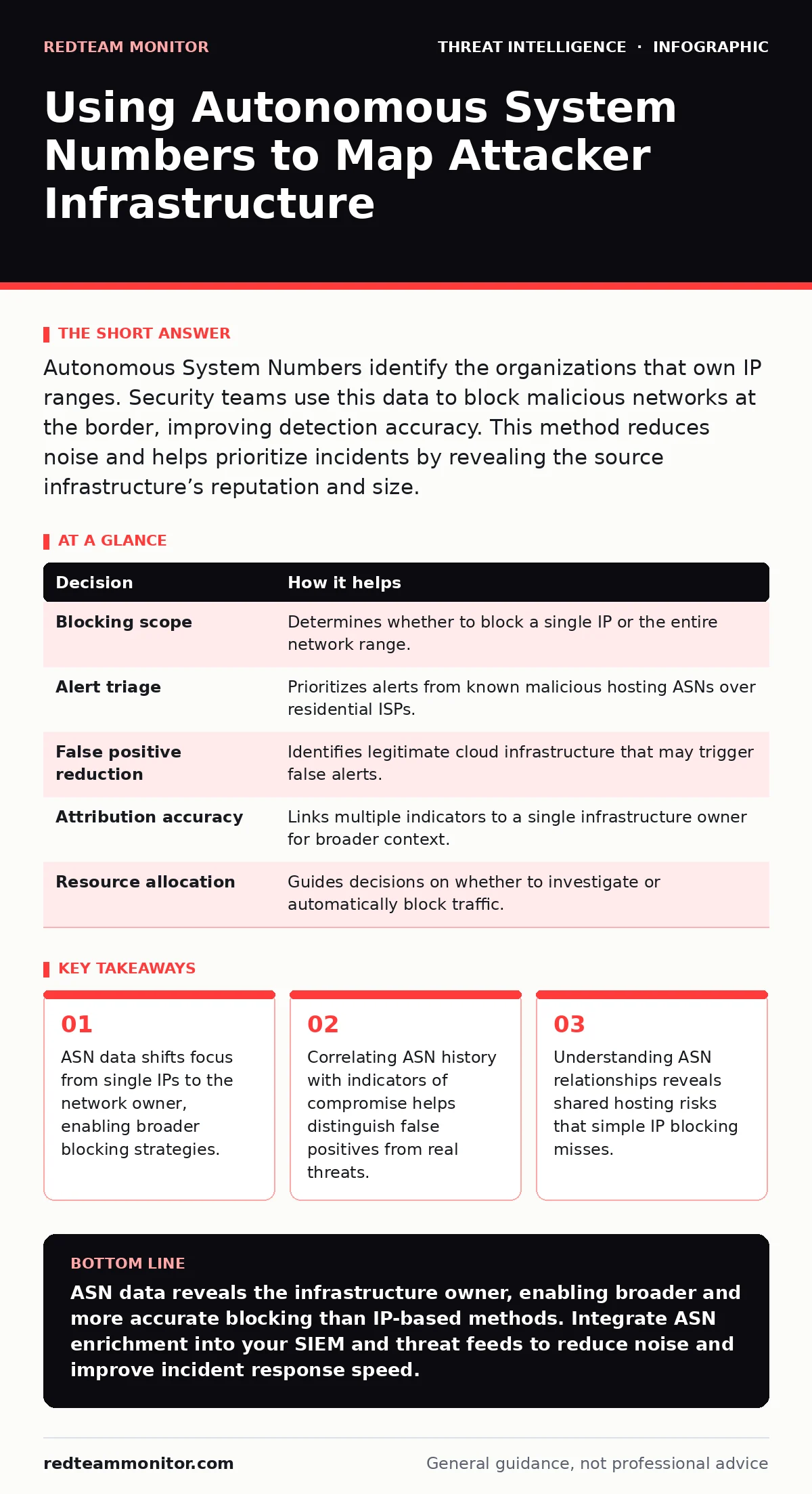
Autonomous System Numbers identify the organizations that own IP ranges. Security teams use this data to block malicious networks at the border, improving detection accuracy. This method reduces noise and helps prioritize incidents by revealing the source infrastructure’s reputation and size.
Why IP Addresses Alone Fail to Tell the Story
You monitor network traffic for malicious indicators of compromise. You see an IP address attempting to connect to a sensitive endpoint. Blocking that single address stops the immediate attempt. It does nothing for the next address from the same owner. Attackers rotate IP addresses frequently to evade simple blocklists. They often control hundreds of addresses within a single network block. Blocking one address is like closing one door in a building with a thousand entrances.
You need a higher-level view of the infrastructure. Autonomous System Numbers provide that view. An ASN is a unique number assigned to a large network or group of networks. It identifies the organization that manages the IP range. This includes internet service providers, cloud platforms, and hosting companies. Using ASNs allows you to attribute activity to the infrastructure owner. This changes how you prioritize and respond to alerts.
The Strategic Shift from IP to Network Ownership
Your security operations team receives thousands of alerts daily. Most come from dynamic IP ranges used by residential internet users. These users may be compromised without their knowledge. Blocking their IPs often blocks legitimate traffic. It also creates noise that hides true threats. ASNs help you filter this noise. You can identify which ASNs belong to known malicious hosting providers. You can also identify ASNs that belong to reputable cloud providers.
Cloud providers have strict abuse reporting mechanisms. They often remove malicious content quickly. Residential ISPs have slower response times. By categorizing traffic by ASN, you can apply different response rules. This reduces the volume of low-priority alerts. It allows analysts to focus on high-risk infrastructure. This shift improves the signal-to-noise ratio in your detection pipelines.
Decisions Informed by ASN Analysis
The value of ASN data lies in the decisions it supports. You use this context to refine your detection logic and response playbooks. The following table outlines common security decisions and how ASN context improves them.
| Decision | How it helps |
|---|---|
| Blocking scope | Determines whether to block a single IP or the entire network range. |
| Alert triage | Prioritizes alerts from known malicious hosting ASNs over residential ISPs. |
| False positive reduction | Identifies legitimate cloud infrastructure that may trigger false alerts. |
| Attribution accuracy | Links multiple indicators to a single infrastructure owner for broader context. |
| Resource allocation | Guides decisions on whether to investigate or automatically block traffic. |
This table shows how ASN data moves your team from reactive blocking to strategic management. You stop treating every IP as an isolated event. You start treating network ownership as a risk factor. This approach aligns with modern operational threat intelligence practices. It turns raw data into actionable context.
How Teams Use ASN Data in Practice
Security teams integrate ASN data into multiple workflows. You enrich your threat feeds with ASN information. When a new indicator appears, you check its ASN. You compare it against known good and bad lists. You can also monitor ASN changes. Attackers sometimes move infrastructure to new ASNs to evade detection. Tracking these movements helps you stay ahead.
You use ASN data to build Sigma rules that look for patterns across network blocks. This helps detect distributed attacks. You can also use ASNs to identify shared hosting environments. If multiple malicious IPs share an ASN, the risk is higher. The hosting provider may be less responsive to abuse reports. This context helps you decide how aggressively to block traffic. It also helps you understand the attacker’s operational security.
The Hidden Cost of Ignoring Infrastructure Context
Imagine a team that blocks IPs without checking ASNs. They block a malicious IP from a large cloud provider. The cloud provider reassigns that IP to a legitimate customer. The team’s blocklist now blocks legitimate traffic. This causes outages for internal users. The team spends hours investigating the false positive. They realize they blocked a single IP instead of the malicious subnet. They could have blocked the entire range with less collateral damage.
Another scenario involves a team that ignores ASN reputation. They see an IP from a neutral ASN. They assume it is safe because the ASN is not blacklisted. The IP is actually part of a bulletproof hosting service. The team misses the threat because they lacked context. Ignoring ASN data leads to both over-blocking and under-blocking. It creates inefficiency and risk. You pay for this in wasted analyst time and security gaps.
See also: Signature Based vs Anomaly Detection: How They Differ in Practice · How Attacker Persistence Works: The Step-by-Step Mechanics
Contrasting Approaches in Threat Response
The difference between using and ignoring ASN data becomes clear in incident response. Consider two hypothetical teams facing the same attack.
Team A reacts to symptoms. They treat each IP as a separate incident. They miss the pattern of infrastructure reuse. Team B treats the infrastructure as the threat. They understand that the ASN is the persistent element. The IPs are temporary. This mindset shift reduces workload. It also improves detection coverage. Team B can also use open-source intelligence (OSINT) to research the ASN. They find history of abuse reports. This confirms their decision to block. Team A lacks this context. They operate in a vacuum. This contrast shows the value of infrastructure-level analysis. It is not just about blocking. It is about understanding the attacker’s resources.
Integrating ASN Data with Existing Tools
You do not need new tools to use ASN data. You can integrate it into existing systems. Your security information and event management (SIEM) can enrich logs with ASN data. You can use APIs to look up ASNs in real-time. You can also store ASN history in your threat intelligence platform. This allows you to track changes over time. You can correlate ASN data with other intelligence sources.
For example, you can link ASNs to initial access brokers who sell compromised credentials. These brokers often use specific infrastructure. Identifying their ASNs helps you detect their campaigns. You can also use ASN data to improve your honeypots. You can configure your deception technology to log ASN data from attackers. This helps you map their infrastructure. You can then share this data with industry peers. This collective defense approach improves everyone’s security.
Limitations and Edge Cases to Watch
ASN data is powerful but not perfect. You must understand its limitations. ASNs change ownership. A legitimate company may sell its ASN to a malicious actor. You must monitor for these changes. Some ASNs are small and private. They may not have public reputation data. You must use caution when blocking these. Cloud providers use large ASNs. Blocking an entire cloud ASN can block many legitimate services.
You must use IP ranges instead of ASNs for cloud traffic. You must also consider geo-location. ASNs do not always match physical location. Attackers can use proxy services to mask their origin. You must combine ASN data with other signals. Do not rely on ASNs alone. Use them as one part of a broader detection strategy. This ensures you avoid false positives while catching true threats.
Key takeaways
- ASN data shifts focus from single IPs to the network owner, enabling broader blocking strategies.
- Correlating ASN history with indicators of compromise helps distinguish false positives from real threats.
- Understanding ASN relationships reveals shared hosting risks that simple IP blocking misses.
ASN data reveals the infrastructure owner, enabling broader and more accurate blocking than IP-based methods. Integrate ASN enrichment into your SIEM and threat feeds to reduce noise and improve incident response speed.
Frequently asked questions
How do I find the ASN for an IP address?
You can use public WHOIS databases or threat intelligence platforms that provide ASN lookups. Most SIEMs and EDR tools also offer enrichment features that automatically resolve ASNs for logged IPs.
How does ASN data help with false positives?
ASN data helps identify legitimate cloud providers and residential ISPs, allowing you to exclude them from aggressive blocking rules and reduce false positive alerts.
How this guide was produced: written by the RedTeam Monitor editorial team with AI assistance, checked against the public references listed below, and reviewed when the facts change. See our editorial policy or report an error.