
Deception Technology FAQ: How to Trap Attackers Without Breaking Your Network
Deception technology turns your entire network into a sensor by placing fake assets that trigger alerts only when an attacker touches them.
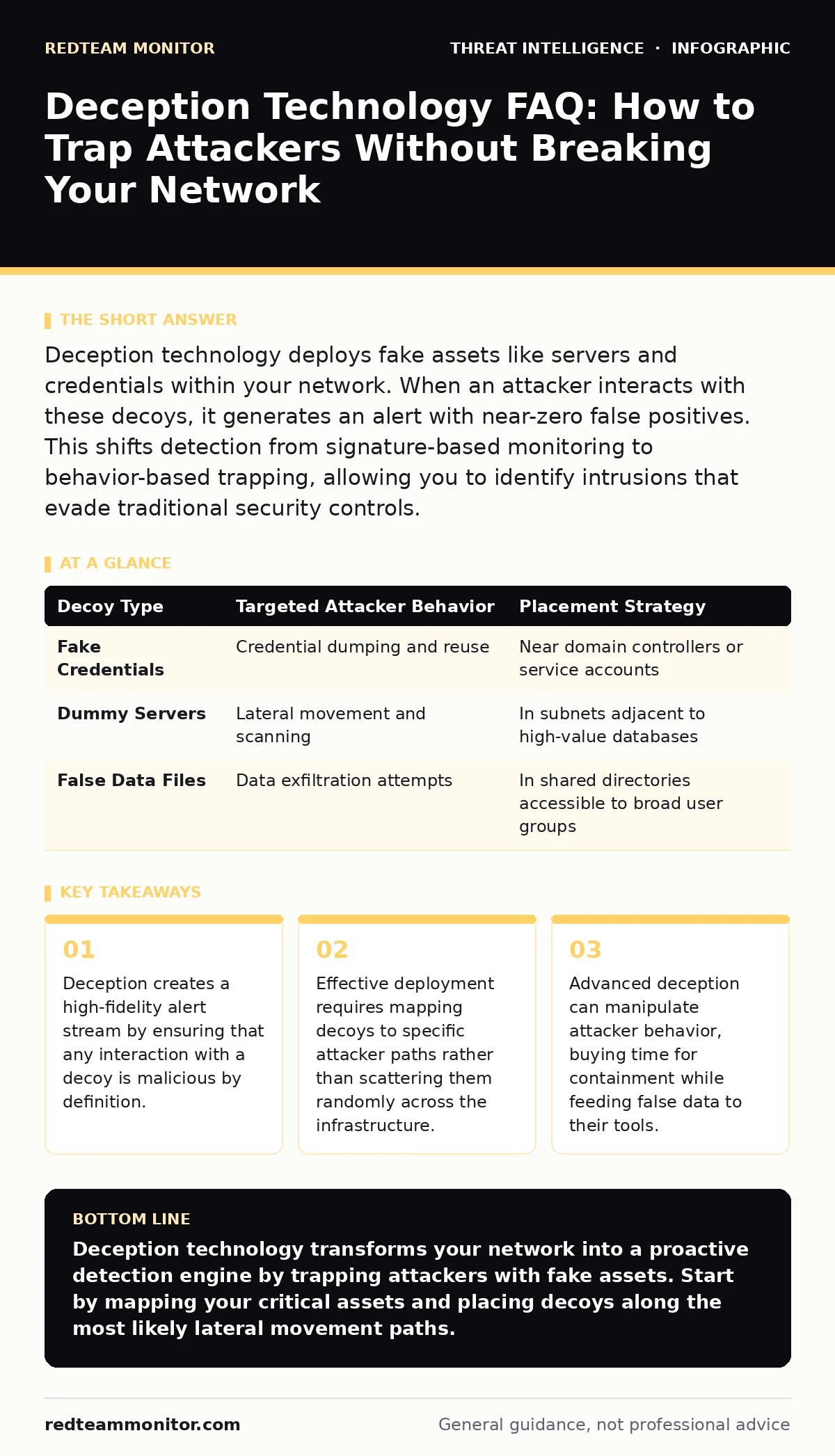
Deception technology deploys fake assets like servers and credentials within your network. When an attacker interacts with these decoys, it generates an alert with near-zero false positives. This shifts detection from signature-based monitoring to behavior-based trapping, allowing you to identify intrusions that evade traditional security controls.
What is deception technology?
Deception technology is a security strategy that places fake assets, known as decoys, within a network to lure and detect attackers. Unlike traditional defenses that try to block all traffic, deception invites interaction with non-production objects. When an attacker touches a decoy, the system logs the event as a confirmed breach. This approach flips the burden of proof, making it easier to identify malicious activity amidst normal noise.
How does it differ from honeypots?
Honeypots are isolated, standalone systems designed to attract attackers away from production assets. Deception technology integrates these traps directly into your live network environment. You place decoys alongside real servers, databases, and credentials. This integration ensures that attackers encounter traps while moving laterally, rather than being diverted to a separate sandbox. It provides visibility into the internal movement of an intruder who has already bypassed perimeter defenses.
Why do false positives matter so little here?
In standard security monitoring, legitimate user activity often triggers alerts, leading to alert fatigue. Deception technology eliminates this noise because no legitimate user should ever interact with a decoy. If a system touches a fake asset, it is by definition an error or an intrusion. This creates a high-signal, low-noise detection channel. You can trust every alert, allowing your team to respond immediately without triage.
Where should I place decoys for maximum effect?
Placement must align with the most likely paths an attacker would take after initial access. You should map your network topology and identify high-value targets and common lateral movement routes. Place decoys near these critical assets or in areas where attackers typically search for credentials. Refer to MITRE ATT&CK Navigator to visualize these paths and ensure your traps cover the techniques attackers are most likely to use. Random placement reduces the likelihood of interception.
| Decoy Type | Targeted Attacker Behavior | Placement Strategy |
|---|---|---|
| Fake Credentials | Credential dumping and reuse | Near domain controllers or service accounts |
| Dummy Servers | Lateral movement and scanning | In subnets adjacent to high-value databases |
| False Data Files | Data exfiltration attempts | In shared directories accessible to broad user groups |
Can attackers detect the traps?
Sophisticated attackers may attempt to identify decoys by analyzing system metadata, response times, or network behavior. If a decoy behaves differently from a real asset, it raises suspicion. To counter this, you must ensure your decoys mirror the operational characteristics of your production environment. This includes matching patch levels, running similar services, and generating plausible traffic patterns. The goal is to make the decoy indistinguishable from a legitimate target.
See also: Attacker Dwell Time: How to Detect and Reduce Intrusion Duration · Using Autonomous System Numbers to Map Attacker Infrastructure
How does deception help with attacker persistence?
Attackers often establish attacker persistence techniques to maintain access even after initial compromise detection. Deception can disrupt this by providing fake persistence mechanisms. When an attacker installs a backdoor on a decoy, they waste effort on a non-functional asset. You gain visibility into their persistence strategy and can track their subsequent actions. This buys time for your team to isolate the real compromised systems and remediate the breach.
What is the operational overhead?
Managing deception technology requires initial configuration and ongoing maintenance to keep decoys realistic. You must update decoy images to match your production environment changes. However, the operational burden is lower than managing complex intrusion detection rules. The system handles the heavy lifting of monitoring and alerting. You focus on responding to the high-fidelity alerts rather than tuning sensors. This efficiency allows smaller teams to achieve broad coverage.
How does it integrate with threat intelligence?
Deception technology generates rich data about attacker tactics, techniques, and procedures. This data enhances your operational threat intelligence by providing real-world evidence of how adversaries move within your specific environment. You can correlate decoy interactions with threat intelligence feeds to identify known threat actors. This integration allows you to refine your defenses based on actual observed behavior rather than theoretical risks. It turns passive monitoring into active intelligence gathering.
Can I use open-source tools?
Yes, you can implement basic deception using open-source intelligence (OSINT) principles and free tools. Many open-source projects provide lightweight honeypots and decoy generators. These tools allow you to deploy traps without significant financial investment. However, they may require more manual configuration and maintenance compared to commercial solutions. You must ensure that your open-source implementations are properly isolated and monitored to prevent accidental disruption.
What are the legal and ethical considerations?
Deploying deception technology must comply with local laws regarding privacy and data collection. You must ensure that decoys do not inadvertently capture sensitive personal information from legitimate users. Transparent policies should define the scope and purpose of deception within your organization. Consult legal counsel to ensure your implementation respects user privacy and regulatory requirements. Ethical deployment builds trust and ensures that your security measures do not become liabilities.
Key takeaways
- Deception creates a high-fidelity alert stream by ensuring that any interaction with a decoy is malicious by definition.
- Effective deployment requires mapping decoys to specific attacker paths rather than scattering them randomly across the infrastructure.
- Advanced deception can manipulate attacker behavior, buying time for containment while feeding false data to their tools.
Deception technology transforms your network into a proactive detection engine by trapping attackers with fake assets. Start by mapping your critical assets and placing decoys along the most likely lateral movement paths.
Frequently asked questions
Does deception technology slow down my network?
No, deception technology typically has minimal impact on network performance. Decoys are lightweight and do not process significant traffic unless an attacker interacts with them. The monitoring overhead is handled by the deception management platform, not the network infrastructure.
Can I use deception technology in a cloud environment?
Yes, deception technology is highly effective in cloud environments. You can deploy cloud-native decoys that mimic your virtual machines, containers, and storage buckets. These decoys help detect misconfigurations and unauthorized access within the cloud infrastructure. Cloud providers often offer services that facilitate the deployment of such traps.
How do I know if a decoy was triggered by a scanner or a human?
Advanced deception platforms analyze the interaction patterns to distinguish between automated scans and human activity. Human interactions often involve specific sequences of commands or file accesses, while scanners generate rapid, uniform requests. This behavioral analysis helps prioritize alerts and focus response efforts on genuine threats.
Is deception technology suitable for small businesses?
Yes, deception technology is scalable and can be tailored for small businesses. Lightweight solutions allow you to deploy a few strategic decoys without significant cost or complexity. These traps provide high-value detection capabilities that complement basic security measures. Small businesses benefit from the low false-positive rate and ease of management.
How this guide was produced: written by the RedTeam Monitor editorial team with AI assistance, checked against the public references listed below, and reviewed when the facts change. See our editorial policy or report an error.