
How Canary Tokens Work: Mechanism, Limits, and Detection Logic
Canary tokens generate noise by triggering external callbacks, which helps distinguish attacker noise from background traffic but fails against isolated networks.
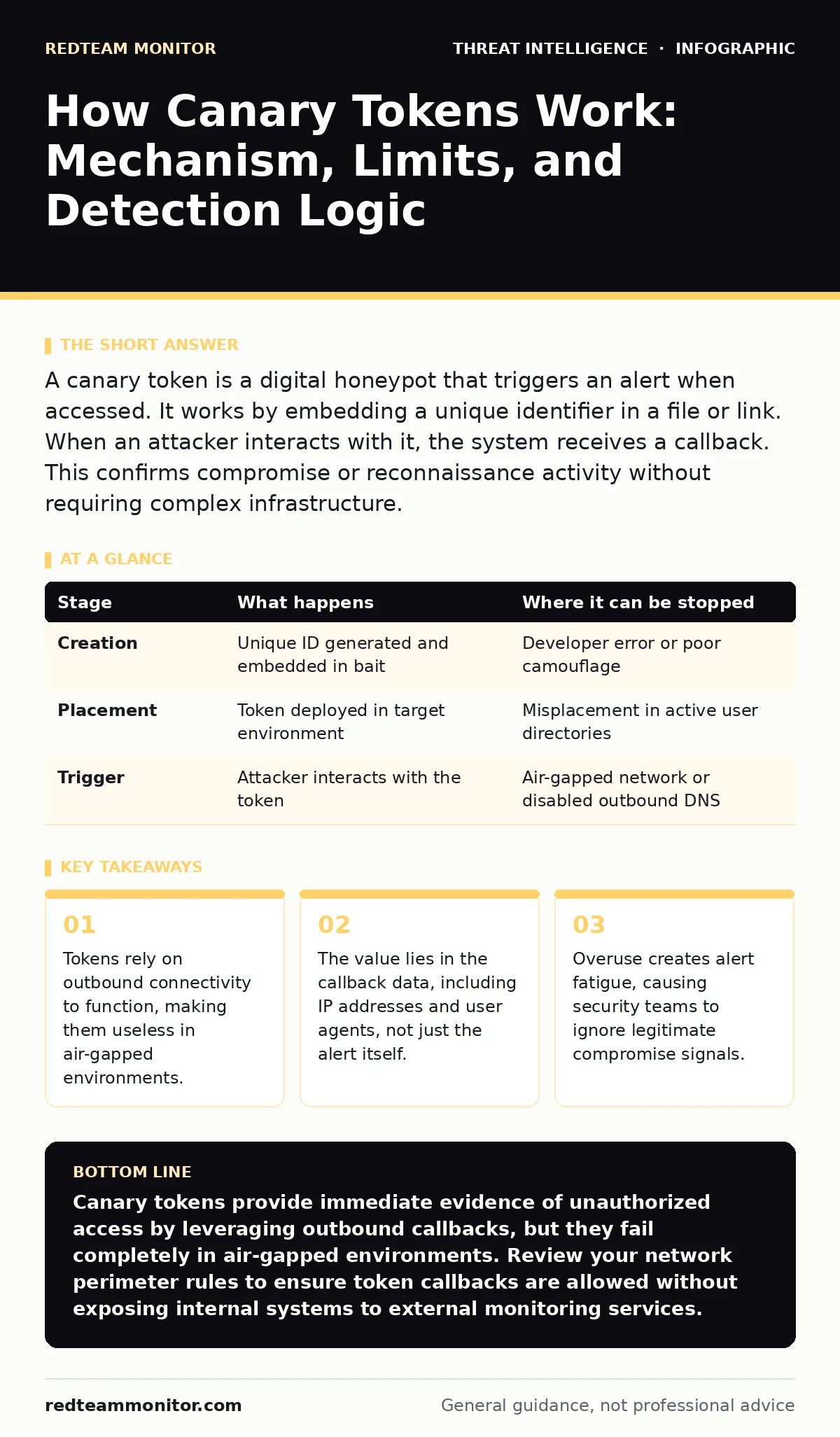
A canary token is a digital honeypot that triggers an alert when accessed. It works by embedding a unique identifier in a file or link. When an attacker interacts with it, the system receives a callback. This confirms compromise or reconnaissance activity without requiring complex infrastructure.
The Anatomy of a Digital Honeypot
Canary tokens are lightweight deception tools designed to detect unauthorized access. Unlike traditional intrusion detection systems that monitor network traffic for known signatures, tokens wait for interaction. They act as bait, placed in locations where legitimate users rarely go or in formats that suggest sensitive data. The core concept is simple: if someone opens the file or visits the link, an alert fires. This shifts the burden of proof. You do not need to prove a breach is happening; the token proves an interaction occurred.
The mechanism relies on a unique identifier embedded in the bait. This identifier links the token to a monitoring service. When the identifier is exposed to the outside world, the service records the event. This provides immediate evidence of compromise or reconnaissance. It turns passive files into active sensors.
Stage 1: Creation and Embedding
The process begins with generating a unique token. This token contains a distinct identifier and a callback instruction. You embed this token into a digital artifact. Common artifacts include PDF documents, Microsoft Word files, email links, or even code repositories. The embedding method depends on the artifact type. For a document, the token might be a hidden hyperlink or a metadata field. For a code repository, it could be a dummy credential or a fake API key.
The goal is to make the token look like valuable data. If it looks like a honeypot, attackers will ignore it. The token must blend into the environment. It should appear as a natural part of the file or system. This requires understanding how attackers search for data. They look for keywords, specific file types, and credentials. Your token must mimic these patterns.
| Stage | What happens | Where it can be stopped |
|---|---|---|
| Creation | Unique ID generated and embedded in bait | Developer error or poor camouflage |
| Placement | Token deployed in target environment | Misplacement in active user directories |
| Trigger | Attacker interacts with the token | Air-gapped network or disabled outbound DNS |
Stage 2: Deployment and Camouflage
Placement is critical for effectiveness. You deploy the token in areas where attackers are likely to look but legitimate users are not. This might include shared drives, backup directories, or development environments. The token must remain dormant until triggered. It should not interfere with normal operations. If a legitimate user opens the file, it generates a false positive. This creates noise and reduces trust in the alerting system.
Camouflage ensures the token is not obvious. Attackers often scan for known honeypot signatures. They look for unusual file names, strange metadata, or known token domains. To counter this, the token must look like standard corporate data. It should have realistic file properties. It should contain plausible content. This is where deception technology intersects with operational threat intelligence. Understanding attacker behavior helps you place the bait correctly.
Stage 3: The Trigger Event
The trigger occurs when an attacker interacts with the token. This interaction can be simple or complex. Opening a PDF might trigger a DNS lookup. Clicking a link might trigger an HTTP request. Copying a credential might trigger a database query. The specific trigger depends on how the token was embedded. The key is that the interaction causes an outbound connection. The token itself does not contain the monitoring logic. It only contains the instruction to call home.
This call home is the critical moment. The system receiving the call records the event. It captures metadata about the interaction. This includes the source IP address, the timestamp, and the user agent string. It may also capture the referrer URL. This data provides context. It tells you who accessed the token and how. This context is more valuable than the alert itself. It allows you to trace the attacker's path.
Stage 4: Callback and Analysis
When the callback occurs, the monitoring service processes the data. It correlates the unique identifier with the original deployment. It checks if the interaction is legitimate. This step often involves checking against known internal IP addresses. If the source IP is internal and belongs to a user who should have access, the alert is suppressed. If the source IP is external or unexpected, the alert is raised.
The analysis phase involves examining the metadata. The IP address reveals the attacker's location or proxy. The user agent reveals the tool or browser used. The timestamp reveals when the compromise occurred. This data feeds into your incident response process. It helps you determine the scope of the breach. It helps you identify other systems that may be compromised. This is where operational threat intelligence becomes actionable. You move from detection to response.
See also: Indicators of Compromise Examples and How to Use Them · Malware Families Explained: Why Small Teams Need Specific Defense
Limits and Edge Cases
Canary tokens have significant limitations. They require outbound connectivity. If the system is air-gapped, the token cannot call home. It becomes a dead end. It provides no value. This makes them ineffective in isolated environments. You must ensure that the systems where you deploy tokens can reach the monitoring service. This often requires configuring firewall rules to allow specific DNS or HTTP traffic.
Another limitation is the risk of false positives. Legitimate users may interact with the token. If the token is placed in a shared drive, a colleague might open it. This generates an alert. You must have a process to validate alerts. This process should include checking user activity logs. It should include verifying the user's identity. Without this process, you will waste time investigating benign events.
Integration with Broader Security
Canary tokens are not a standalone solution. They are part of a larger security strategy. They complement other detection methods. They provide early warning of reconnaissance activity. This allows you to respond before the attacker establishes persistence. Integrating tokens with purple teaming exercises helps you test their effectiveness. You can simulate attacks to see if the tokens trigger correctly. You can refine your placement and camouflage strategies.
They also help detect living-off-the-land attacks. Attackers often use legitimate tools to move laterally. Tokens can detect when these tools access sensitive data. They can alert you to unusual access patterns. This helps you identify compromised accounts. It helps you contain the breach. Using tokens alongside open-source intelligence (OSINT) can also reveal if your tokens have been exposed publicly. This allows you to rotate them before they are compromised.
Maintaining Effectiveness Over Time
Tokens lose effectiveness if they are static. Attackers learn to recognize them. They share signatures and detection methods. To maintain effectiveness, you must rotate tokens regularly. You must change the identifiers. You must change the placement. You must update the camouflage. This requires ongoing maintenance. It requires a process for generating new tokens. It requires a process for deploying them.
You must also analyze the data from triggered tokens. Look for patterns. Are certain tokens triggering more often? Are certain IP addresses recurring? This analysis helps you understand attacker behavior. It helps you improve your defenses. It helps you prioritize your response efforts. Ignoring this data wastes the value of the tokens. It turns them into simple alert generators.
Key takeaways
- Tokens rely on outbound connectivity to function, making them useless in air-gapped environments.
- The value lies in the callback data, including IP addresses and user agents, not just the alert itself.
- Overuse creates alert fatigue, causing security teams to ignore legitimate compromise signals.
Canary tokens provide immediate evidence of unauthorized access by leveraging outbound callbacks, but they fail completely in air-gapped environments. Review your network perimeter rules to ensure token callbacks are allowed without exposing internal systems to external monitoring services.
Frequently asked questions
Do canary tokens require software installation on the endpoint?
No, most tokens are embedded in files or links and rely on standard protocols like DNS or HTTP. They do not require agents on the endpoint.
Can attackers detect and remove canary tokens?
Yes, sophisticated attackers may scan for known token signatures or unusual metadata. Proper camouflage and rotation are necessary to evade detection.
What is the difference between a canary token and a honeypot?
A honeypot is a full system or service designed to attract attackers. A canary token is a lightweight, single-purpose trigger embedded in existing assets.
How do I prevent false positives from legitimate users?
Place tokens in areas where legitimate users do not typically access data. Validate alerts by checking user activity logs and IP addresses.
How this guide was produced: written by the RedTeam Monitor editorial team with AI assistance, checked against the public references listed below, and reviewed when the facts change. See our editorial policy or report an error.