
Why OSINT Matters for Security Operations and Incident Response
Public data reveals attacker infrastructure before intrusion, allowing defenders to block threats at the network edge rather than chasing internal indicators.
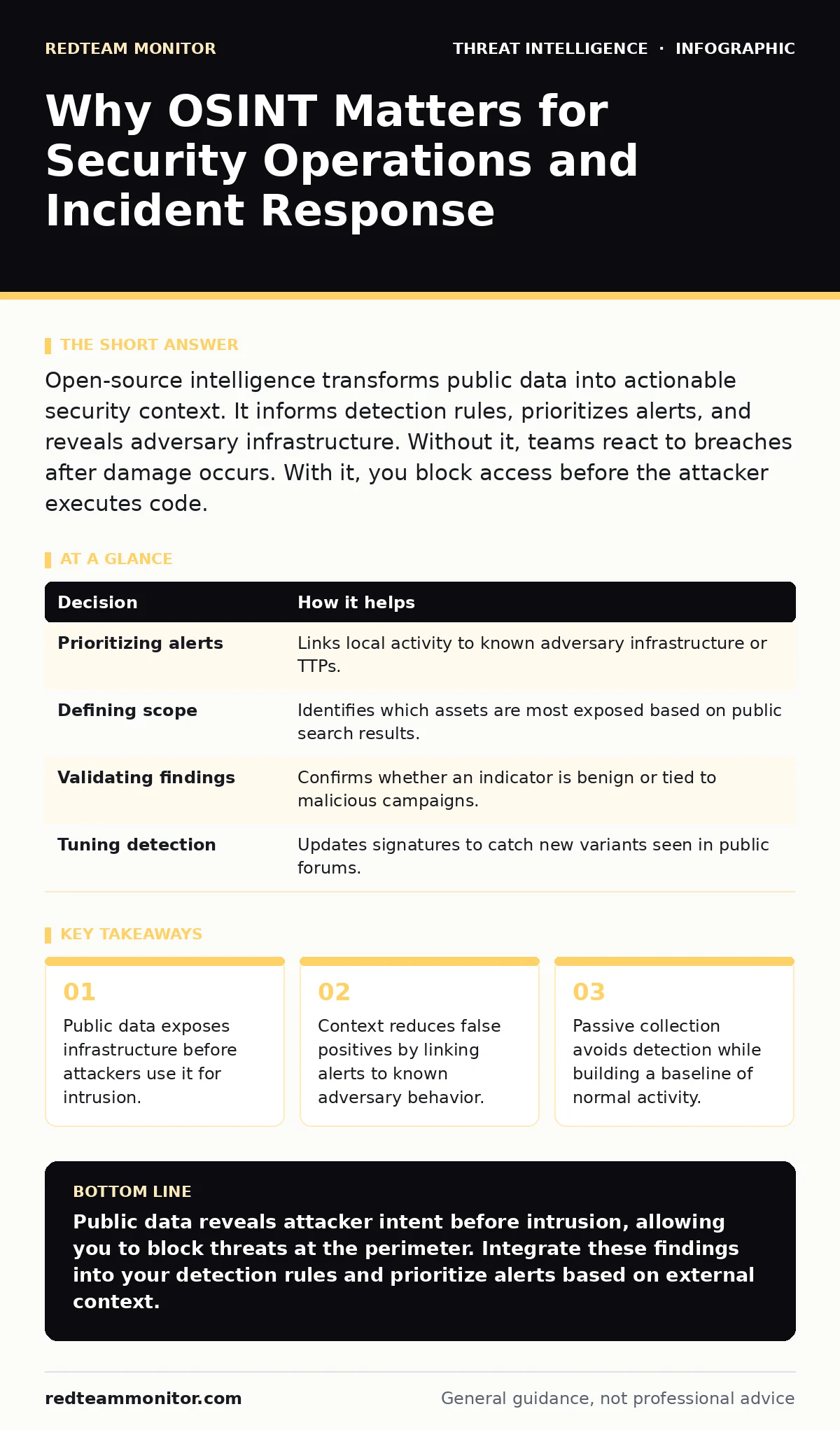
Open-source intelligence transforms public data into actionable security context. It informs detection rules, prioritizes alerts, and reveals adversary infrastructure. Without it, teams react to breaches after damage occurs. With it, you block access before the attacker executes code.
The Cost of Ignoring Public Data
Security operations often treat the internet as a separate domain from internal controls. This separation creates a blind spot. Attackers operate in the open long before they attempt to breach your network. They register domains, configure email servers, and publish code repositories. These actions leave traces that anyone can see.
The difference is not budget or headcount. It is the decision to treat public data as primary intelligence. When you ignore these signals, you are fighting a battle that was lost before the first packet hit your perimeter. You are waiting for an attacker to reveal themselves through malicious activity inside your environment. By then, the attacker has already established initial access.
Decisions Informed by Open Sources
You do not need more data. You need better context. Raw logs are noise. Intelligence is signal. Open-source intelligence provides the context that turns a generic alert into a prioritized action. It helps you decide which alerts require immediate investigation and which are routine noise.
| Decision | How it helps |
|---|---|
| Prioritizing alerts | Links local activity to known adversary infrastructure or TTPs. |
| Defining scope | Identifies which assets are most exposed based on public search results. |
| Validating findings | Confirms whether an indicator is benign or tied to malicious campaigns. |
| Tuning detection | Updates signatures to catch new variants seen in public forums. |
This table shows how public data directly influences daily operations. Without this context, every alert looks the same. With it, you can triage based on risk. You focus on what matters instead of drowning in volume. This approach saves time and reduces fatigue. It ensures your team investigates threats that are actually targeting you.
What Goes Wrong Without It
Operating without external context creates a false sense of security. You assume your internal logs tell the whole story. They do not. Internal logs show what happened inside your network. They do not show what is happening outside. Attackers use living-off-the-land attacks to blend in with normal activity. Without external intelligence, these attacks look like routine administration.
Suppose an attacker uses a legitimate system tool to exfiltrate data. Your internal endpoint detection might see the tool running. It might not flag it as malicious because the tool is signed and trusted. However, public intelligence might reveal that this specific usage pattern is associated with a known threat group. Without that external link, you miss the connection. You let the attacker persist undetected.
This is the hidden cost of isolation. You miss the early warnings. You miss the infrastructure setup. You miss the recruitment of initial access brokers who sell entry to your network. By the time you see internal anomalies, the attacker has already mapped your environment. They know your user accounts, your server roles, and your backup schedules. You are reacting to a settled threat.
How Teams Use It
Teams use open-source intelligence in three main ways. First, they monitor for brand impersonation. They watch for new domains, social media accounts, and code repositories that mimic their identity. This helps catch phishing and fraud early. Second, they track technical indicators. They look for IP addresses, hashes, and URLs associated with malicious activity. They integrate these into their detection rules.
Third, they analyze tactics, techniques, and procedures. They study how attackers operate. They map these behaviors to frameworks like the MITRE ATT&CK Navigator. This helps them build detection rules that catch behavior, not just specific files. Behavior is harder to change than a file hash. This makes your defenses more durable.
These methods work together. Brand monitoring catches social engineering. Technical indicators catch known malware. Behavior analysis catches new attacks. You need all three to have a complete picture. Relying on only one leaves gaps. Attackers will exploit those gaps.
The Passive Advantage
Most collection methods are passive. You query public databases. You search code repositories. You monitor social media. You do not interact with the target. This is critical. Active scanning can trigger alarms. It can reveal your interest to the attacker. Passive collection keeps you invisible.
This invisibility allows you to build a long-term baseline. You can see how the internet views your organization. You can identify exposed credentials, leaked data, or misconfigured cloud storage. You can find these issues before an attacker does. This is operational threat intelligence. It is intelligence that informs immediate action.
Passive intelligence is also cheaper. You do not need expensive tools. You need discipline. You need a process for collecting, analyzing, and acting on data. You need to store this data in a searchable format. This allows you to correlate events over time. You can spot trends that are invisible in the moment.
See also: Malware Families Explained: Why Small Teams Need Specific Defense · Endpoint Detection and Response: Benefits, Limits, and Real Value
Integrating with Existing Controls
Intelligence is useless if it does not reach your controls. You must integrate findings into your detection and response workflows. This means updating firewall rules, blocking domains, and refining detection logic. It also means sharing context with analysts. They need to know why an alert is important.
You can use canary tokens to detect reconnaissance. Place these tokens in public places. When they are accessed, you know someone is probing your environment. This gives you early warning. You can also use deception technology to confuse attackers. Create fake assets that look valuable. Monitor access to these assets. Any access is malicious.
These techniques complement open-source intelligence. They provide active signals from passive data. They help you validate threats. They reduce the time to detection. They make your environment more hostile to attackers. This is the goal. Make it hard for them to succeed.
Building a Sustainable Process
Sustainability requires automation and human judgment. Automate the collection of data. Use scripts to pull public records. Use APIs to search code repositories. Store this data in a central repository. Let humans analyze the context. Machines are good at finding patterns. Humans are good at understanding intent.
Review your process regularly. Update your sources. Remove dead ends. Focus on what works. This keeps your intelligence fresh and relevant. It ensures you are not wasting time on low-value data. It allows you to scale your efforts without scaling your headcount.
This approach builds resilience. It prepares you for new threats. It helps you adapt to changing tactics. It ensures you are always one step ahead. You are not just reacting. You are anticipating. This is the power of open-source intelligence. It turns the public internet into your early warning system.
Key takeaways
- Public data exposes infrastructure before attackers use it for intrusion.
- Context reduces false positives by linking alerts to known adversary behavior.
- Passive collection avoids detection while building a baseline of normal activity.
Public data reveals attacker intent before intrusion, allowing you to block threats at the perimeter. Integrate these findings into your detection rules and prioritize alerts based on external context.
Frequently asked questions
Is OSINT legal to collect?
Collecting publicly available information is generally legal. However, you must respect terms of service and privacy laws. Do not bypass authentication or scrape protected data.
How do I start with OSINT?
Begin by monitoring your brand name and domain variations. Look for new registrations and social media accounts. Use free tools to search for exposed credentials or data leaks.
What is the difference between OSINT and threat intelligence feeds?
OSINT is the raw public data. Threat intelligence feeds are curated lists of indicators derived from OSINT and other sources. Feeds provide convenience, but OSINT provides context.
Can OSINT replace internal logging?
No. OSINT provides external context. Internal logging provides internal evidence. You need both to understand a full incident. One shows the attacker's preparation. The other shows their execution.
How this guide was produced: written by the RedTeam Monitor editorial team with AI assistance, checked against the public references listed below, and reviewed when the facts change. See our editorial policy or report an error.