
Endpoint Detection and Response: Benefits, Limits, and Real Value
EDR shifts security from static file matching to behavioral analysis, but it introduces significant system overhead and alert fatigue that many teams underestimate.
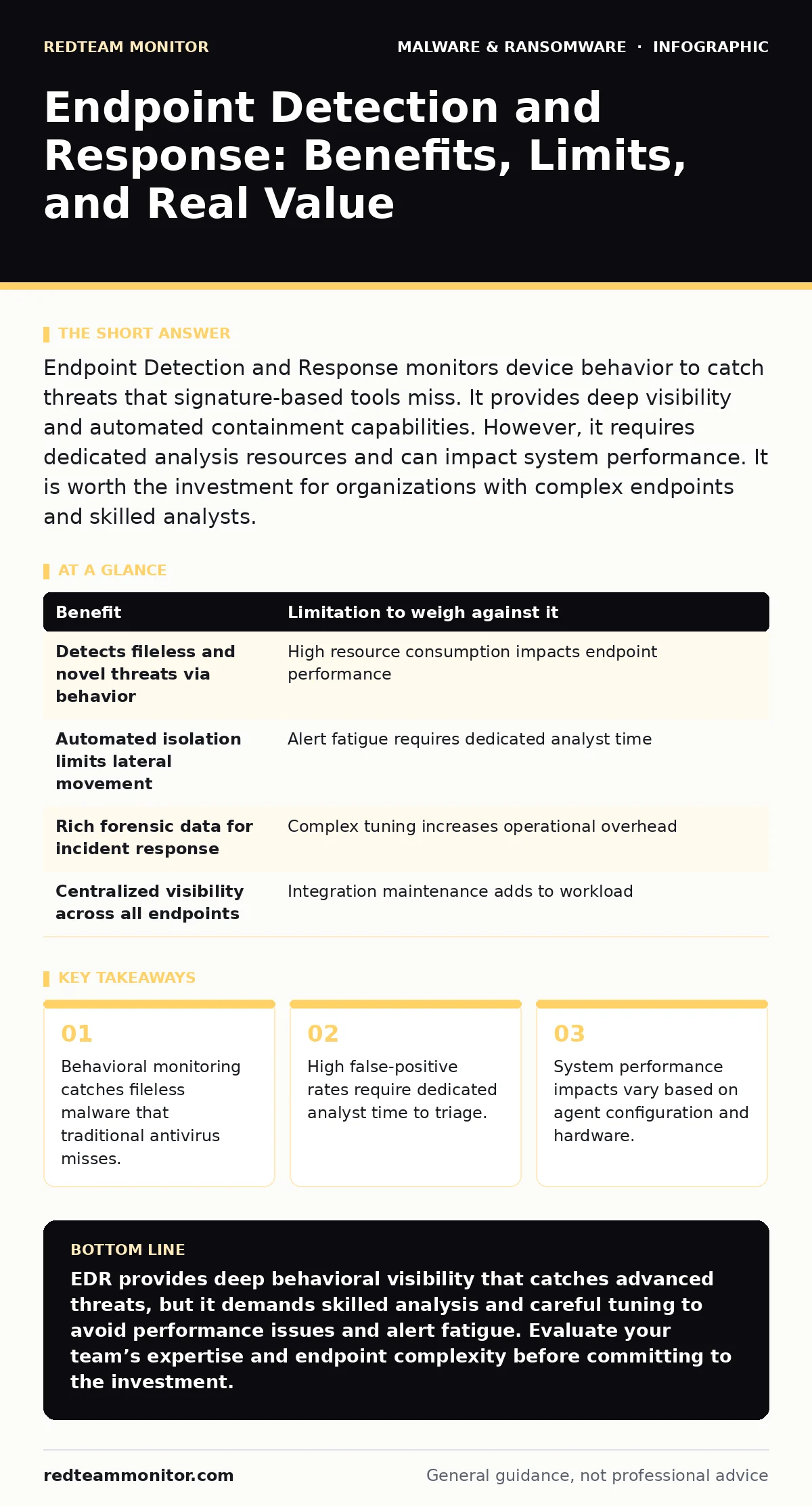
Endpoint Detection and Response monitors device behavior to catch threats that signature-based tools miss. It provides deep visibility and automated containment capabilities. However, it requires dedicated analysis resources and can impact system performance. It is worth the investment for organizations with complex endpoints and skilled analysts.
The Shift from Signatures to Behavior
Traditional antivirus relies on known signatures of malicious files. This approach fails against new threats or code that changes its appearance. Endpoint Detection and Response (EDR) takes a different approach. It records system activity in real time to identify suspicious behavior patterns.
The EDR agent sits on the endpoint and collects telemetry. This data includes process creation, registry changes, and network connections. The solution analyzes this stream of events to detect anomalies. It looks for actions that do not fit normal user or system behavior.
Imagine a legitimate administrative tool is used to download a script from the internet. The script itself may have no known signature. However, the act of a command-line interpreter downloading and executing remote code is suspicious. EDR flags this behavior as potentially malicious.
This behavioral focus allows detection of zero-day malware. These are threats that have never been seen before and lack known signatures. By focusing on what the software does rather than what it is, EDR identifies the intent behind the action.
Operational Benefits Beyond Detection
Detection is only one part of the value proposition. EDR provides visibility into the entire lifecycle of a threat on the endpoint. You can see how an attacker moved laterally across the network. This context is critical for understanding the scope of an incident.
Automated response capabilities reduce the time to containment. When a threat is confirmed, the EDR can isolate the infected endpoint from the network. This stops the spread of ransomware or data exfiltration attempts. The isolation happens without requiring manual intervention on each device.
Forensic investigation becomes faster and more accurate. You can review the history of processes on a compromised machine. This allows you to reconstruct the attack chain step by step. You identify the initial entry point and the subsequent actions taken by the attacker.
This depth of data supports better decision-making during an incident. You know exactly which files were accessed and modified. You can determine if sensitive data was exfiltrated. This clarity helps in meeting compliance requirements and reporting obligations.
The Cost of Visibility and Control
Deep visibility comes with a cost. The EDR agent consumes system resources. It monitors every process and file operation. This constant monitoring can slow down system performance. Users may experience lag or increased boot times.
High-fidelity monitoring generates a large volume of alerts. Not every anomaly is a threat. Legitimate software updates or administrative tasks can trigger warnings. This leads to alert fatigue for security teams. Analysts may miss real threats amidst the noise.
Configuration complexity is another hidden cost. Tuning the EDR to reduce false positives requires expertise. You must balance security sensitivity with operational efficiency. Poor configuration leads to either missed threats or excessive disruption.
Integration with other security tools adds to the workload. The EDR must share data with SIEM or SOAR platforms. Maintaining these connections requires ongoing effort. Misconfigured integrations can lead to data loss or delayed responses.
Weighing Benefits Against Limitations
| Benefit | Limitation to weigh against it |
|---|---|
| Detects fileless and novel threats via behavior | High resource consumption impacts endpoint performance |
| Automated isolation limits lateral movement | Alert fatigue requires dedicated analyst time |
| Rich forensic data for incident response | Complex tuning increases operational overhead |
| Centralized visibility across all endpoints | Integration maintenance adds to workload |
When It Is Worth It
EDR is worth the investment when you have complex endpoints. If your organization uses diverse operating systems and applications, signature-based tools fall short. EDR provides the behavioral context needed to protect this environment.
It is also valuable when you have skilled security analysts. These teams can tune the system and investigate alerts effectively. They turn the data into actionable intelligence. Without this expertise, the EDR becomes a liability rather than an asset.
Organizations handling sensitive data benefit from the forensic capabilities. You need to know exactly what happened during a breach. EDR provides the detailed logs required for thorough investigation. This supports compliance and legal requirements.
Consider the risk of advanced persistent threats. These attackers use sophisticated techniques to avoid detection. EDR’s behavioral analysis catches these subtle indicators. It provides a layer of defense that traditional tools cannot match.
See also: Dumpster Diving Detection: Log Signals and Physical Blind Spots · How Credential Dumps Work: From Memory to Exfiltration
When It Is Not Worth It
EDR may not be worth it for small organizations with limited budgets. The cost of licensing and support is significant. If you lack dedicated security staff, the tool becomes underutilized. You pay for capabilities you cannot effectively use.
Environments with very simple endpoints may not need EDR. If you use only standard office applications on managed devices, signature-based protection may suffice. The overhead of EDR adds complexity without proportional benefit.
Organizations with poor network segmentation should prioritize that first. EDR protects endpoints, but it does not fix network vulnerabilities. If attackers can move freely across the network, endpoint controls are less effective. Fix the network architecture before adding endpoint complexity.
Legacy systems that cannot support modern agents are also a concern. Older operating systems may not run EDR software. Forcing installation can cause instability. In these cases, compensating controls are more practical.
Integrating with Broader Defense Strategies
EDR does not work in isolation. It is part of a layered security strategy. It complements network security and identity management. You must ensure that EDR data feeds into your overall security operations.
Threat intelligence feeds enhance EDR effectiveness. These feeds provide context on emerging threats. The EDR uses this information to adjust its detection rules. This keeps the system current against new attack techniques.
Regular testing validates the EDR’s effectiveness. You should simulate attacks to verify detection and response. This ensures that the system works as expected. It also helps identify gaps in your coverage.
Remember that no single tool provides complete protection. EDR is a powerful component, but it has limits. Combine it with other controls for a resilient security posture. Stay informed about new threats and adjust your strategy accordingly.
Key takeaways
- Behavioral monitoring catches fileless malware that traditional antivirus misses.
- High false-positive rates require dedicated analyst time to triage.
- System performance impacts vary based on agent configuration and hardware.
EDR provides deep behavioral visibility that catches advanced threats, but it demands skilled analysis and careful tuning to avoid performance issues and alert fatigue. Evaluate your team’s expertise and endpoint complexity before committing to the investment.
Frequently asked questions
Does EDR replace antivirus software?
No, EDR complements antivirus by adding behavioral monitoring. Antivirus handles known threats, while EDR detects novel and fileless attacks. Both are needed for comprehensive protection.
How much performance impact does EDR have?
Impact varies by configuration and hardware. Lightweight agents minimize overhead, but high-sensitivity settings can slow systems. Proper tuning balances security and performance.
Can EDR detect all types of malware?
No, no tool detects everything. EDR excels at behavioral threats but may miss highly targeted attacks that mimic normal behavior. Combine with other controls for broader coverage.
Is EDR effective against ransomware?
Yes, EDR can detect ransomware behavior before encryption begins. It can isolate infected endpoints to prevent spread. However, prevention requires multiple layers of defense.
How this guide was produced: written by the RedTeam Monitor editorial team with AI assistance, checked against the public references listed below, and reviewed when the facts change. See our editorial policy or report an error.