
Threat Intelligence Feeds for Small Teams: What to Buy and What to Ignore
Most small organizations waste resources on raw data feeds they cannot process, while ignoring the high-value context that actually stops breaches.
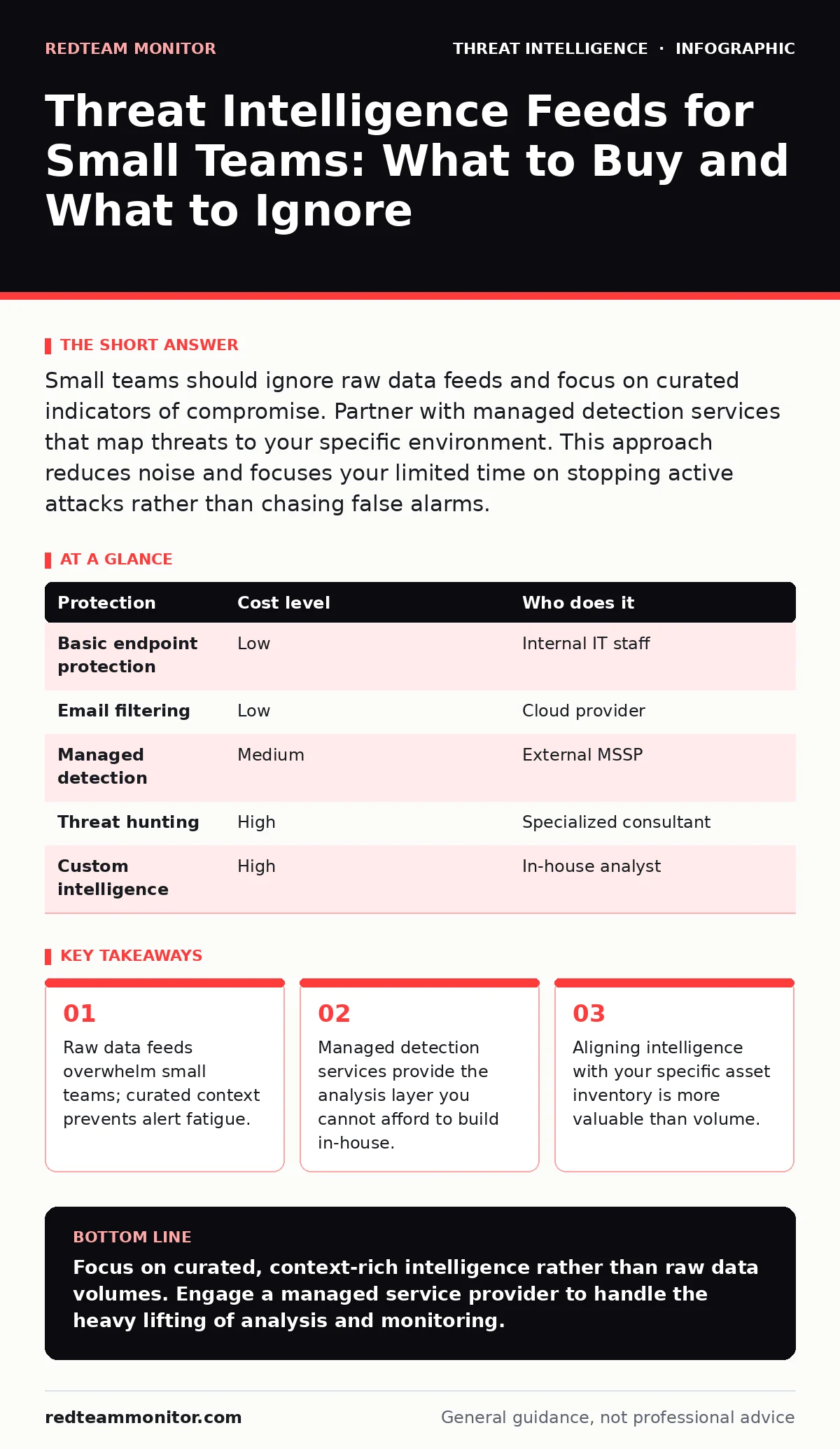
Small teams should ignore raw data feeds and focus on curated indicators of compromise. Partner with managed detection services that map threats to your specific environment. This approach reduces noise and focuses your limited time on stopping active attacks rather than chasing false alarms.
The Noise Problem in Small Environments
Threat intelligence feeds provide data about malicious actors, tools, and targets. Most feeds output raw indicators of compromise, such as IP addresses, file hashes, or domain names. For a large enterprise with dedicated analysts, this data is useful. For a small team, it is overwhelming.
You cannot manually verify thousands of alerts. When you flood your security information and event management system with unvetted data, you create noise. Noise hides real attacks. This phenomenon is known as alert fatigue. Your team stops looking at alerts because most are false positives.
The goal is not to know everything. The goal is to know what is relevant to your specific environment. A feed that tracks cryptocurrency mining malware is useless if you do not run mining hardware. A feed tracking banking trojans is irrelevant if you do not process payments.
Curated Context Over Raw Data
You need intelligence that has already been filtered and analyzed. Look for services that provide curated lists. These lists contain only the most active and dangerous threats. They often include context, such as the attack technique used and the likely impact.
This context helps you prioritize. If a feed tells you that a specific domain is used for phishing, you can block it immediately. If it tells you that the domain is part of a larger campaign targeting your industry, you can investigate further.
Curated intelligence also reduces the burden on your tools. Your firewall or email gateway does not need to process millions of entries. It only needs to check against a small, high-confidence list. This improves performance and accuracy.
The Role of Managed Detection
Most small organizations cannot afford a full-time security operations center. You cannot monitor logs twenty-four hours a day. This is where managed detection and response services become valuable. These providers monitor your environment for you.
They use threat intelligence to hunt for threats. They look for signs of compromise that your automated tools might miss. When they find something, they alert you. They often provide initial triage, telling you if the alert is real or a false positive.
This delegation is critical. It allows you to focus on your core business. You do not need to understand every new exploit. You need to know if your systems are under attack and what to do about it.
| Protection | Cost level | Who does it |
|---|---|---|
| Basic endpoint protection | Low | Internal IT staff |
| Email filtering | Low | Cloud provider |
| Managed detection | Medium | External MSSP |
| Threat hunting | High | Specialized consultant |
| Custom intelligence | High | In-house analyst |
Delegating the Heavy Lifting
You should delegate the collection and initial analysis of threat data. Do not try to build your own intelligence pipeline. The cost of tools and training is too high. The return on investment is too low.
Instead, partner with a provider that understands your industry. They should offer regular reviews of your security posture. They should explain what threats are most likely to target you. They should update your defenses based on new intelligence.
This partnership shifts the burden of staying current. You do not need to read every new report. You rely on your provider to distill the noise into actionable advice. This is a more efficient use of your time and budget.
Questions for Your IT Provider
When selecting a provider, ask specific questions. Do not accept vague promises. You need to understand how they use intelligence to protect you.
- How do you filter threat data for our specific environment?
- What is your process for validating indicators before blocking them?
- How do you communicate urgent threats to our team?
- Can you demonstrate how you detected a recent attack on a similar client?
- Do you map threats to the MITRE ATT&CK Navigator framework?
These questions reveal their methodology. A good provider will have clear answers. They will explain how they balance speed and accuracy. They will show you how they integrate intelligence into your daily operations.
See also: IOC Enrichment: Why Context Beats Raw Data in Threat Hunting
Integrating Intelligence into Daily Work
Threat intelligence is not a one-time purchase. It is an ongoing process. You must integrate it into your daily workflows. This means updating your blocklists regularly. It means reviewing alerts with context.
You should also train your staff. They need to understand what threats look like. They need to know how to report suspicious activity. This human layer is critical. Technology can block known threats, but it cannot stop every new trick.
Consider using deception technology to detect intrusions. This approach places fake assets in your network. When an attacker touches these assets, you get an alert. This method provides high-fidelity alerts with low false positives. It complements traditional intelligence by detecting active attackers, not just known bad indicators.
The Hidden Cost of False Positives
A false positive is an alert that indicates a threat but is actually benign. False positives waste time. They divert your attention from real risks. They erode trust in your security tools.
Small teams are especially vulnerable to this cost. You have fewer people to investigate alerts. Every false positive takes time away from productive work. Over time, this leads to burnout.
To mitigate this, tune your tools. Work with your provider to reduce noise. Focus on high-confidence alerts. Ignore low-priority warnings. This discipline ensures that your team remains effective and responsive.
Beyond Indicators: Understanding Tactics
Indicators of compromise are static. They tell you what was used in the past. Tactics, techniques, and procedures tell you how attackers think. Understanding these patterns helps you defend against future attacks.
You do not need to be an expert in attacker behavior. Your provider should explain these patterns to you. They should show you how attackers gain initial access. They should describe how they maintain presence.
For example, living-off-the-land attacks use legitimate system tools to hide. These attacks are hard to detect with traditional signatures. Your provider should explain how they detect these subtle behaviors. This deeper understanding improves your overall security posture.
Key takeaways
- Raw data feeds overwhelm small teams; curated context prevents alert fatigue.
- Managed detection services provide the analysis layer you cannot afford to build in-house.
- Aligning intelligence with your specific asset inventory is more valuable than volume.
Focus on curated, context-rich intelligence rather than raw data volumes. Engage a managed service provider to handle the heavy lifting of analysis and monitoring.
Frequently asked questions
How many threat feeds do I need?
You likely need only one or two high-quality, curated feeds. Multiple raw feeds create overlap and noise without adding significant value for small teams.
Can I use free threat intelligence?
Free sources exist but often
How this guide was produced: written by the RedTeam Monitor editorial team with AI assistance, checked against the public references listed below, and reviewed when the facts change. See our editorial policy or report an error.