
Attacker Dwell Time: How to Detect and Reduce Intrusion Duration
Most breaches succeed because defenders focus on perimeter entry rather than detecting lateral movement inside the network after the initial compromise occurs.
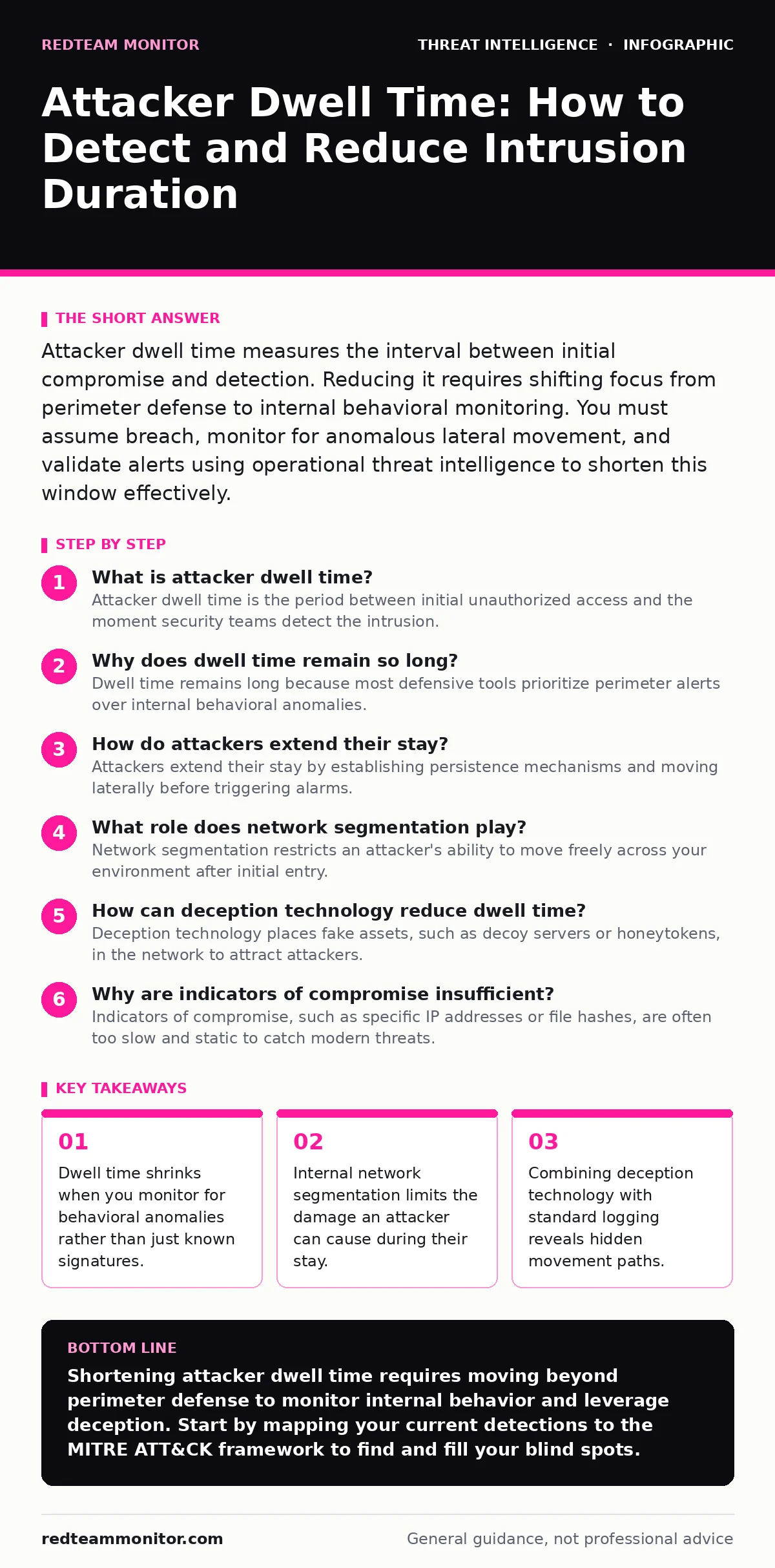
Attacker dwell time measures the interval between initial compromise and detection. Reducing it requires shifting focus from perimeter defense to internal behavioral monitoring. You must assume breach, monitor for anomalous lateral movement, and validate alerts using operational threat intelligence to shorten this window effectively.
What is attacker dwell time?
Attacker dwell time is the period between initial unauthorized access and the moment security teams detect the intrusion. This metric defines the window of opportunity for an adversary to exfiltrate data or install persistent backdoors. A longer dwell time increases the probability of successful data theft. Shortening this interval is the primary goal of modern detection engineering. You measure it by comparing the timestamp of the first malicious activity against the timestamp of the confirmed alert.
Why does dwell time remain so long?
Dwell time remains long because most defensive tools prioritize perimeter alerts over internal behavioral anomalies. Attackers often use legitimate credentials and standard protocols to blend in with normal traffic. This technique, known as living off the land, bypasses signature-based detection systems. Defenders often miss subtle changes in user behavior or file access patterns. The noise from false positives causes alert fatigue, allowing genuine threats to hide in plain sight within the daily operational churn.
How do attackers extend their stay?
Attackers extend their stay by establishing persistence mechanisms and moving laterally before triggering alarms. They create hidden user accounts, modify registry keys, or install scheduled tasks to maintain access. Lateral movement involves jumping from compromised systems to higher-value targets using stolen credentials. They often pause operations to observe network patterns and map the environment. This reconnaissance phase is quiet but critical for their long-term success within your infrastructure.
What role does network segmentation play?
Network segmentation restricts an attacker's ability to move freely across your environment after initial entry. By dividing the network into isolated zones, you limit the blast radius of a single compromised host. An attacker cannot easily pivot from a marketing workstation to a database server if strict access controls exist between segments. This forces them to spend more time finding bypass methods, which increases the chance of detection. Proper segmentation reduces the effective dwell time by containing the threat early.
How can deception technology reduce dwell time?
Deception technology places fake assets, such as decoy servers or honeytokens, in the network to attract attackers. When an adversary interacts with these traps, it generates a high-confidence alert with near-zero false positives. This immediate signal allows defenders to identify the breach much faster than traditional monitoring. Imagine an attacker who clicks a fake credential file; the system logs this interaction instantly. This approach shifts the burden of proof from the defender to the attacker, revealing presence quickly.
| Detection Method | Speed | False Positive Rate | Complexity |
|---|---|---|---|
| Signature Matching | Fast | High | Low |
| Behavioral Analysis | Moderate | Moderate | High |
| Deception Tech | Immediate | Near Zero | Medium |
| Manual Review | Slow | Variable | Very High |
See also: Endpoint Detection and Response: Benefits, Limits, and Real Value · Sandbox Evasion: How Malware Hides and What to Do About It
Why are indicators of compromise insufficient?
Indicators of compromise, such as specific IP addresses or file hashes, are often too slow and static to catch modern threats. Attackers change these indicators frequently to evade detection, rendering yesterday's blocklist useless today. Relying solely on IOCs means you are reacting to past attacks rather than detecting current behavior. You need to look for tactics, techniques, and procedures instead. This behavioral focus allows you to catch variations of an attack even if the specific tools change.
How does MITRE ATT&CK help?
The MITRE ATT&CK framework provides a common language for describing adversary behavior across different stages of an attack. It allows you to map your detection capabilities against known techniques used by threat actors. By identifying gaps in your coverage, you can prioritize building detections for high-risk behaviors. This structured approach ensures you are looking for the right signals at the right time. It transforms vague security concerns into specific, testable detection rules.
What are Sigma rules?
Sigma rules are open-source, vendor-agnostic detection rules that describe suspicious behavior patterns. They allow you to share and adapt detection logic across different security information and event management platforms. This flexibility ensures your detection engine can evolve quickly without being locked into a specific vendor's syntax. You can translate these rules into the format your SIEM understands. This standardization accelerates the deployment of new detections and improves consistency across your security operations.
How do ASNs impact detection?
Autonomous system numbers help categorize traffic sources by their originating network provider. Monitoring unusual ASN activity can reveal connections to known malicious infrastructure or unexpected geographic regions. This contextual data adds another layer of validation to your alerts. If a user account suddenly connects to an ASN typically associated with cloud providers in a different continent, it warrants investigation. This method helps distinguish between legitimate remote work and compromised credentials.
What is the hidden cost of long dwell times?
The hidden cost of long dwell times is the erosion of trust in your security monitoring tools. When attackers operate undetected for weeks, teams begin to doubt the efficacy of their investments. This skepticism leads to reduced alert response times and complacency among analysts. Furthermore, the longer an attacker stays, the more they learn about your defenses, making future attacks harder to stop. This feedback loop weakens your overall security posture over time, creating a cycle of increasing vulnerability.
Key takeaways
- Dwell time shrinks when you monitor for behavioral anomalies rather than just known signatures.
- Internal network segmentation limits the damage an attacker can cause during their stay.
- Combining deception technology with standard logging reveals hidden movement paths.
Shortening attacker dwell time requires moving beyond perimeter defense to monitor internal behavior and leverage deception. Start by mapping your current detections to the MITRE ATT&CK framework to find and fill your blind spots.
Frequently asked questions
Can I eliminate dwell time completely?
No, it is impossible to guarantee zero dwell time. The goal is to reduce it to a timeframe where the attacker cannot achieve their objectives before detection and containment.
How often should I update my detection rules?
You should review and update detection rules regularly, especially after new threat intelligence emerges or when your infrastructure changes. Continuous tuning is necessary to maintain effectiveness.
Does red teaming help reduce dwell time?
Yes, red teaming simulates real-world attacks to test your detection capabilities. It reveals gaps in your monitoring and helps you validate that your alerts trigger correctly against sophisticated techniques.
What is operational threat intelligence?
Operational threat intelligence provides actionable data about adversary tactics and infrastructure. It helps you prioritize detections based on current threats rather than generic risks, improving your response speed.
How this guide was produced: written by the RedTeam Monitor editorial team with AI assistance, checked against the public references listed below, and reviewed when the facts change. See our editorial policy or report an error.