
Signature Based vs Anomaly Detection: How They Differ in Practice
Signature detection misses new threats entirely, while anomaly detection creates noise that overwhelms teams without precise tuning and context.
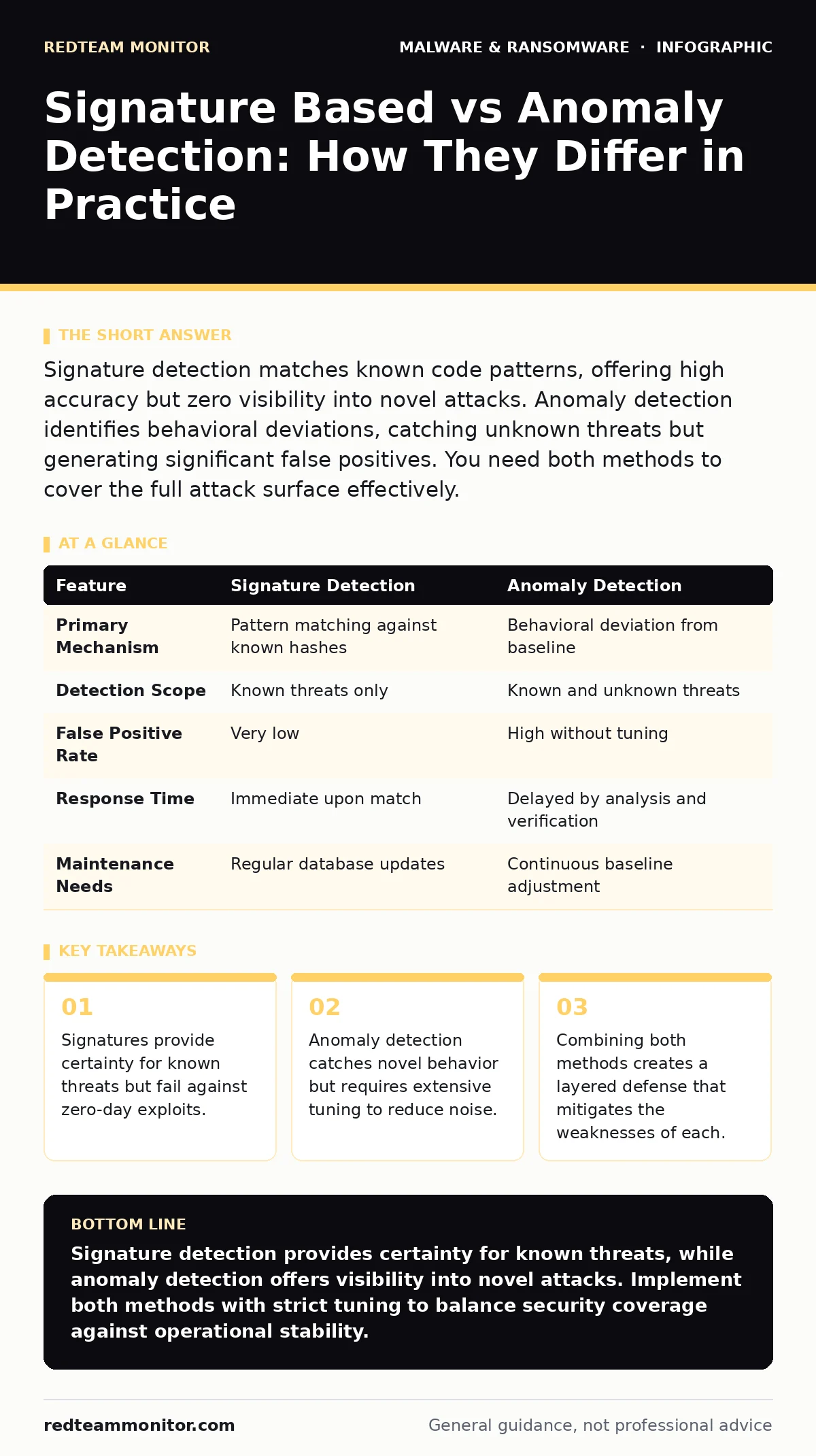
Signature detection matches known code patterns, offering high accuracy but zero visibility into novel attacks. Anomaly detection identifies behavioral deviations, catching unknown threats but generating significant false positives. You need both methods to cover the full attack surface effectively.
What is the difference between signature based and anomaly detection?
Signature based detection compares file hashes or code sequences against a database of known malicious artifacts, whereas anomaly detection monitors system behavior for deviations from established baselines. The former relies on prior knowledge of the threat, while the latter relies on statistical probability of unusual activity. Signature detection is deterministic and binary, providing clear answers for known threats. Anomaly detection is probabilistic, flagging actions that look wrong without necessarily identifying the specific malware family. This fundamental difference dictates how you tune and trust each system.
How does signature detection work in practice?
Signature detection operates by scanning files, memory, or network packets for specific byte sequences or cryptographic hashes that match known malware. When a match occurs, the security product quarantines or deletes the object immediately. This method is highly efficient because it requires minimal computational overhead and produces very few false positives. The trade-off is that it only detects threats that have already been identified and cataloged. It cannot see anything new, making it blind to zero-day attacks or polymorphic malware that changes its signature slightly.
Why does anomaly detection generate so much noise?
Anomaly detection algorithms establish a baseline of normal behavior for users, processes, or network traffic, then flag significant deviations from that norm. Because "normal" behavior varies widely across different departments and roles, the baseline is often too broad or too narrow. A sudden large file transfer might be malicious exfiltration or a legitimate backup job. Without precise context, the system flags both as suspicious. This leads to alert fatigue, where security analysts ignore warnings because most are benign. Tuning these systems requires continuous adjustment to reflect legitimate changes in business operations.
| Feature | Signature Detection | Anomaly Detection |
|---|---|---|
| Primary Mechanism | Pattern matching against known hashes | Behavioral deviation from baseline |
| Detection Scope | Known threats only | Known and unknown threats |
| False Positive Rate | Very low | High without tuning |
| Response Time | Immediate upon match | Delayed by analysis and verification |
| Maintenance Needs | Regular database updates | Continuous baseline adjustment |
When does signature detection fail completely?
Signature detection fails when attackers use code obfuscation, encryption, or packing to alter the binary structure of the malware. If the signature changes, the scanner no longer recognizes the threat as malicious. This is common in modern ransomware campaigns that use custom loaders or fileless techniques. The malware never touches the disk in a recognizable form, existing only in memory. Since there is no static file to hash, signature-based tools have nothing to compare against. This limitation is why endpoint detection and response (EDR) solutions have become standard, as they monitor execution rather than just file presence.
How do you reduce false positives in anomaly detection?
Reducing false positives in anomaly detection requires narrowing the scope of monitoring and refining the baseline data. You must exclude known benign activities, such as scheduled backups or software updates, from the alerting criteria. Implementing user and entity behavior analytics (UEBA) helps contextualize alerts by understanding typical user roles. For example, a developer pushing large code repositories is normal, while a finance employee doing the same is not. Regularly reviewing and updating the baseline ensures it reflects current operational realities. This process is labor-intensive but necessary for the system to be useful.
See also: Indicators of Compromise Examples and How to Use Them · How Attacker Persistence Works: The Step-by-Step Mechanics
Can signature detection catch fileless malware?
Signature detection struggles with fileless malware because these attacks do not create traditional executable files on the disk. Instead, they use legitimate system tools like PowerShell or Windows Management Instrumentation to execute malicious code in memory. Since there is no file to scan, traditional signature engines miss the threat entirely. Advanced signature engines can inspect memory dumps or script content, but this is resource-intensive and less common. This is why understanding sandbox evasion techniques is critical, as attackers often use fileless methods to bypass static analysis environments that rely on file signatures.
What is the role of heuristics in bridging the gap?
Heuristics act as a middle ground between strict signature matching and broad anomaly detection. Heuristic engines analyze code characteristics, such as API calls or system modifications, to guess if a file is malicious. If a file behaves like malware, even without a known signature, heuristics may flag it. This approach catches some zero-day threats but still generates false positives. It is less noisy than pure anomaly detection but less accurate than signature detection. Heuristics require careful threshold tuning to balance detection rates with operational stability. They are often integrated into endpoint detection and response (EDR) platforms to provide immediate triage capabilities.
How do you combine both methods effectively?
Combining signature and anomaly detection creates a defense-in-depth strategy that leverages the strengths of each. Use signature detection for rapid, high-confidence blocking of known threats, reducing the immediate attack surface. Use anomaly detection to identify novel or sophisticated attacks that signatures miss.
The key is integration: anomaly alerts should trigger deeper investigation, while signature blocks should feed into threat intelligence feeds. This layered approach ensures that no single method's weakness becomes a critical vulnerability. It also supports business continuity planning by maintaining operations during sophisticated, slow-moving attacks that evade simple signatures.
Why is context critical for accurate detection?
Context determines whether an alert is a security incident or a routine operation. An IP connection to a known command-and-control server is malicious, regardless of the user. However, a large data transfer is only suspicious if it deviates from the user's typical behavior. Without context, anomaly detection is just noise. Signature detection also benefits from context, such as knowing that a specific script is part of a legitimate software installation. Integrating identity management and asset inventory data helps systems understand who is doing what and why. This reduces the manual effort required to triage alerts and improves overall security posture.
Key takeaways
- Signatures provide certainty for known threats but fail against zero-day exploits.
- Anomaly detection catches novel behavior but requires extensive tuning to reduce noise.
- Combining both methods creates a layered defense that mitigates the weaknesses of each.
Signature detection provides certainty for known threats, while anomaly detection offers visibility into novel attacks. Implement both methods with strict tuning to balance security coverage against operational stability.
Frequently asked questions
Which detection method is better for ransomware?
Signature detection blocks known ransomware variants quickly, but anomaly detection is necessary to catch new strains before they are cataloged. You need both to effectively defend against ransomware campaigns.
Do I need separate tools for signature and anomaly detection?
Not necessarily. Many modern endpoint detection and response (EDR) solutions integrate both methods, using signatures for immediate blocking and behavioral analysis for deeper investigation.
How often should I update my signature databases?
Signature databases should update automatically and frequently, often multiple times per day, to ensure protection against the latest known threats and variants.
Can anomaly detection replace human analysts?
No. Anomaly detection generates alerts that require human judgment to interpret. It identifies potential issues but cannot determine intent or context without analyst review and triage.
How this guide was produced: written by the RedTeam Monitor editorial team with AI assistance, checked against the public references listed below, and reviewed when the facts change. See our editorial policy or report an error.