
Business Continuity Planning Examples: 3 Real Workflows That Keep Systems Running
Most teams confuse business continuity with disaster recovery, treating data restoration as the only goal while ignoring the operational steps that keep services alive during an outage.
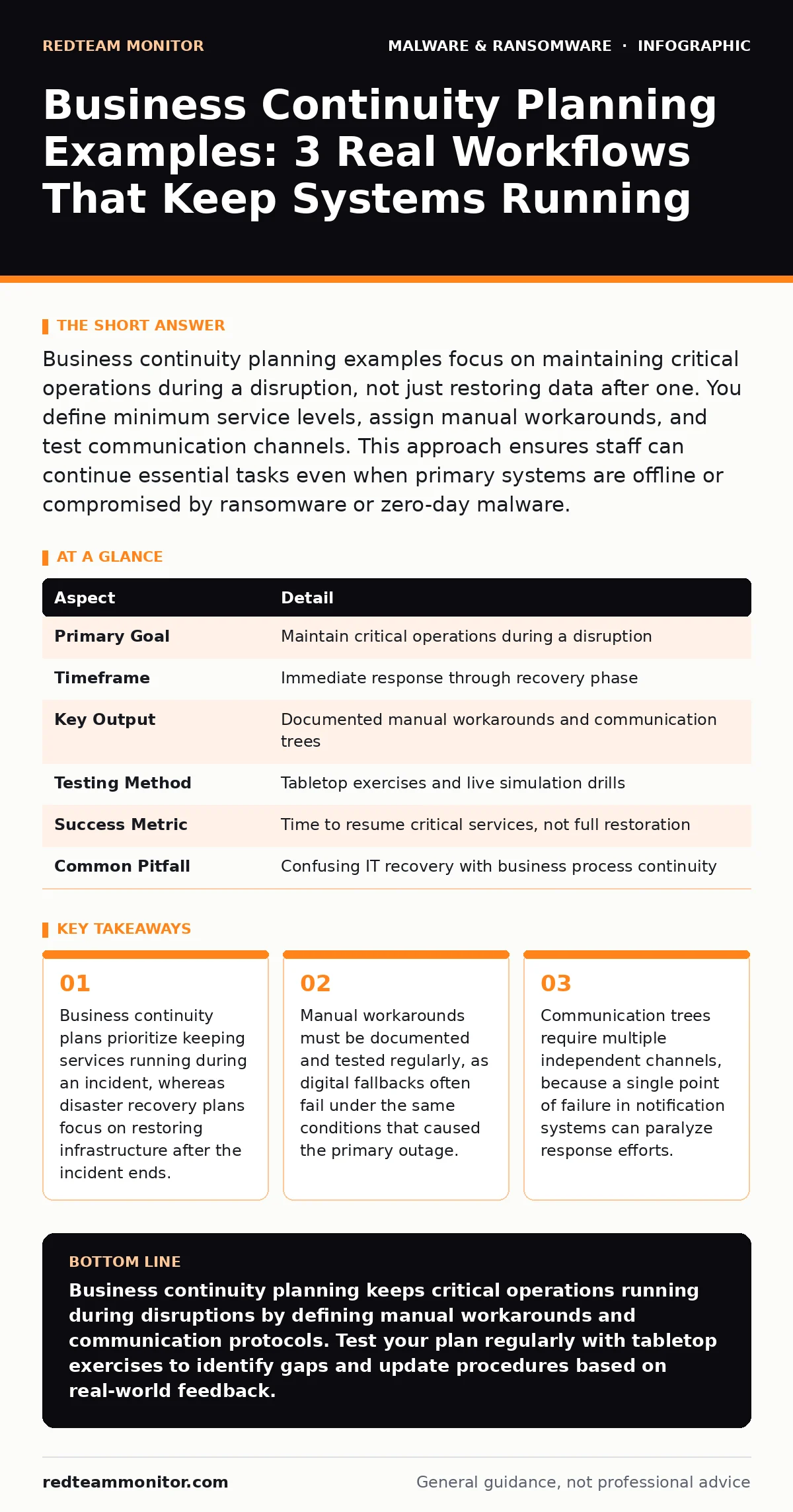
Business continuity planning examples focus on maintaining critical operations during a disruption, not just restoring data after one. You define minimum service levels, assign manual workarounds, and test communication channels. This approach ensures staff can continue essential tasks even when primary systems are offline or compromised by ransomware or zero-day malware.
Understanding Business Continuity Planning Examples
Business continuity planning examples reveal how organizations maintain critical functions during a disruption. You design these plans to keep essential services running when primary systems fail, rather than waiting to restore everything afterward. This distinction matters because downtime costs money and reputation. You identify which processes must continue at all costs. You then define the minimum resources needed to support those processes. This approach differs from disaster recovery plans, which focus on rebuilding infrastructure. You need both, but they serve different purposes. Continuity keeps the lights on. Recovery rebuilds the house.
| Aspect | Detail |
|---|---|
| Primary Goal | Maintain critical operations during a disruption |
| Timeframe | Immediate response through recovery phase |
| Key Output | Documented manual workarounds and communication trees |
| Testing Method | Tabletop exercises and live simulation drills |
| Success Metric | Time to resume critical services, not full restoration |
| Common Pitfall | Confusing IT recovery with business process continuity |
You must define what "critical" means for your specific environment. Not all systems deserve equal attention. You prioritize based on impact. A customer-facing portal might be critical. An internal HR portal might be tolerable to lose for 24 hours. This prioritization dictates your resource allocation. You cannot protect everything equally. You must choose where to invest your defensive efforts. This choice requires honest assessment of your business dependencies. You map these dependencies before you write the plan.
How Continuity Plans Work in Practice
A business continuity plan functions as a decision tree for chaos. You start with a trigger event. This could be a power outage, a cyberattack, or a natural disaster. You then assess the scope. Is it local or global? You activate the appropriate tier of response. You notify stakeholders using pre-defined channels. You switch to manual or degraded modes of operation. You monitor the situation for changes. You adjust your response as new information emerges. You document every action taken. This documentation helps with post-incident analysis. It also provides legal protection.
Imagine a retail company loses its point-of-sale system due to ransomware. The business continuity plan activates immediately. Staff switch to handwritten receipts. They log transactions in a secure notebook. They promise customers digital receipts later. The store stays open. Sales continue. The brand remains functional. The IT team works to isolate the infection. They restore systems from clean backups. This process might take days. The business survives because it had a manual workaround. Without that plan, the store closes. Revenue stops. Customers leave. The manual process is slow, but it works.
You must test these workarounds regularly. People forget how to use paper forms. They forget where the notebooks are kept. They forget who has authority to approve exceptions. You run drills to expose these gaps. You update the plan based on drill results. You ensure new hires know the procedures. You integrate continuity training into onboarding. This keeps the knowledge fresh. It prevents reliance on tribal knowledge. Tribal knowledge disappears when staff leave.
Who Is Affected by Continuity Failures
Business continuity failures impact everyone in the organization. Frontline staff face confusion and stress. They need clear instructions on what to do. Middle management struggles with decision-making under pressure. They need authority and guidelines. Executives deal with reputational risk and financial loss. They need accurate status updates. Customers experience service degradation. They need transparency and honesty. Partners and suppliers face supply chain disruptions. They need coordination and clarity.
You often overlook third-party dependencies. Your system might be down, but your partner's system is up. Or vice versa. You need plans for both scenarios. You cannot control your vendors, but you can prepare for their failures. You assess their continuity capabilities. You include them in your risk assessments. You define fallback options if they fail. This extends your responsibility beyond your own walls. It acknowledges the interconnected nature of modern business.
Computer worms can spread rapidly across networks, affecting multiple systems simultaneously. If your continuity plan only addresses single-point failures, you will fail. You must consider cascading failures. You must plan for widespread impact. This requires a holistic view of your environment. You map all connections. You identify all dependencies. You test for complex failure modes. This depth separates good plans from great ones.
What To Do About Planning Gaps
You start by conducting a business impact analysis. You identify critical processes. You estimate the cost of downtime. You determine the maximum tolerable outage time. You then design controls to meet those targets. You implement manual workarounds. You establish communication protocols. You train staff on procedures. You test the plan regularly. You refine it based on feedback. This is an iterative process. You never finish planning. You continuously improve.
You must address human factors. Stress impairs judgment. Clear checklists reduce cognitive load. You simplify procedures for high-pressure situations. You avoid jargon. You use plain language. You provide visual aids. You make instructions easy to follow. You ensure accessibility. You consider language barriers. You accommodate disabilities. This inclusivity ensures everyone can participate in the response. It maximizes your operational capacity.
You also need to consider legal and regulatory requirements. Some industries have strict continuity mandates. You must comply with these rules. You document your compliance efforts. You audit your processes. You update your plan to reflect changes. You stay informed about new threats. You adapt to evolving risks. This vigilance keeps your plan relevant. It ensures you are prepared for the unknown.
Common Mistakes in Continuity Planning
People usually get wrong the difference between speed and accuracy. They rush to restore systems without verifying data integrity. This leads to further corruption. They prioritize technical recovery over business needs. They forget that a restored system is useless if the business processes are broken. They fail to communicate clearly. They use outdated contact lists. They rely on a single communication channel. They neglect manual workarounds. They assume staff will remember procedures. They do not test their plans. They treat the plan as a static document.
You must avoid these traps. You verify data before restoration. You align technical efforts with business priorities. You maintain multiple communication channels. You document and test manual workarounds. You train staff regularly. You update your plan frequently. You treat it as a living document. This mindset shift improves your resilience. It reduces your risk. It protects your organization.
Fileless malware operates in memory, avoiding traditional file-based detection. If your continuity plan relies on file integrity checks, you will miss this threat. You must incorporate behavioral analysis. You monitor for anomalous activity. You plan for memory-based compromises. This adds complexity to your detection strategy. It requires more advanced tools. It demands more skilled analysts. You must invest in these capabilities.
See also: Stop Denial-of-Wallet Attacks: Response and Recovery Steps
Integrating With Related Security Measures
Your business continuity plan must align with other security measures. You coordinate with incident response teams. You share information freely. You define clear handoffs. You avoid duplication of effort. You ensure consistency in messaging. You integrate with disaster recovery plans. You coordinate with IT operations. You align with security operations. This integration creates a unified response. It reduces confusion. It improves efficiency.
You also consider the threat of malicious mobile apps. Employees might use personal devices for work. These devices can introduce vulnerabilities. You include mobile devices in your continuity planning. You define policies for remote access. You secure mobile communications. You plan for device loss or theft. This extends your protection to the edge. It acknowledges the reality of modern work.
Sandbox evasion techniques allow malware to hide during analysis. If your security tools use sandboxes, you must be aware of their limitations. You complement sandboxing with other detection methods. You use signature-based scanning. You use heuristic analysis. You use threat intelligence. This layered approach improves your detection rates. It reduces your blind spots. It strengthens your overall security posture.
DLL sideloading is a technique where malicious code is executed via legitimate applications. If your continuity plan assumes standard execution paths, you will miss this vector. You monitor for unusual library loading. You enforce application whitelisting. You restrict execution permissions. This reduces your attack surface. It makes sideloading harder. It protects your critical systems.
Testing And Refining Your Plan
You test your plan through tabletop exercises. You simulate various scenarios. You gather feedback from participants. You identify gaps and weaknesses. You update the plan accordingly. You conduct live drills periodically. You measure response times. You evaluate decision-making quality. You assess communication effectiveness. You refine your procedures based on results. This continuous improvement cycle keeps your plan effective.
You also review your plan after real incidents. You conduct post-incident reviews. You analyze what worked and what failed. You update your plan to reflect lessons learned. You share these lessons with the organization. You promote a culture of learning. This openness improves your resilience. It builds trust. It enhances your reputation.
Zero-day malware exploits unknown vulnerabilities. You cannot patch for these threats immediately. Your continuity plan must handle the unexpected. You rely on detection and response. You isolate affected systems. You switch to manual modes. You communicate with stakeholders. You manage the crisis. This flexibility is key. It allows you to adapt to novel threats. It keeps your organization running.
Key takeaways
- Business continuity plans prioritize keeping services running during an incident, whereas disaster recovery plans focus on restoring infrastructure after the incident ends.
- Manual workarounds must be documented and tested regularly, as digital fallbacks often fail under the same conditions that caused the primary outage.
- Communication trees require multiple independent channels, because a single point of failure in notification systems can paralyze response efforts.
Business continuity planning keeps critical operations running during disruptions by defining manual workarounds and communication protocols. Test your plan regularly with tabletop exercises to identify gaps and update procedures based on real-world feedback.
Frequently asked questions
What is the difference between business continuity and disaster recovery?
Business continuity focuses on maintaining essential operations during a disruption, while disaster recovery focuses on restoring IT infrastructure and data after the disruption ends.
How often should I test my business continuity plan?
You should test your business continuity plan at least annually, with tabletop exercises conducted quarterly to keep procedures fresh and identify emerging gaps.
Do I need a business continuity plan for a small business?
Yes, small businesses are often more vulnerable to disruptions and can survive less downtime, making a tailored business continuity plan critical for long-term survival.
What are the most common triggers for activating a business continuity plan?
Common triggers include cyberattacks like ransomware, natural disasters, power outages, supply chain failures, and critical system malfunctions that halt essential operations.
How this guide was produced: written by the RedTeam Monitor editorial team with AI assistance, checked against the public references listed below, and reviewed when the facts change. See our editorial policy or report an error.