
Stop Denial-of-Wallet Attacks: Response and Recovery Steps
Attackers exploit idle resources to drain accounts before alerts trigger, making budget caps and resource tagging the primary defense against financial loss.
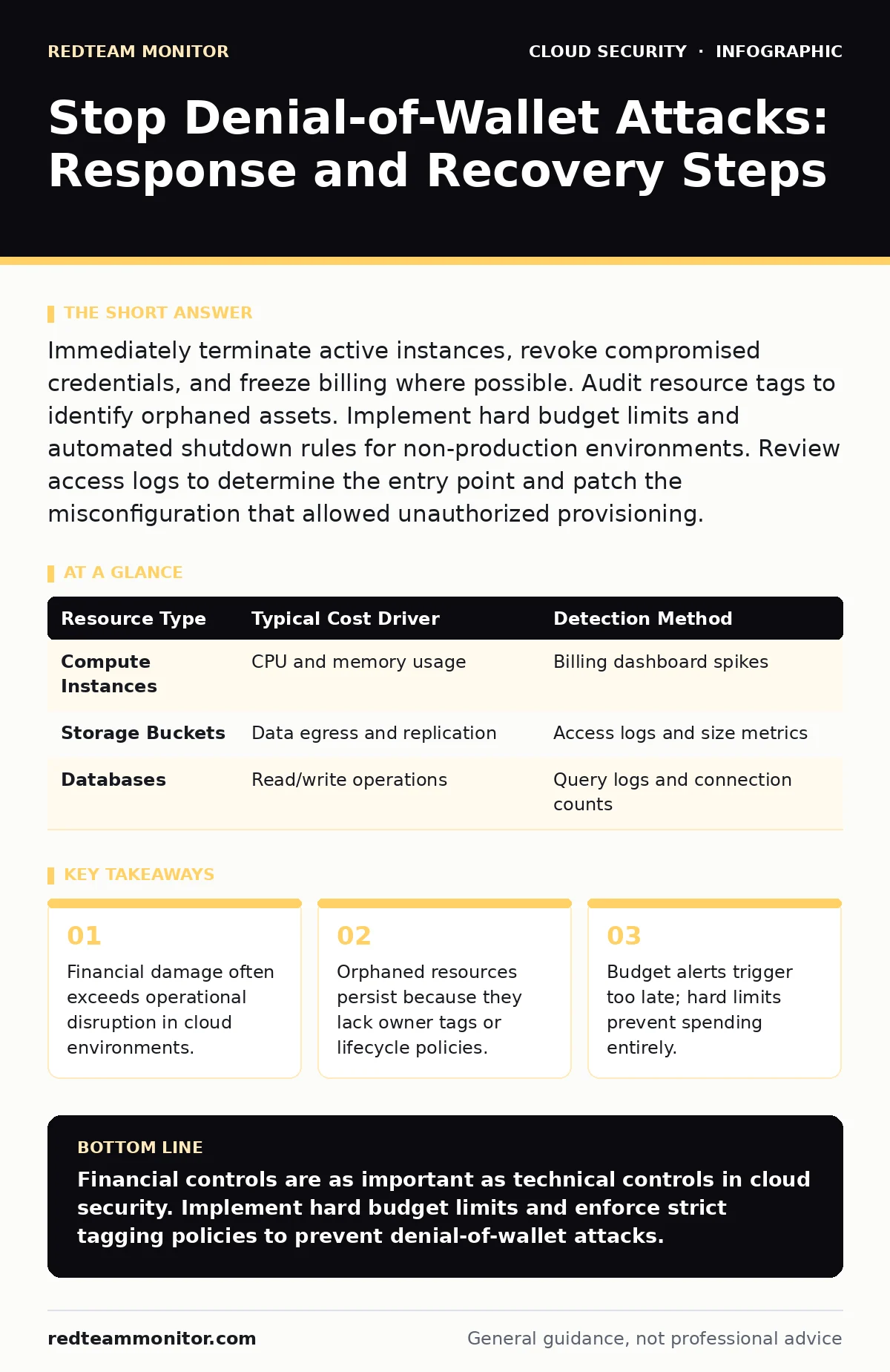
Immediately terminate active instances, revoke compromised credentials, and freeze billing where possible. Audit resource tags to identify orphaned assets. Implement hard budget limits and automated shutdown rules for non-production environments. Review access logs to determine the entry point and patch the misconfiguration that allowed unauthorized provisioning.
First hour
Immediate containment
Denial-of-wallet attacks aim to exhaust your cloud budget by provisioning expensive resources. The attacker does not need to steal data; they only need to spend your money. You must stop the bleeding immediately. Identify the resources consuming the most credits or compute units. Check your billing dashboard for spikes in usage. Look for unusual instance types, such as high-memory or GPU-accelerated nodes, appearing in regions you do not use.
- Terminate unauthorized compute instances and containers.
- Revoke active API keys and access tokens associated with the compromised account.
- Disable public access to storage buckets and databases.
- Capture memory dumps and logs from critical systems before deletion.
The speed of response determines the financial impact. Cloud resources scale instantly, meaning costs can escalate from zero to thousands of credits in minutes. You cannot undo spending, but you can stop future charges. Verify that the termination commands succeeded. Some attackers create multiple layers of resources to ensure at least some survive your cleanup efforts. Check for hidden instances or unattached volumes that continue to incur storage fees.
Notification chain
You must inform specific teams within the first hour. Delaying notification allows the attacker to pivot to other accounts or services. Tell your finance team to monitor for unexpected invoices. They may need to place a hold on payment methods linked to the cloud account. Notify your legal department if the attack involves data exfiltration alongside resource consumption. They will determine if regulatory reporting is required.
Inform your cloud provider’s security team. They can provide insights into the attack vector and may offer tools to block specific IP ranges or user agents. Do not assume they will detect the anomaly automatically. Your account is one of many. Proactive communication helps them identify patterns that might affect other customers. Document every action you take. This record supports insurance claims and internal audits.
First day
Forensic analysis
Identify how the attacker gained permission to provision resources. Most denial-of-wallet attacks exploit overprivileged service accounts. These accounts often have broad permissions to create and manage compute instances. Attackers look for these high-privilege identities in exposed repositories or misconfigured identity providers. Review the identity and access management logs. Look for successful authentication events from unfamiliar locations or user agents.
Check for misconfigurations in your infrastructure as code templates. Attackers often modify deployment scripts to include expensive resource types. Compare the current state of your infrastructure with the last known good configuration. Identify any deviations. Look for resources created outside of your standard CI/CD pipeline. These manual creations are often the first sign of compromise.
| Resource Type | Typical Cost Driver | Detection Method |
|---|---|---|
| Compute Instances | CPU and memory usage | Billing dashboard spikes |
| Storage Buckets | Data egress and replication | Access logs and size metrics |
| Databases | Read/write operations | Query logs and connection counts |
Examine the network traffic logs. Attackers often use compromised instances to mine cryptocurrency or launch further attacks. This generates distinct traffic patterns. Look for connections to known malicious IP addresses or unusual ports. Analyze the DNS queries made by the compromised instances. They may be resolving domains used for command and control communication.
Budget controls
Implement hard budget limits on all accounts. Soft alerts are insufficient. They notify you after spending has occurred. Hard limits prevent provisioning when the budget is reached. This stops the attack vector entirely. Configure these limits at the project or organizational level. Ensure that critical production services have separate budgets from development and testing environments. This prevents a single attack from shutting down your entire business.
Review your tagging strategy. Resources without proper tags are difficult to identify and manage. Attackers often create resources without tags to avoid detection by automated cleanup scripts. Enforce mandatory tagging for all new resources. Use automated policies to delete resources that lack owner or environment tags after a specified period. This reduces the attack surface and simplifies forensic analysis.
First week
Recovery and hardening
Restore services from clean backups. Verify that the backups do not contain the attacker’s modifications. Scan the restored images for malware and unauthorized configurations. Deploy the restored services into isolated environments. Monitor them closely for signs of reinfection. Gradually shift traffic back to the recovered services. Ensure that your monitoring tools are active and configured to alert on anomalous behavior.
Update your security policies based on the findings. Revise the permissions for service accounts. Apply the principle of least privilege. Remove unnecessary permissions to create or modify resources. Implement just-in-time access for administrative tasks. This reduces the window of opportunity for attackers to exploit compromised credentials.
- Rotate all secrets and API keys.
- Update firewall rules to block malicious IPs.
- Patch vulnerable software and libraries.
- Conduct a post-incident review with all stakeholders.
Integrate lessons learned into your development workflow. Update your infrastructure as code templates to include security controls. Add checks for resource types and regions. Prevent the deployment of unauthorized resources at the pipeline level. This shifts security left and reduces the risk of similar attacks in the future.
Preventing recurrence
Denial-of-wallet attacks exploit gaps in visibility and control. You must close these gaps permanently. Implement continuous monitoring for resource creation and deletion. Alert on any resource created outside of your standard processes. Use automated tools to enforce compliance with your security policies. These tools should block non-compliant resources before they are provisioned.
Review your cloud security groups regularly. Ensure that they restrict access to necessary ports and protocols only. Remove any overly permissive rules. Test your rules periodically to verify they are effective. Misconfigured security groups are a common entry point for attackers.
Consider implementing zero trust network access. This approach verifies every request as if it originates from an untrusted network. It reduces the risk of lateral movement within your environment. Even if an attacker compromises one resource, they cannot easily access others. This limits the scope of the damage.
Regularly audit your cloud vulnerability management processes. Ensure that you are patching vulnerabilities promptly. Unpatched software is a common vector for initial compromise. Keep your inventory of cloud assets up to date. You cannot protect what you do not know you have.
Long-term strategy
Denial-of-wallet attacks are likely to increase as cloud adoption grows. Attackers are becoming more sophisticated. They target organizations with weak financial controls. You must treat financial security as a core component of your cybersecurity strategy. Integrate financial monitoring with your security operations center. Correlate security events with billing data. This provides a holistic view of your risk posture.
Educate your development teams about the risks of overprivileged accounts. They are often the first line of defense. Encourage them to follow secure coding practices. Provide training on cloud security best practices. Make security a shared responsibility. This cultural shift is critical for long-term resilience.
Review your insurance coverage. Ensure that it covers cyber extortion and financial loss due to cloud attacks. Understand the exclusions and limitations. This prepares you for the financial impact of a breach. Do not assume that standard policies cover cloud-specific risks.
See also: Implement Single Sign-On: A Step-by-Step Rollout Plan · How Secrets Managers Work: Mechanism, Limits, and Hidden Costs
Related topics
Understanding the broader context of cloud security helps you build a stronger defense. Misconfigurations are the root cause of many attacks. Reviewing Kubernetes misconfigurations can help you secure your container workloads. Exposed dashboards provide easy access for attackers. Learn how to prevent exposed Kubernetes dashboards from becoming entry points. Network segmentation limits the spread of attacks. Properly configured cloud security groups are essential for this. Access control reduces the risk of privilege escalation.
Implement zero trust network access to verify every request. Service meshes add another layer of security. Explore service mesh security to protect inter-service communication. Secrets management prevents credential leaks. Use secrets managers to handle sensitive data. Regular audits find vulnerabilities. Integrate cloud vulnerability management into your workflow. Secure migration prevents legacy issues. Follow cloud migration security best practices.
Key takeaways
- Financial damage often exceeds operational disruption in cloud environments.
- Orphaned resources persist because they lack owner tags or lifecycle policies.
- Budget alerts trigger too late; hard limits prevent spending entirely.
Financial controls are as important as technical controls in cloud security. Implement hard budget limits and enforce strict tagging policies to prevent denial-of-wallet attacks.
Frequently asked questions
How do I detect a denial-of-wallet attack in real-time?
Monitor billing dashboards for sudden spikes in usage. Set up alerts for unusual resource creation patterns. Correlate security logs with financial data to identify anomalies.
Can I recover funds lost to a denial-of-wallet attack?
Cloud providers rarely refund unauthorized charges. Prevention is the only reliable method. Focus on stopping the attack quickly to minimize financial loss.
What is the difference between a denial-of-service and a denial-of-wallet attack?
Denial-of-service aims to disrupt availability. Denial-of-wallet aims to exhaust financial resources. Both cause downtime, but the latter directly impacts your budget.
How often should I review my cloud security groups?
Review them monthly or after any significant infrastructure change. Automated tools can help enforce compliance continuously. Manual reviews catch complex misconfigurations.
How this guide was produced: written by the RedTeam Monitor editorial team with AI assistance, checked against the public references listed below, and reviewed when the facts change. See our editorial policy or report an error.