
Service Mesh Security Misconceptions That Weaken Your Defense
Service meshes shift the trust boundary to the application edge, creating new attack surfaces that standard network controls cannot see or block.
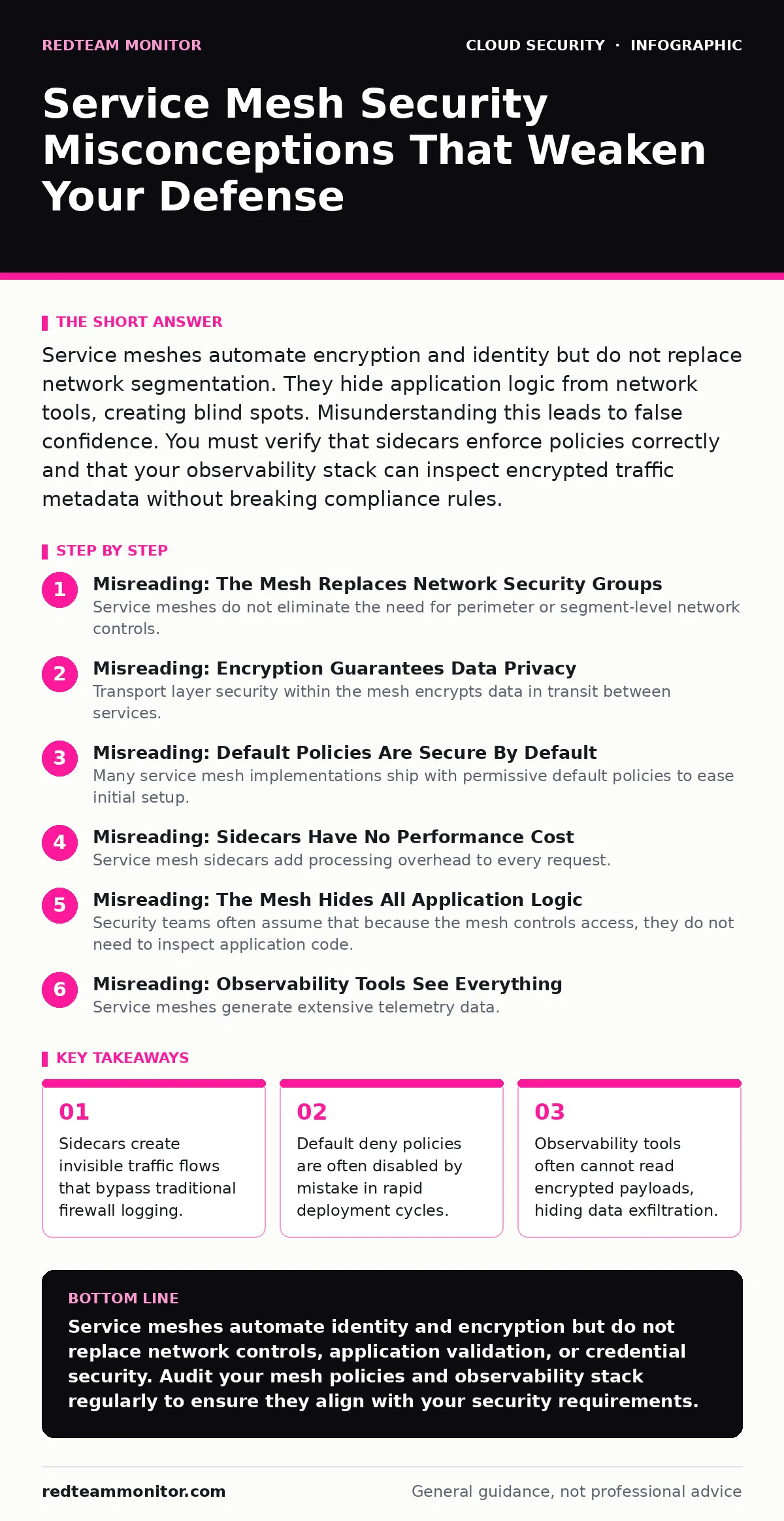
Service meshes automate encryption and identity but do not replace network segmentation. They hide application logic from network tools, creating blind spots. Misunderstanding this leads to false confidence. You must verify that sidecars enforce policies correctly and that your observability stack can inspect encrypted traffic metadata without breaking compliance rules.
Misreading: The Mesh Replaces Network Security Groups
Service meshes do not eliminate the need for perimeter or segment-level network controls. Operators often assume that because service-to-service traffic is encrypted and authenticated within the mesh, external network controls become redundant. This is a dangerous oversight. Service meshes manage traffic between known services. They do not block unauthorized ingress from the internet or lateral movement from compromised nodes outside the mesh scope.
You still need cloud security groups to restrict which nodes can communicate at the IP level. If a malicious actor gains access to a node, they can potentially pivot to other nodes if network segmentation is weak. The mesh handles application-layer identity, while network controls handle host-level reachability. Relying solely on the mesh leaves your infrastructure exposed to attacks that target the underlying compute layer before the mesh sidecar ever sees the traffic.
Misreading: Encryption Guarantees Data Privacy
Transport layer security within the mesh encrypts data in transit between services. This prevents eavesdropping on the network cables or virtual switches. It does not protect data at rest, nor does it protect data once it is decrypted within the service memory. Attackers targeting the application process itself can still read sensitive information if they compromise the host or the container runtime.
Imagine a scenario where a developer hardcodes database credentials in the application source code. The mesh encrypts the HTTP request traveling to the database. However, the application decrypts it in memory to use the credential. A memory dump of that process reveals the secret. You must use secrets managers to handle sensitive values. The mesh secures the pipe, but you must secure the water flowing through it.
Misreading: Default Policies Are Secure By Default
Many service mesh implementations ship with permissive default policies to ease initial setup. Operators often deploy the mesh and assume it is immediately enforcing strict access controls. In reality, many meshes allow all traffic by default until explicit authorization policies are written. This creates a window of vulnerability where services can communicate freely without restriction.
You must audit your authorization policies regularly. Check that every service has a defined allow list. Verify that no service has a wildcard allow rule. This process is similar to reviewing infrastructure-as-code misconfigurations. If you do not explicitly deny traffic, the mesh will likely permit it. Assuming security by default without verification is a common failure point in production environments.
Misreading: Sidecars Have No Performance Cost
Service mesh sidecars add processing overhead to every request. They intercept traffic, decrypt it, apply policies, and re-encrypt it. This introduces latency and consumes CPU and memory resources. Teams often overlook this cost in capacity planning. Under high load, the sidecar itself can become a bottleneck, causing service degradation or timeouts.
Monitor sidecar resource usage closely. Set resource limits and requests for sidecars in your Kubernetes misconfigurations audits. If sidecars consume too much CPU, they can starve the application process. This trade-off between security granularity and performance is inevitable. You must balance the depth of inspection with the speed of your business-critical transactions. Ignoring this cost leads to unstable systems during traffic spikes.
Misreading: The Mesh Hides All Application Logic
Security teams often assume that because the mesh controls access, they do not need to inspect application code. The mesh enforces who can talk to whom. It does not validate the content of the request. A legitimate service can send a malformed or malicious payload to another service. The mesh permits the connection because the identity is correct.
This is where application-level validation becomes critical. You cannot rely on the mesh to stop SQL injection or command injection attacks. These attacks happen after the traffic reaches the application logic. The mesh secures the transport, not the payload. You must implement input validation and output encoding within your application code. The mesh is a gatekeeper, not a filter for content.
See also: Stop Denial-of-Wallet Attacks: Response and Recovery Steps · How Secrets Managers Work: Mechanism, Limits, and Hidden Costs
Misreading: Observability Tools See Everything
Service meshes generate extensive telemetry data. However, this data often lacks context about the actual business transaction. Observability tools may show that Service A called Service B. They may not show what data was passed or why the call failed. Encrypted traffic prevents deep packet inspection. You lose visibility into the payload content.
This creates a blind spot for detecting data exfiltration. If an attacker compromises a service, they can exfiltrate data in small, encrypted chunks. The mesh logs the connection, but not the data. You must correlate mesh telemetry with application logs. Use distributed tracing to map business transactions across services. Without this correlation, you cannot detect subtle misuse of legitimate access.
Misreading: Mesh Configuration Is Static
Service mesh configurations change frequently as services are added, removed, or updated. Operators often treat mesh configuration as a one-time setup. They do not integrate mesh policy management into their continuous deployment pipelines. This leads to configuration drift. Policies become outdated or inconsistent across environments.
Treat mesh policies as code. Store them in version control. Review them as part of your pull request process. This aligns with best practices for infrastructure-as-code misconfigurations. Automated testing of mesh policies prevents accidental misconfigurations. If you do not automate policy updates, you will inevitably introduce security gaps during rapid development cycles.
Misreading: The Mesh Eliminates Credential Management
Service meshes often automate certificate rotation and distribution. This reduces the operational burden of managing TLS certificates. However, it does not eliminate the need for secure credential management. Services still need identities. These identities must be protected. If an attacker compromises the mesh control plane, they can issue fraudulent certificates.
You must secure the control plane of your service mesh. Restrict access to the control plane APIs. Use role-based access control to limit who can modify mesh configurations. This is similar to preventing cloud account hijacking. If the control plane is compromised, the entire trust model collapses. Automating certificates is convenient, but it does not replace the need for strict access controls around the authority that issues them.
Key takeaways
- Sidecars create invisible traffic flows that bypass traditional firewall logging.
- Default deny policies are often disabled by mistake in rapid deployment cycles.
- Observability tools often cannot read encrypted payloads, hiding data exfiltration.
Service meshes automate identity and encryption but do not replace network controls, application validation, or credential security. Audit your mesh policies and observability stack regularly to ensure they align with your security requirements.
Frequently asked questions
Does a service mesh protect against DDoS attacks?
Service meshes can help mitigate some DDoS attacks by rate-limiting requests and managing connection limits. They do not replace dedicated DDoS protection services that operate at the network edge. You need both layers for comprehensive protection.
Can a service mesh detect malware in traffic?
No, service meshes do not inspect traffic for malware signatures. They focus on identity and access control. You need separate security tools, such as web application firewalls or intrusion detection systems, to scan for malware and malicious payloads in the traffic.
How does a service mesh handle service discovery?
Service meshes automatically discover services and manage their endpoints. They update routing tables dynamically as services scale up or down. This reduces the need for manual configuration of DNS entries or load balancer rules. The mesh maintains an up-to-date view of the service topology.
Is it safe to run the mesh control plane in production?
Yes, but it must be highly secured and monitored. The control plane is a critical component. Compromise of the control plane allows attackers to manipulate traffic and policies. Use strict access controls, encryption, and monitoring to protect the control plane environment from unauthorized access.
How this guide was produced: written by the RedTeam Monitor editorial team with AI assistance, checked against the public references listed below, and reviewed when the facts change. See our editorial policy or report an error.