
Stop Kubernetes Misconfigurations: The Real Prevention Hierarchy
Most Kubernetes breaches stem from default settings that remain active because teams mistake deployment success for security completion.
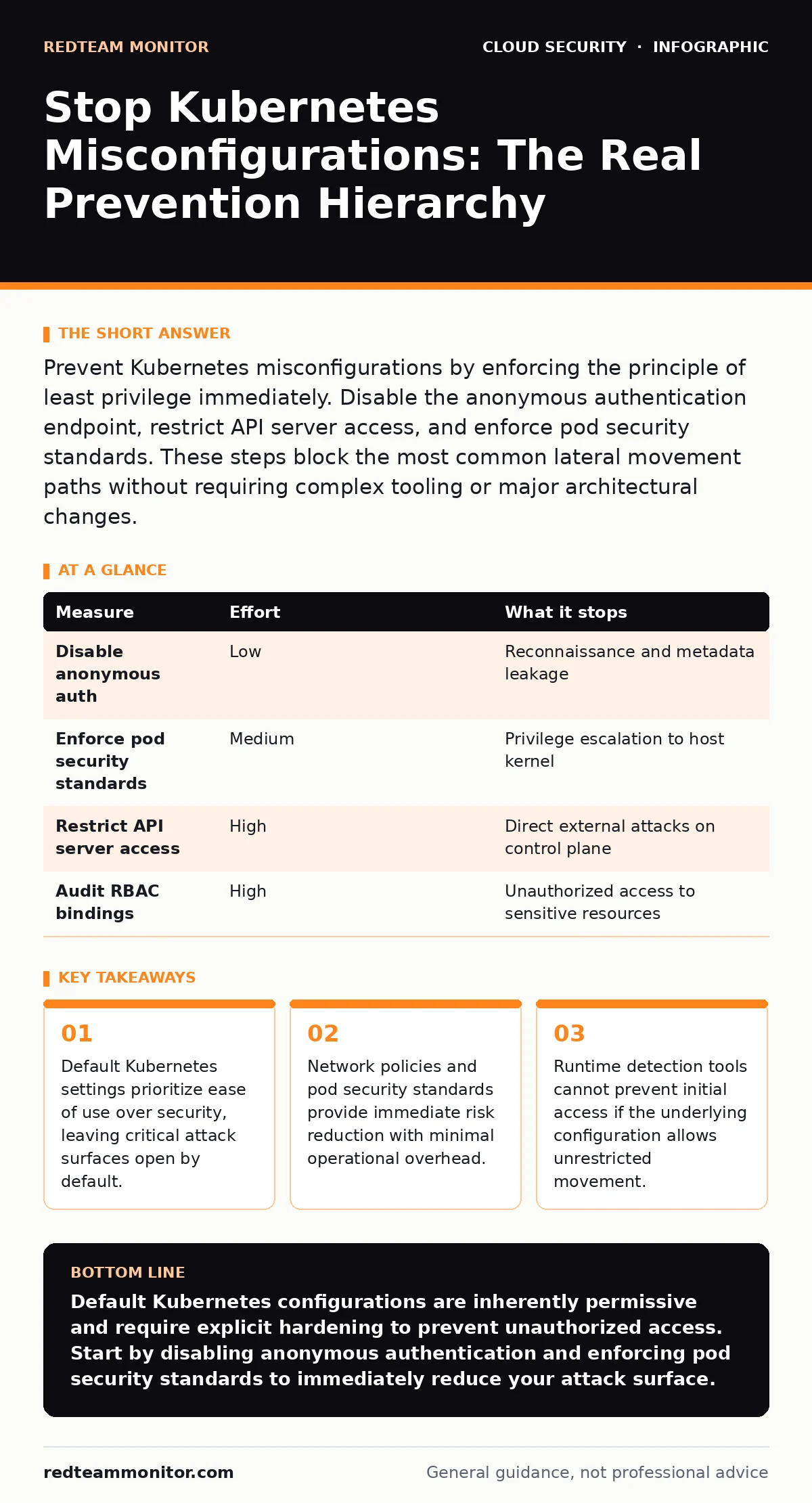
Prevent Kubernetes misconfigurations by enforcing the principle of least privilege immediately. Disable the anonymous authentication endpoint, restrict API server access, and enforce pod security standards. These steps block the most common lateral movement paths without requiring complex tooling or major architectural changes.
Default Settings Are Attack Surfaces
Kubernetes is designed to be permissive by default. This design choice accelerates development but creates a silent risk accumulation. When you deploy a cluster, the control plane assumes trust between components unless you explicitly deny it. This assumption is where most misconfigurations originate. You are not securing a static server; you are managing a dynamic system where permissions shift with every deployment.
The anonymous authentication endpoint is often the first gap. If enabled, unauthenticated users can inspect cluster metadata. This information reveals node counts, pod names, and service endpoints. Attackers use this data to map the environment before launching a targeted exploit. Disabling this endpoint removes the ability for outsiders to enumerate your infrastructure. It is a single configuration change that stops reconnaissance dead.
Enforce Pod Security Standards
Pod security standards define how containers interact with the host system. Without these standards, a compromised container can escalate privileges to the host kernel. This escalation grants the attacker control over the entire node, not just the application. You must enforce these standards at the namespace level to prevent developers from bypassing restrictions.
The baseline standard prevents privilege escalation and access to host devices. The restricted standard adds further constraints, such as dropping all Linux capabilities. Applying the restricted standard to production workloads is the most effective way to limit blast radius. If a container is compromised, the attacker remains trapped within the container boundaries. This isolation prevents lateral movement to other pods on the same node.
Restrict API Server Access
The Kubernetes API server is the entry point for all cluster operations. It handles authentication, authorization, and auditing. If this server is exposed to the public internet, attackers can attempt credential stuffing or exploit known vulnerabilities. You must restrict access to the API server using network segmentation.
Place the API server in a private network segment. Allow access only from trusted bastion hosts or CI/CD pipelines. Use mutual TLS authentication to ensure that only verified clients can communicate with the server. This approach ensures that even if an attacker obtains credentials, they cannot reach the API endpoint without being on the internal network.
| Measure | Effort | What it stops |
|---|---|---|
| Disable anonymous auth | Low | Reconnaissance and metadata leakage |
| Enforce pod security standards | Medium | Privilege escalation to host kernel |
| Restrict API server access | High | Direct external attacks on control plane |
| Audit RBAC bindings | High | Unauthorized access to sensitive resources |
Manage Role-Based Access Control
Role-Based Access Control (RBAC) determines who can do what within the cluster. Misconfigured RBAC is the leading cause of insider threats and compromised service accounts. The default service account often has excessive permissions. Applications running with these accounts can access secrets and deploy new workloads.
Audit your RBAC bindings regularly. Remove any role that grants cluster-admin privileges to non-human identities. Service accounts should have the minimum permissions required to function. This reduces the impact if a service account token is stolen. You should also rotate service account tokens frequently to limit the window of exposure.
Automate Configuration Validation
Manual configuration checks are error-prone and unsustainable. You need automated validation to catch misconfigurations before they reach production. Integrate policy engines into your CI/CD pipeline. These tools scan manifests and Helm charts for violations of security best practices.
Define policies that enforce your security requirements. For example, require that all images come from a trusted registry and that containers run as non-root users. Block deployments that fail these checks. This shift-left approach prevents misconfigurations from entering the cluster. It also provides developers with immediate feedback, reducing the friction of security compliance.
See also: Service Mesh Security Misconceptions That Weaken Your Defense · Implement Single Sign-On: A Step-by-Step Rollout Plan
Monitor for Anomalous Behavior
Static configuration checks are not enough. You must monitor runtime behavior to detect deviations from the norm. Look for unexpected network connections, privilege escalation attempts, or unusual file system access. These indicators suggest that a misconfiguration has been exploited.
Use runtime security tools to collect telemetry from nodes and containers. Correlate this data with your RBAC and network policies. If a pod attempts to access a resource it should not have permission for, alert immediately. This detection capability complements your preventive measures by catching failures in your configuration logic.
Close the Loop with Continuous Review
Security is not a one-time task. Cluster configurations drift over time as new services are added and old ones are removed. You must establish a continuous review process to identify and remediate new misconfigurations. Schedule regular audits of your cluster state.
Compare the current state against your desired state. Identify any deviations and remediate them automatically where possible. This process ensures that your security posture remains consistent. It also helps you understand the operational impact of your security controls.
Checklist for Today
Start with these three actions to reduce your risk immediately. They require minimal effort but provide significant security benefits.
- Disable the anonymous authentication endpoint on the API server.
- Enforce the baseline pod security standard on all production namespaces.
- Audit and restrict the permissions of default service accounts.
Key takeaways
- Default Kubernetes settings prioritize ease of use over security, leaving critical attack surfaces open by default.
- Network policies and pod security standards provide immediate risk reduction with minimal operational overhead.
- Runtime detection tools cannot prevent initial access if the underlying configuration allows unrestricted movement.
Default Kubernetes configurations are inherently permissive and require explicit hardening to prevent unauthorized access. Start by disabling anonymous authentication and enforcing pod security standards to immediately reduce your attack surface.
Frequently asked questions
Does Kubernetes encrypt data at rest by default?
No, Kubernetes does not encrypt etcd data at rest by default. You must configure encryption providers to protect sensitive data stored in the cluster's data store.
How do I prevent secrets from being exposed in environment variables?
Use a dedicated secrets manager to inject secrets at runtime. This prevents secrets from being stored in pod specifications or visible in process listings.
Can I use network policies to protect the control plane?
Network policies apply to pod traffic, not control plane components. You must use firewall rules and cloud security groups to protect the API server and other control plane endpoints.
What is the impact of running containers as root?
Running as root allows a compromised container to access all host resources. It bypasses kernel namespaces and makes privilege escalation trivial for an attacker.
How this guide was produced: written by the RedTeam Monitor editorial team with AI assistance, checked against the public references listed below, and reviewed when the facts change. See our editorial policy or report an error.