
Infrastructure-as-Code Myths: Why Static Scanning Fails to Catch Errors
Infrastructure-as-code misconfigurations often stem from environmental drift and runtime dynamics that static analysis tools cannot detect or prevent.
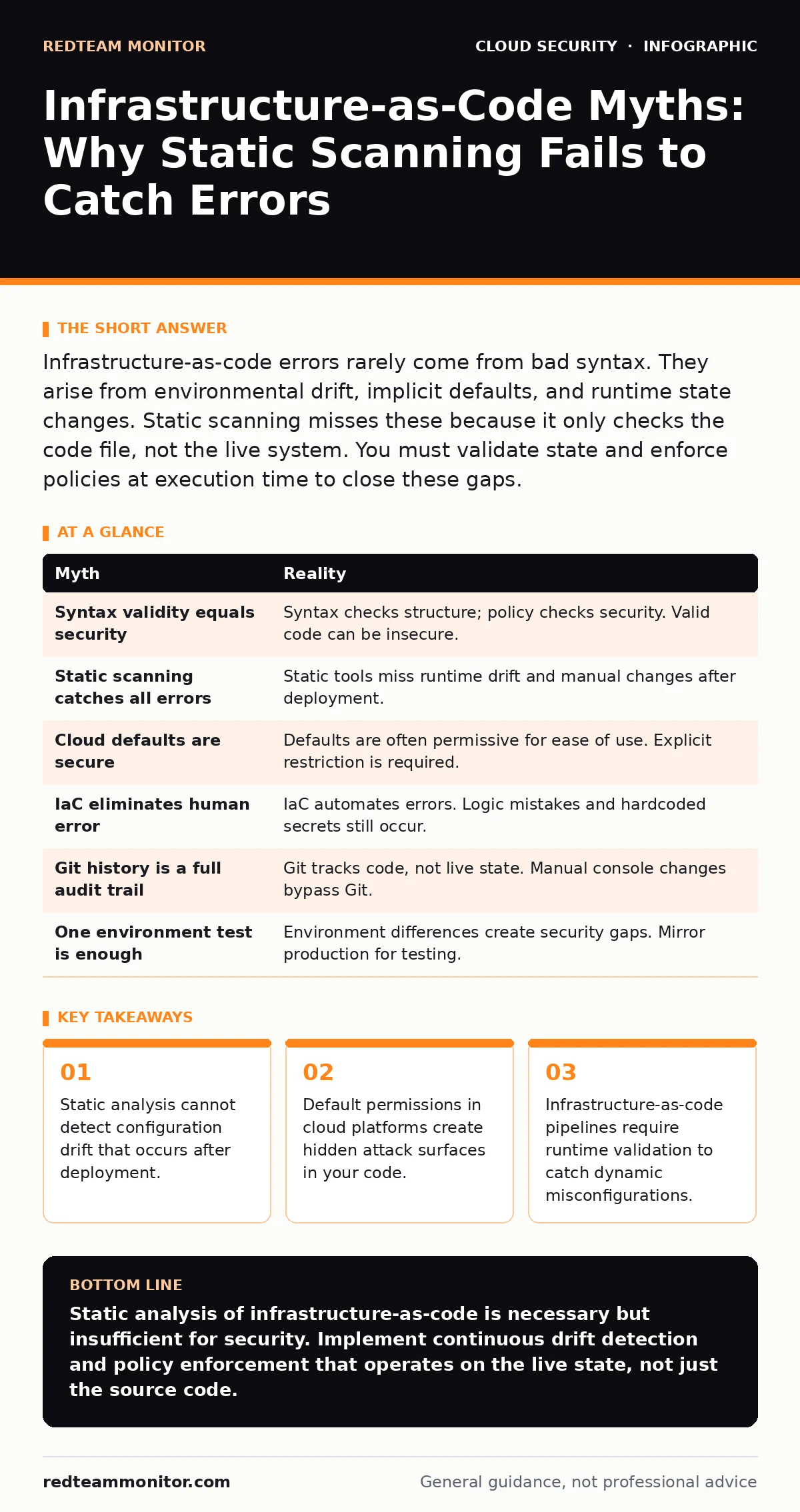
Infrastructure-as-code errors rarely come from bad syntax. They arise from environmental drift, implicit defaults, and runtime state changes. Static scanning misses these because it only checks the code file, not the live system. You must validate state and enforce policies at execution time to close these gaps.
Myth: Syntax Validity Equals Security Configuration
Reality: A configuration file that parses correctly without errors is not secure. Syntax validation only confirms that the code follows the required structural rules of the language or template. It does not evaluate whether the resulting infrastructure adheres to security best practices or organizational policy. You might have perfectly valid Terraform or CloudFormation code that explicitly grants public read access to sensitive storage buckets. The parser accepts this because the syntax is correct. The security risk remains hidden until an auditor or attacker discovers the exposed data. You must separate syntax checking from policy enforcement in your pipeline.
Myth: Static Scanning Catches All Misconfigurations
Reality: Static application security testing tools analyze code files before they are deployed. They identify known patterns of insecure configurations, such as unencrypted volumes or overly permissive network rules. These tools fail to detect configuration drift. Drift happens when the live infrastructure changes after deployment due to manual edits, automated scaling events, or external dependencies.
The code repository still contains the secure version, but the running system is vulnerable. You cannot rely on static scans alone because they represent a historical snapshot, not the current state. You need continuous compliance monitoring to detect deviations from the intended state.
Imagine a developer manually opens a security group port for debugging and forgets to close it. The static scanner sees the original code and reports no issues. The production environment remains exposed. This gap between declared state and actual state is where most breaches originate. See our guide on cloud security groups for details on managing these dynamic boundaries.
Myth: Least Privilege Is Automatically Enforced by Cloud Defaults
Reality: Cloud platforms often provision resources with broad default permissions to ensure functionality out of the box. Infrastructure-as-code templates frequently inherit these defaults unless explicitly restricted. If you do not specify restrictive permissions in your code, the deployed resource retains the platform’s permissive baseline. This creates a silent accumulation of privilege. Over time, your infrastructure becomes more accessible than necessary. You must explicitly define deny rules and restrict access in every template. Assuming defaults are secure is a dangerous assumption that leads to excessive privilege exposure.
Myth: Infrastructure-as-Code Eliminates Human Error Completely
Reality: Infrastructure-as-code reduces the risk of manual click errors in control panels, but it introduces new sources of human error. Developers may write logic that appears correct in isolation but fails under specific conditions. They might hardcode temporary credentials, misconfigure dependency orders, or misunderstand the scope of a variable. The code executes exactly as written, even if the intent was different. Automation amplifies mistakes rather than eliminating them. A single error in a template can propagate across dozens of environments simultaneously. You need peer review processes and integration tests to catch logical errors before they scale.
Suppose a variable for a database password is defined in a public repository because the developer misunderstood how interpolation works. The code runs perfectly, but the secret is now exposed to anyone with repository access. This is a human error in logic, not a syntax error. Refer to our section on secrets managers to understand how to handle sensitive data properly.
Myth: Version Control History Provides Sufficient Audit Trails
Reality: Version control systems track changes to code files, but they do not track the state of the infrastructure. You can see who changed a line of code and when, but you cannot see what that change did to the live environment. Multiple commits might merge in a way that creates a configuration conflict not visible in the individual diffs. Furthermore, manual changes made directly to the cloud console bypass version control entirely. These out-of-band changes create a divergence between the recorded history and the actual system. You need infrastructure state tracking that correlates code commits with actual resource changes.
See also: Implement Single Sign-On: A Step-by-Step Rollout Plan · Stop Denial-of-Wallet Attacks: Response and Recovery Steps
Myth: Testing in One Environment Guarantees Security Everywhere
Reality: Infrastructure behavior varies across environments due to differences in network topology, available resources, and underlying platform versions. A configuration that is secure in a development environment might be insecure in production because production has different network boundaries or access controls. Developers often test against simplified mocks that do not reflect the complexity of the production environment. This creates a false sense of security. You must test infrastructure configurations in environments that closely mirror production. This includes testing network policies, identity permissions, and data encryption at rest and in transit.
Imagine a microservices architecture where internal traffic is unencrypted in development because it is on a private network. In production, this traffic might traverse a public subnet or a different availability zone. The same code results in data exposure. This highlights the need for environment-aware testing. Check our guide on service mesh security for strategies to secure internal traffic consistently.
| Myth | Reality |
|---|---|
| Syntax validity equals security | Syntax checks structure; policy checks security. Valid code can be insecure. |
| Static scanning catches all errors | Static tools miss runtime drift and manual changes after deployment. |
| Cloud defaults are secure | Defaults are often permissive for ease of use. Explicit restriction is required. |
| IaC eliminates human error | IaC automates errors. Logic mistakes and hardcoded secrets still occur. |
| Git history is a full audit trail | Git tracks code, not live state. Manual console changes bypass Git. |
| One environment test is enough | Environment differences create security gaps. Mirror production for testing. |
Myth: Policy-as-Code Blocks All Non-Compliant Deployments
Reality: Policy-as-code tools evaluate configurations against defined rules during the planning or deployment phase. They block deployments that violate explicit rules. However, they cannot block changes that occur outside the deployment pipeline. If an administrator modifies a resource directly in the cloud console, the policy engine is bypassed. Additionally, policies must be maintained and updated as threats evolve. A static set of rules will become obsolete. You must combine admission control with continuous monitoring. Admission control prevents bad deployments; continuous monitoring detects and remediates drift.
Myth: Infrastructure-as-Code Misconfigurations Are Rare
Reality: Misconfigurations are the leading cause of cloud security incidents. They occur because complexity increases with scale. As organizations adopt more services and integrate more systems, the surface area for error grows. Infrastructure-as-code makes these errors reproducible and widespread. A single misconfigured template can compromise hundreds of instances. The frequency of these errors is high because they are subtle and often invisible until exploited. You must treat configuration management as a continuous security discipline, not a one-time setup task.
Suppose an organization migrates to the cloud without updating its security policies. The old on-premises controls do not apply to cloud-native services. The infrastructure-as-code templates inherit these gaps. The result is a persistent state of misconfiguration. See our guide on cloud migration security for strategies to bridge these gaps.
Key takeaways
- Static analysis cannot detect configuration drift that occurs after deployment.
- Default permissions in cloud platforms create hidden attack surfaces in your code.
- Infrastructure-as-code pipelines require runtime validation to catch dynamic misconfigurations.
Static analysis of infrastructure-as-code is necessary but insufficient for security. Implement continuous drift detection and policy enforcement that operates on the live state, not just the source code.
Frequently asked questions
Does infrastructure-as-code replace the need for manual security reviews?
No. Infrastructure-as-code automates deployment but requires rigorous review of the code logic, variables, and dependencies to ensure security intent is preserved.
How do I detect configuration drift in real-time?
Use continuous compliance tools that compare the live infrastructure state against the desired state defined in your infrastructure-as-code templates.
Can policy-as-code prevent manual changes by administrators?
Policy-as-code typically blocks deployment pipeline changes. To prevent manual changes, you must enforce strict IAM permissions that restrict direct console access.
Is it safe to use public infrastructure-as-code templates?
Public templates may contain insecure defaults or outdated patterns. Always review and test them in isolated environments before using them in production.
How this guide was produced: written by the RedTeam Monitor editorial team with AI assistance, checked against the public references listed below, and reviewed when the facts change. See our editorial policy or report an error.