
Cloud Migration Security: Step-by-Step Implementation Plan
Most migration failures stem from misconfigured network boundaries rather than application code, making infrastructure validation the first line of defense.
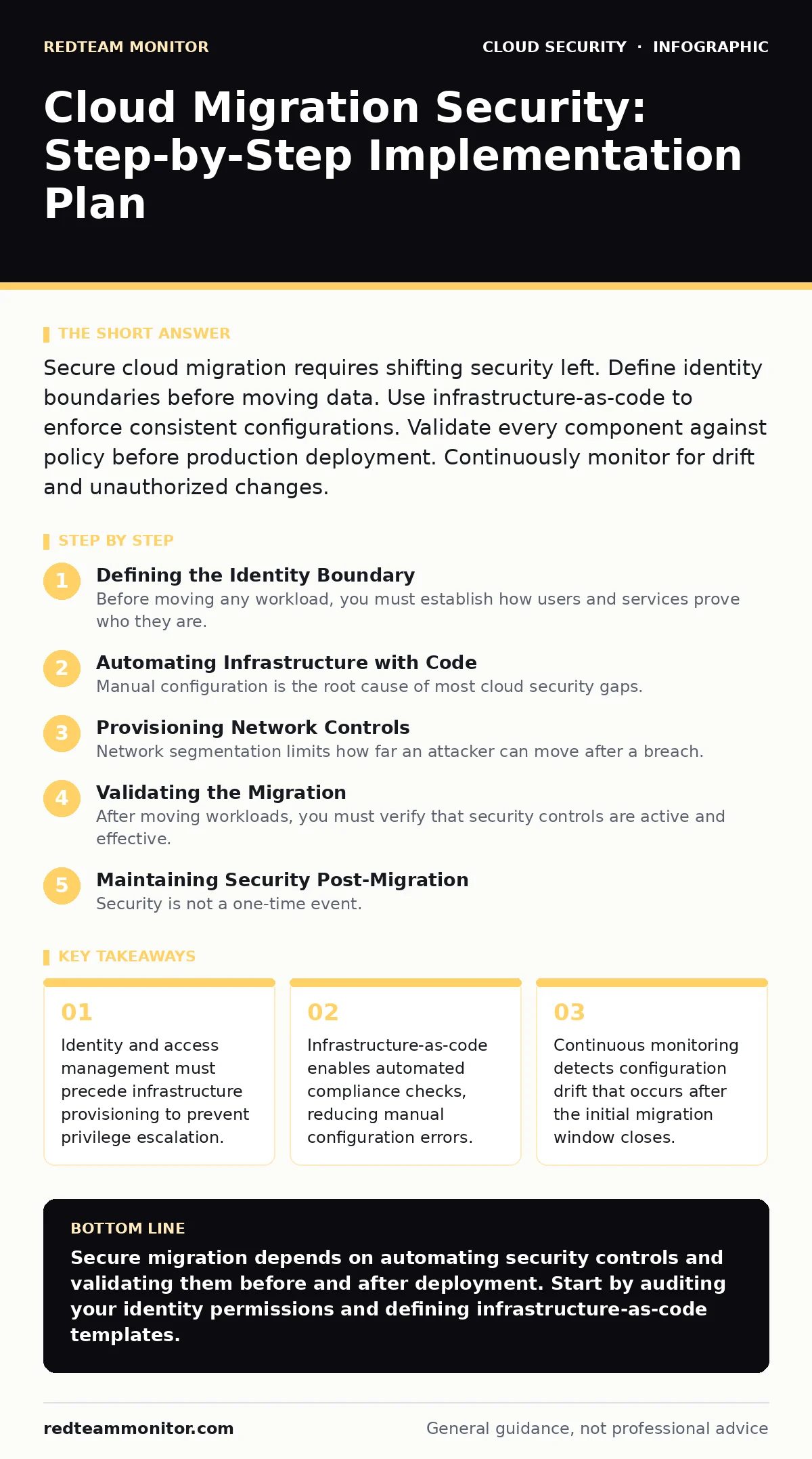
Secure cloud migration requires shifting security left. Define identity boundaries before moving data. Use infrastructure-as-code to enforce consistent configurations. Validate every component against policy before production deployment. Continuously monitor for drift and unauthorized changes.
Defining the Identity Boundary
Before moving any workload, you must establish how users and services prove who they are. Identity is the new perimeter. In a cloud environment, traditional network borders dissolve, making access controls the primary defense mechanism. You need a centralized directory that manages user accounts and permissions. This system should enforce single sign-on so that credentials are managed in one place rather than scattered across multiple platforms.
Suppose you migrate an application without updating its authentication method. The old system might accept local user accounts that no longer exist in your central directory. These orphaned accounts become backdoors. You must audit every service principal and user account. Remove any account that does not have a current business justification. Define least-privilege roles for each function. This ensures that even if an account is compromised, the attacker has limited access.
Automating Infrastructure with Code
Manual configuration is the root cause of most cloud security gaps. Humans make mistakes when repeating tasks. Infrastructure-as-code allows you to define your cloud resources in text files. You store these files in version control. This creates an audit trail of every change. When you deploy infrastructure, you run a script that builds the environment exactly as defined.
You must treat infrastructure code like application code. Run static analysis tools against these files before deployment. These tools check for known vulnerabilities and misconfigurations. For example, they can detect if a storage bucket is publicly accessible. If the code fails the check, the deployment stops. This prevents insecure configurations from ever reaching production. You should also use secrets managers to handle sensitive data like passwords and API keys. Never hardcode these values into your infrastructure definitions.
Provisioning Network Controls
Network segmentation limits how far an attacker can move after a breach. You must define rules that control traffic between different parts of your cloud environment. Cloud security groups act as virtual firewalls for individual instances. They filter inbound and outbound traffic based on specific criteria.
Start by denying all traffic by default. Then, add explicit rules to allow only the traffic necessary for the application to function. For instance, a web server should accept traffic only on standard web ports. It should not accept direct connections from the public internet to its database port. Test these rules immediately after creation. Use a tool that scans your network configuration for overly permissive rules. A rule that allows all inbound traffic from any source is a common mistake.
Step 1: Audit Existing Permissions
Review all existing user and service accounts. Identify any accounts with administrative privileges that do not need them. Revoke excessive permissions. Document the required permissions for each role.
Verification: Attempt to perform an administrative action with a standard user account. The action should fail. If it succeeds, your permissions are too broad.
Step 2: Deploy Infrastructure-as-Code Templates
Create templates for all cloud resources. Include security configurations within these templates. Define encryption settings, network rules, and logging requirements.
Verification: Run the template through a policy-as-code tool. The tool should report zero violations. If it reports violations, fix the template before proceeding.
Step 3: Implement Least-Privilege Access
Assign roles to users and services based on the principle of least privilege. Each role should have only the permissions necessary to perform its specific tasks.
Verification: Review the permission assignments. Ensure no user has access to resources outside their domain. Check that service accounts cannot access human user data.
Step 4: Enable Comprehensive Logging
Configure logging for all cloud resources. Ensure logs capture authentication events, configuration changes, and network traffic. Send logs to a secure, immutable storage location.
Verification: Simulate a login failure. Check the logs to confirm the event was recorded. Verify that the log entry includes the source IP address and timestamp.
Validating the Migration
After moving workloads, you must verify that security controls are active and effective. Do not assume that the cloud provider’s default settings are secure. You must validate each control against your security policy.
Check for exposed Kubernetes dashboards if you are using container orchestration. These dashboards often provide administrative access to the cluster. If left open, attackers can take full control. Scan your environment for publicly accessible administrative interfaces. Close any ports that are not explicitly required for business operations.
Suppose you migrate a database to the cloud. You must verify that encryption is enabled at rest and in transit. Check the configuration of the database instance. Ensure that SSL/TLS is required for all connections. Test the connection from an unauthorized source. The connection should be rejected.
Maintaining Security Post-Migration
Security is not a one-time event. It requires continuous monitoring and adjustment. Configuration drift occurs when manual changes diverge from the defined infrastructure code. This drift can introduce vulnerabilities over time.
Use automated tools to detect drift. These tools compare the current state of your cloud environment against the desired state defined in your code. If a difference is found, alert your team. You can also configure automated remediation to revert unauthorized changes. This keeps your environment consistent with your security policy.
Monitor for anomalous behavior. Look for unusual login times, locations, or access patterns. Investigate any alerts immediately. Update your security controls as your environment evolves. New services and applications may require new permissions. Review and adjust permissions regularly.
Related considerations include preventing cloud account hijacking by enforcing multi-factor authentication on all administrative accounts. You should also consider data residency requirements to ensure data remains in specific geographic regions. For deeper technical implementation, see our guide on Kubernetes misconfigurations.
See also: Implement Single Sign-On: A Step-by-Step Rollout Plan · Stop Denial-of-Wallet Attacks: Response and Recovery Steps
Checklist for Verification
- All user accounts are tied to a central identity provider.
- Administrative accounts require multi-factor authentication.
- Infrastructure-as-code templates pass static analysis checks.
- Security groups deny all traffic by default.
- Logging is enabled for all critical resources.
- Encryption is enabled for data at rest and in transit.
- Public access to administrative interfaces is blocked.
- Drift detection is active and alerts are configured.
Key takeaways
- Identity and access management must precede infrastructure provisioning to prevent privilege escalation.
- Infrastructure-as-code enables automated compliance checks, reducing manual configuration errors.
- Continuous monitoring detects configuration drift that occurs after the initial migration window closes.
Secure migration depends on automating security controls and validating them before and after deployment. Start by auditing your identity permissions and defining infrastructure-as-code templates.
Frequently asked questions
How do I prevent configuration drift in the cloud?
Use infrastructure-as-code to define your desired state. Run automated tools that compare the actual environment against this code. Alert or auto-remediate any differences found.
Is encryption alone enough for cloud security?
No. Encryption protects data if it is stolen. It does not prevent unauthorized access or misconfigurations. You must also implement strict access controls and network segmentation.
What is the first step in securing a cloud migration?
Audit and clean up your identity and access management. Ensure that only necessary users and services have access. Define least-privilege roles before provisioning infrastructure.
How often should I review cloud security configurations?
Continuously. Use automated tools to monitor for changes and drift. Conduct manual reviews of permissions and policies at regular intervals, such as quarterly or after major changes.
How this guide was produced: written by the RedTeam Monitor editorial team with AI assistance, checked against the public references listed below, and reviewed when the facts change. See our editorial policy or report an error.