
Cloud Vulnerability Management: 8 Answers for Secure Infrastructure
Cloud vulnerabilities shift from static code flaws to dynamic configuration errors, requiring continuous monitoring rather than periodic scanning to maintain security posture.
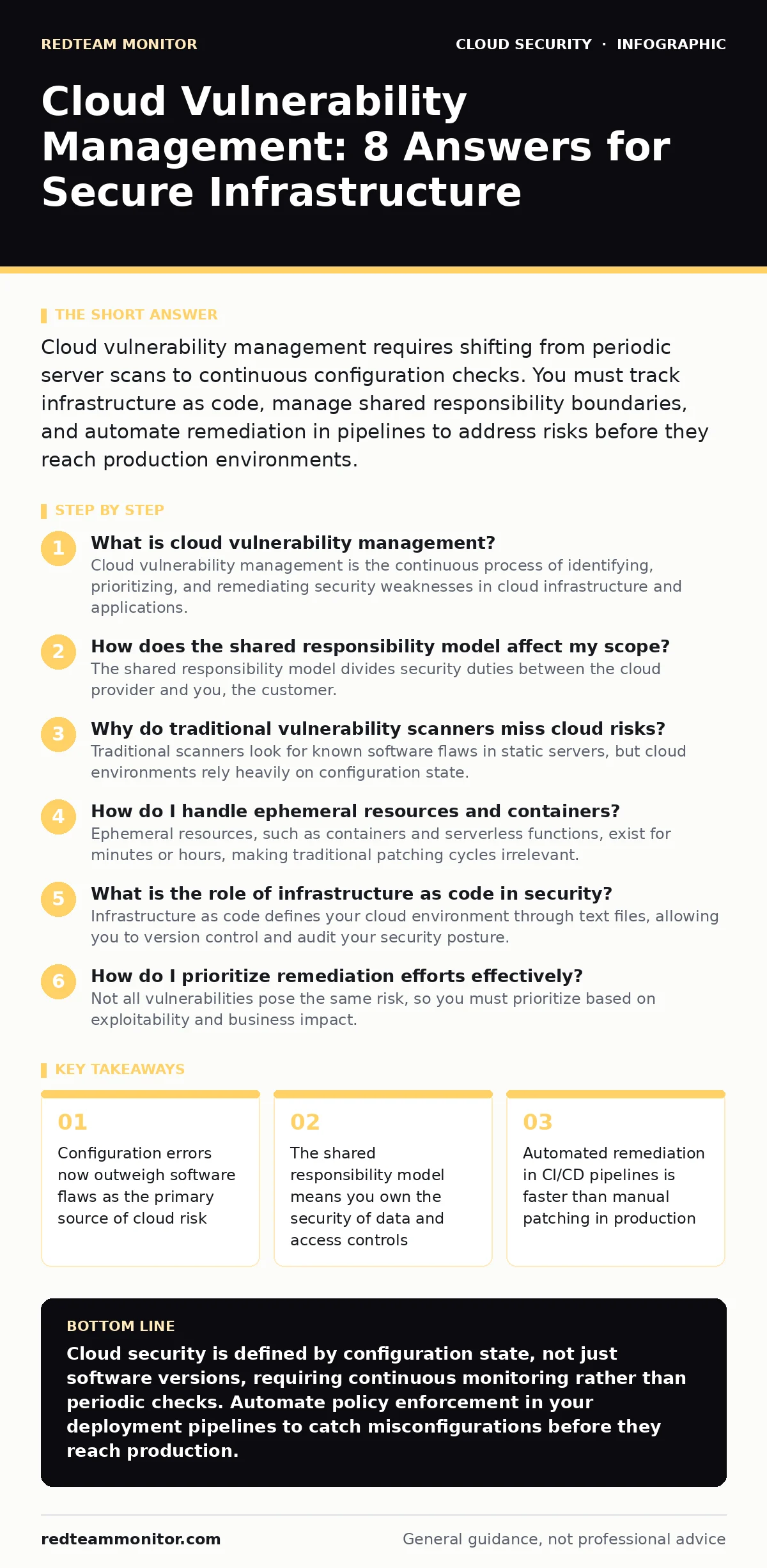
Cloud vulnerability management requires shifting from periodic server scans to continuous configuration checks. You must track infrastructure as code, manage shared responsibility boundaries, and automate remediation in pipelines to address risks before they reach production environments.
What is cloud vulnerability management?
Cloud vulnerability management is the continuous process of identifying, prioritizing, and remediating security weaknesses in cloud infrastructure and applications. Unlike traditional on-premise scanning, this process must account for ephemeral resources and dynamic configurations that change constantly. You are not just checking for outdated software versions; you are verifying that access controls and network rules remain secure as infrastructure scales.
How does the shared responsibility model affect my scope?
The shared responsibility model divides security duties between the cloud provider and you, the customer. The provider secures the underlying hardware, network, and host operating systems, while you secure your data, identity management, and application configurations. Misunderstanding this boundary leads to false confidence; assuming the provider protects your database access is a critical error. You must secure the guest operating system, the data within it, and the network traffic flowing through your virtual private cloud.
Why do traditional vulnerability scanners miss cloud risks?
Traditional scanners look for known software flaws in static servers, but cloud environments rely heavily on configuration state. A server might have no software vulnerabilities yet still be exposed because a storage bucket is publicly accessible or an identity policy is too permissive. These configuration errors are transient and often created by automated deployment scripts. Scanning only the operating system ignores the larger attack surface presented by misconfigured services and open ports.
How do I handle ephemeral resources and containers?
Ephemeral resources, such as containers and serverless functions, exist for minutes or hours, making traditional patching cycles irrelevant. You cannot patch a container that is already destroyed; you must secure the image before it is deployed. This requires shifting security left by scanning images in the build pipeline and blocking vulnerable images from being pushed to the registry. You must also verify that runtime environments do not grant excessive privileges to short-lived processes. See our guide on Kubernetes misconfigurations for details on managing cluster-level security policies.
| Resource Type | Lifecycle | Primary Vulnerability Source | Remediation Strategy |
|---|---|---|---|
| Virtual Machines | Long-lived | Outdated OS packages | Scheduled patching and reboot |
| Containers | Short-lived | Vulnerable base images | Image scanning in CI/CD |
| Serverless | Event-driven | Excessive function permissions | Least privilege IAM policies |
| Storage Buckets | Persistent | Public access settings | Automated policy enforcement |
What is the role of infrastructure as code in security?
Infrastructure as code defines your cloud environment through text files, allowing you to version control and audit your security posture. When you define security rules in code, you can detect misconfigurations before they are deployed to the cloud. This shifts vulnerability management from reactive detection to proactive prevention. You can run static analysis tools against your code repositories to ensure that no storage accounts are created with public read access. This approach reduces the noise of false positives generated by runtime scanning.
See also: Implement Single Sign-On: A Step-by-Step Rollout Plan · Stop Denial-of-Wallet Attacks: Response and Recovery Steps
How do I prioritize remediation efforts effectively?
Not all vulnerabilities pose the same risk, so you must prioritize based on exploitability and business impact. A critical flaw in an internet-facing web server requires immediate attention, while a low-severity issue in an internal database may be deferred. Context matters; you must consider whether the vulnerable component is accessible from the internet and what data it protects. Integrating threat intelligence helps you identify which vulnerabilities are actively being exploited in the wild. This prevents you from wasting resources fixing theoretical risks while ignoring active threats.
How do I manage secrets and credentials securely?
Hardcoding credentials in application code or configuration files is a major source of compromise. You must use dedicated secrets managers to store and retrieve sensitive data like API keys and database passwords. These tools encrypt secrets at rest and provide audit logs for every access attempt. Rotating credentials automatically reduces the window of opportunity for attackers who steal a static password. Integrating secrets management into your deployment pipeline ensures that applications never interact with raw credentials. Refer to our guide on secrets managers for implementation best practices.
What is the impact of identity and access misconfigurations?
Identity is the new perimeter in cloud environments, making access control misconfigurations a top risk. Overly broad permissions allow users or services to access resources they do not need, increasing the blast radius of a compromise. You must enforce the principle of least privilege, granting only the permissions necessary for a task. Regularly auditing access policies helps identify stale permissions for employees who have left or services that are no longer used. This reduces the attack surface and limits lateral movement by attackers. See our guide on cloud account hijacking for strategies to detect and prevent unauthorized access.
How do I ensure compliance with data residency requirements?
Data residency laws require that specific types of data remain within certain geographic boundaries. Cloud providers offer regions and availability zones that map to these legal jurisdictions, but misconfiguration can cause data to replicate across borders unintentionally. You must define and enforce policies that restrict data storage and processing to approved regions. Automated tools can scan your environment to ensure that no storage buckets or databases are provisioned in unauthorized locations. This prevents legal violations and potential fines resulting from accidental data exposure. Check our guide on data residency for a deeper look at regional compliance nuances.
How do I integrate vulnerability management into DevOps?
Integrating security into the development pipeline, often called DevSecOps, ensures that vulnerabilities are caught early. You should run automated scans during the build and deployment phases, failing the build if critical issues are detected. This prevents vulnerable code from ever reaching the production environment. Continuous monitoring in production detects drift from the secure baseline, alerting you when configurations change unexpectedly. This creates a feedback loop where security improvements are continuously tested and validated. See our guide on cloud migration security for strategies to secure existing workloads during transition.
Key takeaways
- Configuration errors now outweigh software flaws as the primary source of cloud risk
- The shared responsibility model means you own the security of data and access controls
- Automated remediation in CI/CD pipelines is faster than manual patching in production
Cloud security is defined by configuration state, not just software versions, requiring continuous monitoring rather than periodic checks. Automate policy enforcement in your deployment pipelines to catch misconfigurations before they reach production.
Frequently asked questions
Do I need a separate tool for cloud vulnerability management?
You do not need a separate tool if your existing platform supports cloud-native asset discovery and configuration auditing, but specialized tools often provide deeper context for cloud-specific risks.
How often should I scan cloud environments?
You should scan continuously or at least every time infrastructure changes, as cloud resources are dynamic and can be misconfigured at any moment by automated processes.
Can I automate remediation for all vulnerabilities?
You can automate remediation for configuration errors and patching, but complex application vulnerabilities often require manual code review and testing to ensure business functionality is not broken.
What is the biggest risk in serverless architectures?
The biggest risk is excessive permissions granted to function execution roles, which can allow an attacker to pivot to other cloud resources if a function is compromised.
How this guide was produced: written by the RedTeam Monitor editorial team with AI assistance, checked against the public references listed below, and reviewed when the facts change. See our editorial policy or report an error.