
How Data Residency Works: Mapping Storage and Compliance
Data residency rules apply only to storage, not transit, meaning your data can legally cross borders if it never settles in unauthorized regions.
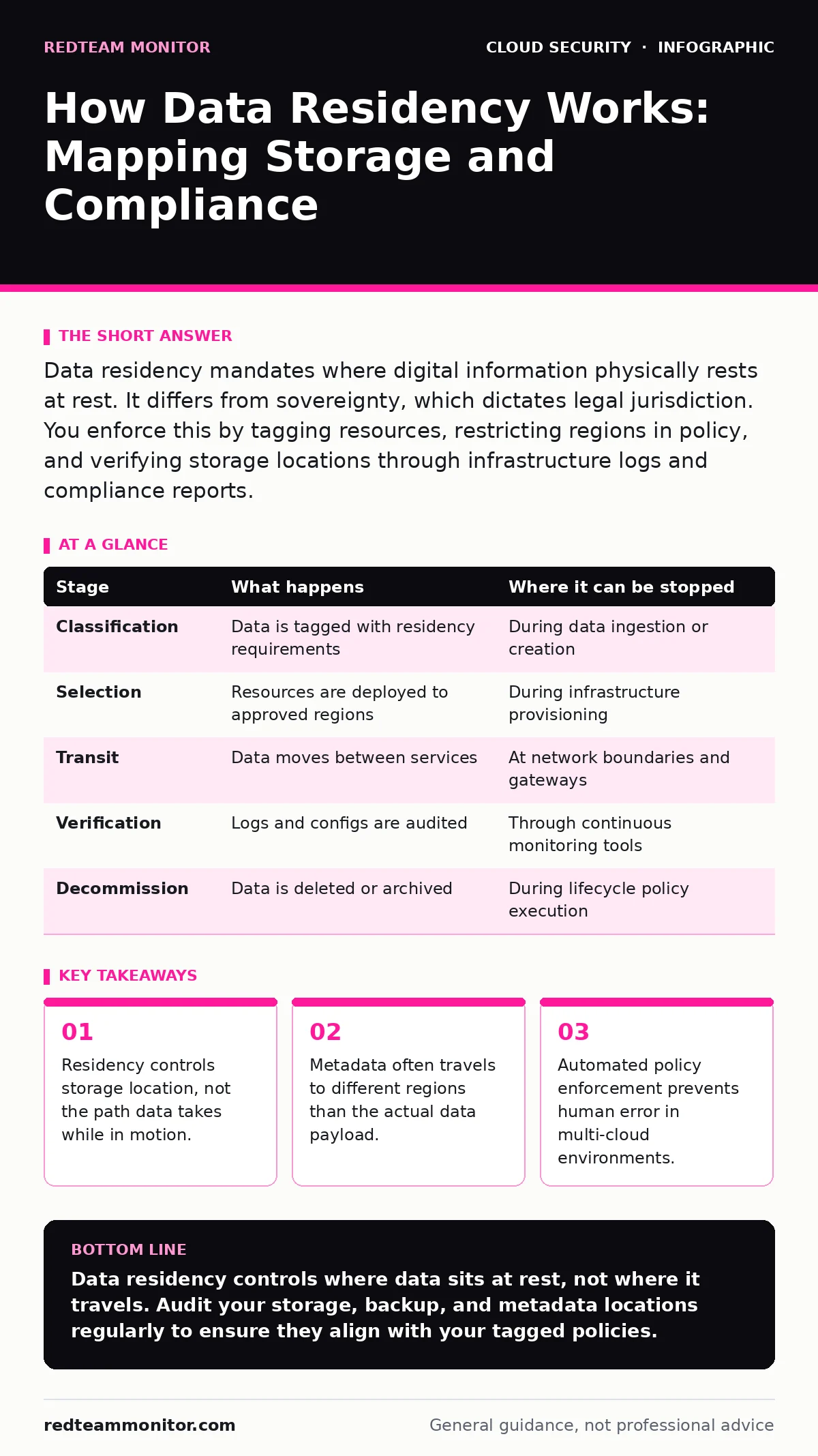
Data residency mandates where digital information physically rests at rest. It differs from sovereignty, which dictates legal jurisdiction. You enforce this by tagging resources, restricting regions in policy, and verifying storage locations through infrastructure logs and compliance reports.
Defining the Physical Boundary
Data residency requires that specific information remains within defined geographic borders while at rest. This is distinct from data sovereignty, which involves the legal authority a nation exercises over data. Residency is a technical constraint; sovereignty is a legal one. You must understand the difference because compliance teams often conflate them. A file stored in Frankfurt satisfies a German residency requirement regardless of German law.
You enforce residency by mapping data to physical locations. This mapping relies on the cloud provider’s infrastructure documentation. Providers publish the physical locations of their data centers. You select these locations during resource creation. Once selected, the data stays there unless you move it.
Stage 1: Classification and Tagging
You cannot protect what you cannot identify. The first step is labeling data based on sensitivity and regulatory requirements. This involves tagging resources with metadata that indicates their residency needs. For example, a database containing customer health records receives a tag requiring storage in a specific country.
Without precise tagging, enforcement is impossible. Automated systems read these tags to apply policies. If a tag is missing or incorrect, the data may land in the wrong region. This creates immediate non-compliance. You must establish a strict tagging convention early in your workflow.
Consider the complexity of unstructured data. Documents uploaded by users rarely come with metadata. You must scan content to determine its classification. This scanning process itself generates logs and metadata. Those logs must also be tagged. If you ignore the logs, you create a compliance gap.
Stage 2: Region Selection and Isolation
After tagging, you define where resources can exist. This involves configuring allowed regions in your cloud account settings. You block all other regions to prevent accidental deployment. This is often called region whitelisting. It ensures that no new resource can be created outside the approved list.
You must also consider service-specific limitations. Some global services store data in a central location regardless of your region selection. For instance, certain DNS or caching services may distribute data globally for performance. You must identify these exceptions. They often violate strict residency requirements.
Imagine you deploy a containerized application. The application code is stored in a registry. The runtime data goes to a database. The logs go to a monitoring service. Each of these components can reside in different regions. You must enforce residency for each component independently.
Stage 3: In-Transit Management
Data moves between endpoints, services, and backups. Residency rules typically do not restrict transit. Data can cross oceans during transmission. However, it cannot be cached or stored in unauthorized regions. You must ensure that intermediaries do not write data to disk in prohibited zones.
Encryption protects data in transit, but it does not hide its location. Encrypted data still has a physical location. You must verify that encryption keys are stored in compliant regions. If keys are stored elsewhere, you may violate residency laws even if the data is encrypted. This is a common oversight.
You should use private connections for sensitive data. Private networks reduce the exposure surface. They do not guarantee residency, but they limit the number of nodes handling the data. Fewer nodes mean fewer opportunities for accidental storage.
Stage 4: Verification and Monitoring
Assumptions lead to breaches. You must continuously verify that data remains in the correct location. This requires logging and auditing. You check storage locations against your policy. Any deviation triggers an alert. You must investigate every alert. False positives are common, but false negatives are catastrophic.
You should automate this verification. Manual checks are insufficient for large environments. Use infrastructure-as-code tools to validate configurations. These tools compare your actual state with your desired state. They highlight discrepancies immediately.
See also: Service Mesh Security Misconceptions That Weaken Your Defense · Implement Single Sign-On: A Step-by-Step Rollout Plan
Stage 5: Decommissioning and Archival
Data lifecycle management includes deletion. When data expires, you must ensure it is removed from all compliant and non-compliant locations. This includes cached copies, backups, and snapshots. Residency requirements often dictate retention periods. You must align your deletion policies with these periods.
Archival storage often moves data to cheaper, colder storage tiers. These tiers may be located in different regions. You must verify that archival locations also meet residency requirements. If not, you must keep data in the primary region, accepting higher costs. This is a common trade-off.
Mapping the Workflow
The table below summarizes the stages and control points. Use this to audit your current setup.
| Stage | What happens | Where it can be stopped |
|---|---|---|
| Classification | Data is tagged with residency requirements | During data ingestion or creation |
| Selection | Resources are deployed to approved regions | During infrastructure provisioning |
| Transit | Data moves between services | At network boundaries and gateways |
| Verification | Logs and configs are audited | Through continuous monitoring tools |
| Decommission | Data is deleted or archived | During lifecycle policy execution |
Integration with Access Controls
Residency is not just about storage. It is about who can access that storage. If an unauthorized user in a different region can access the data, you may face legal risks. You must combine residency controls with access management. This includes single sign-on for centralized identity management. It also includes zero trust network access to verify every request.
You should also review cloud security groups to ensure traffic flows only to compliant regions. Misconfigured groups can allow data to leak to unauthorized networks. Regular audits of cloud account hijacking risks are necessary to prevent attackers from moving data.
Hidden Costs and Trade-offs
Enforcing strict residency has hidden costs. Latency increases if you cannot use the nearest data center. Performance suffers. Compliance overhead rises. You spend more time auditing than building. You must balance these costs against regulatory requirements.
Not all data needs strict residency. Public data can go anywhere. Classify carefully. Over-classification leads to unnecessary complexity. Under-classification leads to fines. Find the middle ground.
Common Pitfalls
Third-party services often bypass your controls. If you use a global analytics service, your data may leave your designated region. You must vet every integration. Check their privacy policies and infrastructure maps. Demand guarantees.
Metadata is often overlooked. File names, timestamps, and access logs contain information. This metadata may be stored separately. Ensure it complies with residency rules. If not, you have a partial compliance failure.
Key takeaways
- Residency controls storage location, not the path data takes while in motion.
- Metadata often travels to different regions than the actual data payload.
- Automated policy enforcement prevents human error in multi-cloud environments.
Data residency controls where data sits at rest, not where it travels. Audit your storage, backup, and metadata locations regularly to ensure they align with your tagged policies.
Frequently asked questions
Does encryption satisfy data residency requirements?
No, encryption protects confidentiality but does not change the physical location of the data or its legal jurisdiction.
Can I use global load balancers with strict residency rules?
Yes, as long as the load balancer does not cache or store data in non-compliant regions and only directs traffic to compliant backends.
How do I handle data replication for disaster recovery?
You must ensure that the disaster recovery site is in a compliant region or that the replication is encrypted and meets specific legal exemptions.
What if a cloud provider moves my data without notice?
Review your service level agreement and shared responsibility model; providers usually notify you, but you must verify storage locations regularly.
How this guide was produced: written by the RedTeam Monitor editorial team with AI assistance, checked against the public references listed below, and reviewed when the facts change. See our editorial policy or report an error.