
Data Residency Rules: Why Location Alone Fails Compliance
Data residency controls physical storage sites, but it does not restrict who can access the data or where it moves during processing.
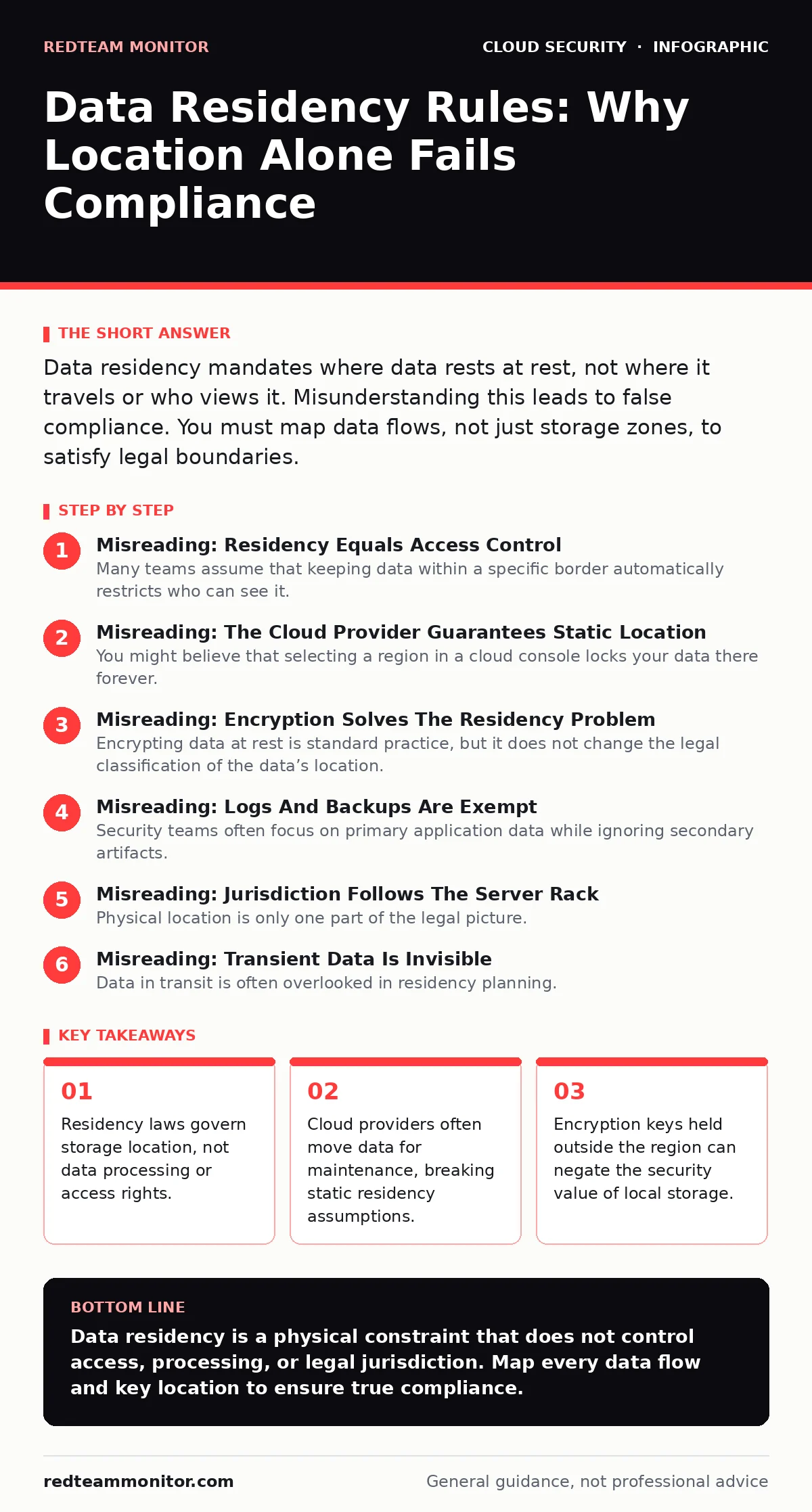
Data residency mandates where data rests at rest, not where it travels or who views it. Misunderstanding this leads to false compliance. You must map data flows, not just storage zones, to satisfy legal boundaries.
Misreading: Residency Equals Access Control
Many teams assume that keeping data within a specific border automatically restricts who can see it. This is a fundamental error in security logic. Data residency is a geographical constraint on storage, not an identity and access management policy. A user in a different country can access data stored locally if their credentials permit it.
Imagine a scenario where your database sits in Frankfurt, but your support team logs in from New York. The data remains in Germany, satisfying residency rules, but the access event originates abroad. This creates a compliance conflict if local laws restrict cross-border data processing. You must separate storage location from access policies.
Correct reading: Treat residency as a physical constraint and access control as a logical constraint. Use zero trust network access to verify every user, regardless of where the data lives. Do not rely on geography to block unauthorized eyes.
Misreading: The Cloud Provider Guarantees Static Location
You might believe that selecting a region in a cloud console locks your data there forever. Cloud providers operate on shared infrastructure that requires constant maintenance, patching, and balancing. Your data may move between availability zones within the same region for performance or repair.
Some providers also replicate data across regions for disaster recovery without explicit user configuration. If your backup region crosses a border, you have violated residency requirements even if your primary data center is compliant. The default behavior of many services is global redundancy, not local isolation.
Correct reading: Assume data mobility is the default state. Explicitly disable cross-region replication for sensitive datasets. Verify the provider’s disaster recovery architecture to ensure backups stay within the required jurisdiction.
Misreading: Encryption Solves The Residency Problem
Encrypting data at rest is standard practice, but it does not change the legal classification of the data’s location. If you encrypt files and store them in a non-compliant region, you are still storing data there. The presence of ciphertext does not exempt you from residency laws.
The real issue lies with the encryption keys. If the keys are managed by the cloud provider in a different region, the provider can technically decrypt the data. This creates a legal ambiguity about where the "readable" data exists. Some jurisdictions view the key location as the effective data location.
Correct reading: Use secrets managers to keep keys within the same jurisdiction as the data. This ensures that even if the ciphertext moves, the ability to read it remains under local control. Encryption protects confidentiality, not residency compliance.
Misreading: Logs And Backups Are Exempt
Security teams often focus on primary application data while ignoring secondary artifacts. Logs, audit trails, and crash dumps contain sensitive information that falls under the same residency rules as your main database. These files are often shipped to central logging servers for analysis.
If you ship logs from a European server to a central US analytics platform, you have transferred personal data across borders. This happens automatically in many cloud setups. The convenience of centralized monitoring often overrides the strictness of data locality requirements.
Correct reading: Map every data stream, including logs and metrics. Filter or anonymize data before it leaves the region. Consider regional logging endpoints that aggregate locally before any cross-border transfer occurs.
Misreading: Jurisdiction Follows The Server Rack
Physical location is only one part of the legal picture. Data residency laws often tie compliance to the legal jurisdiction of the service provider, not just the physical hardware. If a US-based company hosts your data in Ireland, US laws may still apply to that data under certain circumstances.
This creates a hidden risk. You may satisfy the physical requirement of storing data in the EU, but fail the legal requirement of keeping it outside US jurisdiction. The provider’s headquarters and legal domicile matter as much as the data center’s zip code.
Correct reading: Review the provider’s legal terms and data processing agreements. Identify which laws govern the provider’s access to your data. Physical residency is necessary but not sufficient for full legal compliance.
See also: Service Mesh Security Misconceptions That Weaken Your Defense · Implement Single Sign-On: A Step-by-Step Rollout Plan
Misreading: Transient Data Is Invisible
Data in transit is often overlooked in residency planning. When a user uploads a file, it travels through multiple network hops before reaching the storage destination. If these hops cross borders, the data has technically left the required region.
Caching layers and content delivery networks also store temporary copies of data. These edge nodes may be distributed globally to improve performance. Even if the final storage is local, the transient copies on edge servers may violate strict residency policies.
Correct reading: Disable global caching for sensitive content. Use private endpoints to keep data within the provider’s internal network. Ensure that your network architecture prevents unintended cross-border routing.
How To Check Your Understanding
To verify your stance, map a single piece of sensitive data from creation to deletion. Trace every hop, every copy, and every key rotation. Identify where the data lives, where the keys live, and who can access it. If any step crosses a border without explicit legal allowance, you have a gap.
This exercise reveals hidden flows that automated tools miss. It forces you to confront the difference between where you think data is and where it actually goes. Regular re-mapping is necessary as cloud services evolve and add new features.
Key takeaways
- Residency laws govern storage location, not data processing or access rights.
- Cloud providers often move data for maintenance, breaking static residency assumptions.
- Encryption keys held outside the region can negate the security value of local storage.
- Backups and logs often escape the primary data center, creating hidden compliance gaps.
Data residency is a physical constraint that does not control access, processing, or legal jurisdiction. Map every data flow and key location to ensure true compliance.
Frequently asked questions
Does data residency affect performance?
Yes, storing data far from users increases latency. You must balance compliance requirements with application speed by choosing regions close to your user base.
Can I use a hybrid cloud for residency?
Yes, but you must ensure the private cloud components also meet the same residency and security standards. Consistency across the entire stack is required.
How do I handle global teams accessing local data?
Use **zero trust network access** to verify identity regardless of location. Implement strict access policies that do not rely on geographic IP filtering alone.
What if the cloud provider moves my data without notice?
This is a breach of contract. Ensure your service level agreements explicitly forbid unauthorized cross-border data movement. Monitor for unexpected region changes.
How this guide was produced: written by the RedTeam Monitor editorial team with AI assistance, checked against the public references listed below, and reviewed when the facts change. See our editorial policy or report an error.