
IOC Enrichment: Why Context Beats Raw Data in Threat Hunting
Raw indicators lack context, so enrichment adds historical and structural data that turns noise into actionable intelligence for security teams.
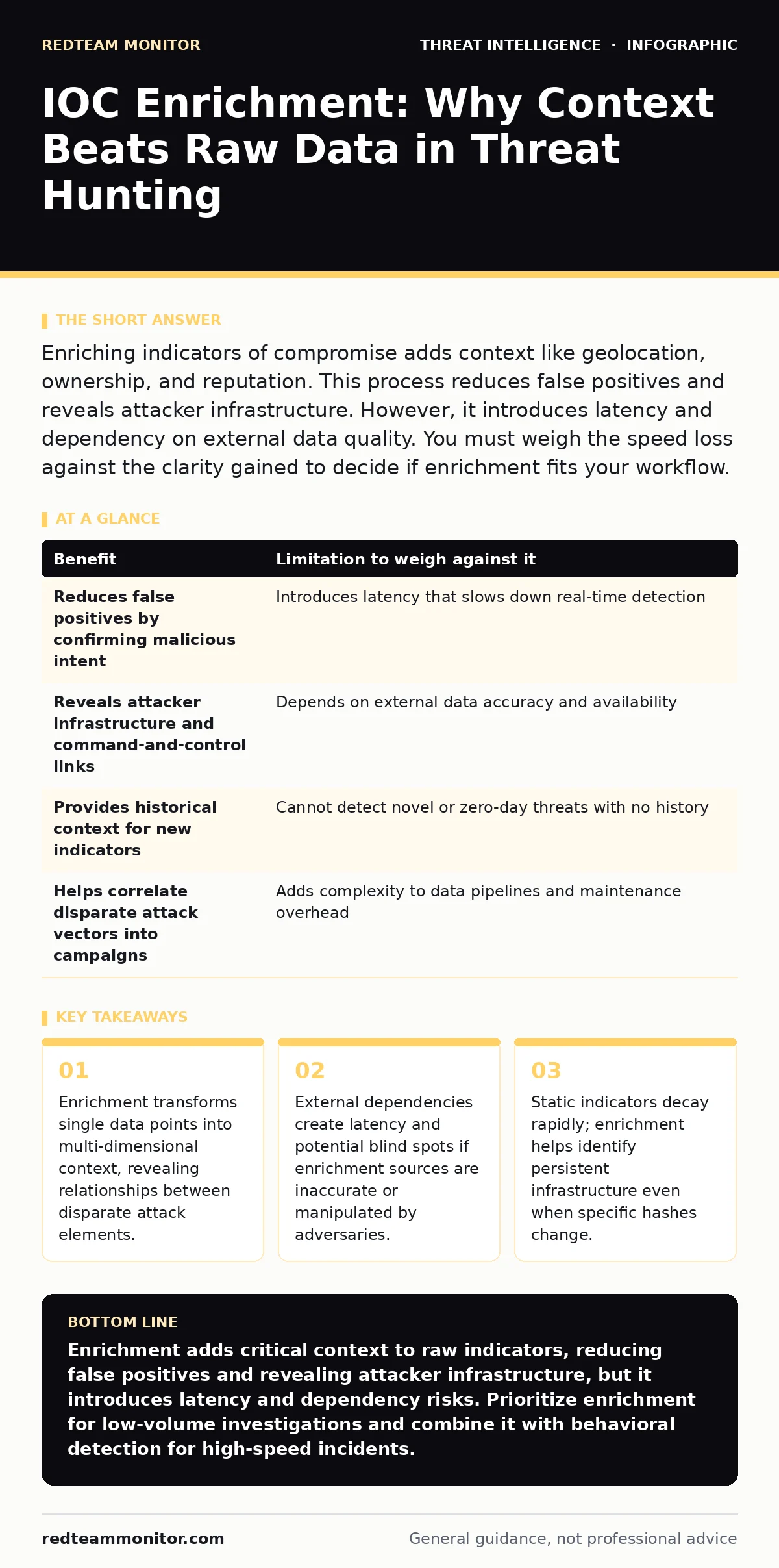
Enriching indicators of compromise adds context like geolocation, ownership, and reputation. This process reduces false positives and reveals attacker infrastructure. However, it introduces latency and dependency on external data quality. You must weigh the speed loss against the clarity gained to decide if enrichment fits your workflow.
What Indicator Enrichment Actually Solves
Indicator enrichment adds contextual metadata to raw identifiers like hashes, domains, or IP addresses. A raw hash tells you nothing about its origin, age, or associated behavior. Enrichment connects that hash to file names, first-seen dates, and related network traffic. This process turns isolated data points into a narrative. Security teams use this context to distinguish between benign software updates and malicious payloads.
The value lies in reducing the cognitive load required to triage alerts. You stop guessing whether an alert is noise or signal. The mechanism relies on cross-referencing local data with external threat intelligence feeds. This cross-referencing reveals patterns that single sources miss. It allows you to see the broader infrastructure behind a specific attack vector.
The Hidden Costs of Adding Context
Enrichment is not free. The primary cost is latency. Every external query adds milliseconds to your detection pipeline. When processing thousands of events per second, these delays accumulate. High latency can cause alert fatigue or missed real-time blocks. Another cost is dependency. You rely on the accuracy and availability of third-party data providers. If an enrichment source goes offline, your pipeline breaks.
If a source provides incorrect data, your team wastes time investigating false positives. Adversaries actively manipulate public data to poison these sources. They register domains that look legitimate or upload benign files to public repositories. This manipulation creates blind spots that enrichment cannot fix. You must validate external data against internal observability.
Weighing Benefits Against Limitations
| Benefit | Limitation to weigh against it |
|---|---|
| Reduces false positives by confirming malicious intent | Introduces latency that slows down real-time detection |
| Reveals attacker infrastructure and command-and-control links | Depends on external data accuracy and availability |
| Provides historical context for new indicators | Cannot detect novel or zero-day threats with no history |
| Helps correlate disparate attack vectors into campaigns | Adds complexity to data pipelines and maintenance overhead |
When Enrichment Is Worth the Effort
Enrichment delivers high value when investigating low-and-slow attacks. These attacks generate few alerts per day, allowing time for deep analysis. Investigating initial access brokers often requires understanding the full scope of compromised credentials. Enrichment reveals whether those credentials appear in other breaches or dark web listings. It helps you prioritize remediation efforts based on risk severity. Suppose you find a suspicious domain in DNS logs.
Enrichment shows the domain's registration date, nameserver history, and associated autonomous system numbers (ASNs) in threat intelligence. This context confirms if the domain is part of a known malicious campaign. You gain confidence in your blocklist decisions. Enrichment is also valuable for forensic investigations where timeline reconstruction is critical. It fills gaps in local logging by providing external timestamps and attribution data.
When Enrichment Hurts Your Response
Enrichment fails during high-volume, fast-moving incidents. Ransomware attacks or large-scale scanning campaigns generate millions of events. Querying external APIs for every IP address creates a bottleneck. Your detection engine slows down, missing critical signals. In these scenarios, speed matters more than depth. Use simple blocklists and rate limiting instead of deep enrichment. Another failure point is when dealing with highly targeted, novel attacks.
If an adversary uses fresh infrastructure, external databases have no history. Enrichment returns empty or generic results. You waste time waiting for data that does not exist. Focus on behavioral anomalies instead. Look for unusual process executions or rare network connections. Behavioral detection does not rely on prior knowledge of the threat. It detects actions that violate normal system baselines.
See also: Signature Based vs Anomaly Detection: How They Differ in Practice · How Attacker Persistence Works: The Step-by-Step Mechanics
Managing Data Quality and Decay
Indicators of compromise decay rapidly. A malicious IP address may be reassigned to a benign user within days. A file hash might match a legitimate software update after a vendor patch. Enrichment data must be fresh. Stale data leads to blocking legitimate traffic or missing active threats. Implement strict retention policies for your enrichment cache. Expire old data regularly to prevent false positives.
Verify the age of indicators before acting on them. Cross-reference multiple sources to confirm malicious intent. If one source flags an IP as malicious, check if others agree. Disagreements indicate uncertainty. Treat uncertain indicators with caution. Do not block them automatically. Investigate them manually if resources allow. This approach balances security with operational stability.
Integrating Enrichment Into Your Workflow
Successful enrichment requires integration into your existing toolchain. Manual lookups are too slow for daily operations. Automate the enrichment process within your security information and event management system. Use APIs to fetch context during alert triage. Display enrichment data directly in the analyst interface. This reduces context switching and speeds up decision-making. However, keep the pipeline simple.
Complex integrations break often. Start with a few high-value indicators like domains and IPs. Expand to hashes and URLs later. Monitor the performance impact of enrichment queries. Adjust timeout settings to prevent pipeline stalls. Train analysts to interpret enrichment data correctly. Teach them to spot manipulated data and conflicting sources. Human judgment remains the final filter.
Beyond Static Indicators
Static indicators like hashes and IPs are easy to change. Modern attackers use domain generation algorithms and fast-flux networks to evade detection. Enrichment helps, but it is not enough. Combine indicator enrichment with behavioral analysis. Look for patterns in attacker persistence techniques. Identify unusual registry modifications or scheduled tasks. These behaviors persist even when indicators change.
Map these behaviors to the MITRE ATT&CK Navigator to understand the attack phase. This mapping provides a strategic view of the threat. It helps you prioritize defenses based on impact rather than just detection. Enrichment supports this view by providing context for the behaviors you observe. It connects the dots between technical actions and strategic intent.
Key takeaways
- Enrichment transforms single data points into multi-dimensional context, revealing relationships between disparate attack elements.
- External dependencies create latency and potential blind spots if enrichment sources are inaccurate or manipulated by adversaries.
- Static indicators decay rapidly; enrichment helps identify persistent infrastructure even when specific hashes change.
Enrichment adds critical context to raw indicators, reducing false positives and revealing attacker infrastructure, but it introduces latency and dependency risks. Prioritize enrichment for low-volume investigations and combine it with behavioral detection for high-speed incidents.
Frequently asked questions
How does IOC enrichment help with false positives?
Enrichment provides historical context and reputation data that distinguishes malicious activity from legitimate software updates or common network traffic.
What happens if an enrichment source is compromised?
Your detection pipeline may receive manipulated data, leading to missed threats or blocked legitimate traffic. Always cross-reference multiple sources.
Is enrichment necessary for every alert?
No. High-volume alerts require speed over depth. Use simple blocklists for mass scanning and reserve enrichment for low-and-slow investigations.
How do I handle indicator decay?
Implement strict retention policies and cache expiration. Regularly update your enrichment data to ensure you are not acting on stale information.
How this guide was produced: written by the RedTeam Monitor editorial team with AI assistance, checked against the public references listed below, and reviewed when the facts change. See our editorial policy or report an error.