
Sigma Rules Meaning: How Detection Logic Works Without Vendor Lock
Sigma rules abstract detection logic from specific log formats, allowing security teams to share threat hunting strategies across any security information and event management platform.
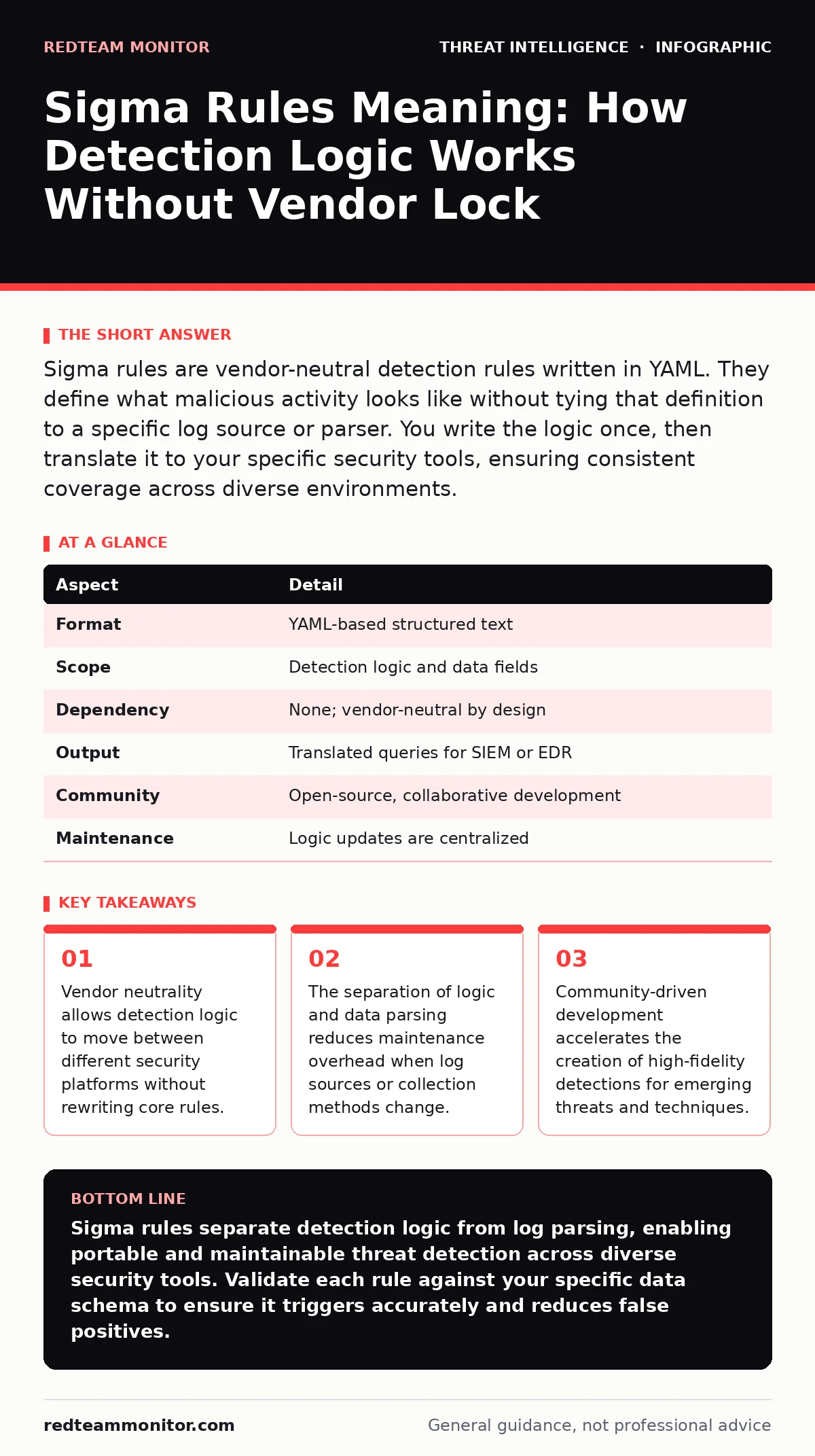
Sigma rules are vendor-neutral detection rules written in YAML. They define what malicious activity looks like without tying that definition to a specific log source or parser. You write the logic once, then translate it to your specific security tools, ensuring consistent coverage across diverse environments.
Sigma Rules Meaning and Core Definition
Sigma rules meaning centers on abstraction. A Sigma rule is a structured definition of a malicious pattern, written in YAML format. It describes the "what" of a threat—the specific log fields, values, and operators that indicate compromise—without specifying the "where" or "how" the log data is retrieved. This separation allows the same detection logic to run on Windows Event Logs, Linux syslog, or cloud audit trails. You define the intent once. The translation layer handles the rest.
This approach solves a persistent problem in security operations. Traditionally, detection engineers wrote queries specific to their tool, such as KQL for Microsoft Sentinel or SPL for Splunk. If an organization switched tools, or if a new log source required monitoring, those queries became obsolete or required manual rewriting. Sigma rules break this dependency. They provide a common language for detection engineering. The rule itself remains static. The backend adapter changes to fit the environment.
| Aspect | Detail |
|---|---|
| Format | YAML-based structured text |
| Scope | Detection logic and data fields |
| Dependency | None; vendor-neutral by design |
| Output | Translated queries for SIEM or EDR |
| Community | Open-source, collaborative development |
| Maintenance | Logic updates are centralized |
How Sigma Rules Work in Practice
The mechanism relies on a two-stage process. First, you write the rule using generic field names. For example, you might reference process_name or event_id. These are abstract concepts, not database columns. Second, a translation engine maps these abstract fields to the actual schema of your log source. If you use a Windows endpoint, the engine knows that process_name maps to the Image field in Event ID 4688. If you use a Linux endpoint, it might map to process.name in Auditd logs.
This translation happens at query time or during rule ingestion. The security tool receives a native query it can execute efficiently. The Sigma rule itself never touches the data directly. This architecture ensures that the detection logic remains pure. It is not cluttered with SQL syntax or proprietary query language quirks. You focus on the threat behavior. The tool handles the data retrieval.
Who Benefits from Sigma Abstraction
Security teams managing heterogeneous environments gain the most value. If your infrastructure includes on-premises servers, cloud instances, and remote endpoints, log formats vary wildly. Maintaining separate detection rules for each platform creates a maintenance nightmare. A change in one rule must be replicated across dozens of others. Sigma rules consolidate this effort. You update the YAML file once. The translation layer propagates the change to all connected systems.
Threat intelligence analysts also benefit. When sharing indicators of compromise or behavioral patterns, they can use Sigma rules as the delivery mechanism. Recipients can ingest the rule regardless of their tooling. This standardization improves the speed of defense. It removes the friction of converting shared intelligence into actionable queries. Organizations that rely on operational threat intelligence find this interoperability particularly valuable for rapid response.
What to Do About Rule Management
Treating Sigma rules as static files leads to decay. Log schemas change. Adversaries adapt. You must treat detection engineering as a continuous cycle. Start by curating a baseline of high-value rules from the community repository. Do not ingest everything. Many community rules are noisy or irrelevant to your environment. Filter for rules that match your critical assets and known threat vectors.
Next, establish a testing pipeline. Before deploying a rule to production, run it against historical data. This step reveals false positives and performance issues. A rule that triggers on every benign user action creates alert fatigue. It buries real threats under noise. Adjust the logic or add exclusions until the signal-to-noise ratio is acceptable. Document every change. If a rule fails to detect a known test, you need to know why.
Common Misconceptions About Sigma
Many teams assume that Sigma rules are ready-to-use detections. They are not. A Sigma rule is a template. It requires context to function correctly. The translation layer must understand your specific log schema. If your logs are missing fields or use non-standard naming, the translation will fail or produce inaccurate results. You must validate that your data collection aligns with the rule's expectations.
Another misconception is that Sigma eliminates the need for detection engineering. It reduces repetitive work, but it does not remove the need for judgment. Deciding which behaviors constitute a threat requires human expertise. Sigma provides the syntax. You provide the strategy. Relying solely on community rules without understanding the underlying logic leaves gaps in your defense. You must review and tune each rule to fit your specific risk profile.
See also: Signature Based vs Anomaly Detection: How They Differ in Practice · How Attacker Persistence Works: The Step-by-Step Mechanics
Integrating Sigma with Broader Defense
Sigma rules fit into a larger detection ecosystem. They complement other data sources and techniques. For instance, you can use Sigma rules to identify suspicious process creation. You then correlate those alerts with indicators of compromise from threat feeds. This enrichment adds context. It helps distinguish between a false positive and a genuine intrusion.
Consider how red teaming exercises validate your Sigma coverage. When internal testers simulate attacks, they generate logs that should trigger your rules. If they do not, you have identified a gap. This feedback loop improves detection quality over time. It ensures that your rules reflect real-world adversary behavior, not just theoretical patterns. Integrating Sigma with honeypots can also provide early warning. If a honeypot triggers a Sigma rule, it indicates active scanning or exploitation attempts.
Maintaining Detection Hygiene
Detection hygiene involves regular review and pruning. Rules that generate no hits for months may be obsolete. They consume resources and clutter the management interface. Archive them or delete them. Conversely, rules that generate constant noise need tuning. Adjust thresholds or add exclusions. The goal is precision. Every alert should demand attention.
Version control is non-negotiable. Store your Sigma rules in a code repository. Track changes, assign owners, and document rationale. This practice enables collaboration and auditability. When a rule fails or causes an outage, you can trace the change history. You can revert to a previous version if necessary. This discipline transforms detection engineering from a chaotic task into a structured engineering practice.
The abstraction provided by Sigma rules meaning is powerful, but it requires discipline. You gain portability and standardization. You lose the excuse of vendor lock-in. The responsibility for accurate detection shifts to your team. You must ensure that the data you collect supports the logic you define.
Key takeaways
- Vendor neutrality allows detection logic to move between different security platforms without rewriting core rules.
- The separation of logic and data parsing reduces maintenance overhead when log sources or collection methods change.
- Community-driven development accelerates the creation of high-fidelity detections for emerging threats and techniques.
Sigma rules separate detection logic from log parsing, enabling portable and maintainable threat detection across diverse security tools. Validate each rule against your specific data schema to ensure it triggers accurately and reduces false positives.
Frequently asked questions
Do Sigma rules replace SIEM queries?
Sigma rules define the logic, but they must be translated into native SIEM queries. They do not run directly; they serve as a blueprint for the actual search commands your platform executes.
Can I write my own Sigma rules?
Yes. The YAML format is open and well-documented. You can create custom rules for internal threats or specific compliance requirements, then share them with your team or the community.
How do Sigma rules handle missing data?
Sigma rules assume specific fields exist. If your log source lacks a field referenced in the rule, the translation may fail or the query may return no results. You must ensure data completeness.
Are Sigma rules effective against nation-state cyber attacks?
They are effective if the attack leaves detectable logs. Sigma rules focus on behavior and artifacts. If an adversary operates silently without generating logs, no rule can detect them. Coverage depends on data visibility.
How this guide was produced: written by the RedTeam Monitor editorial team with AI assistance, checked against the public references listed below, and reviewed when the facts change. See our editorial policy or report an error.