
Operational Threat Intelligence: Turning Data into Security Decisions
Operational threat intelligence bridges the gap between raw data and action by telling you exactly what to block and when to investigate.
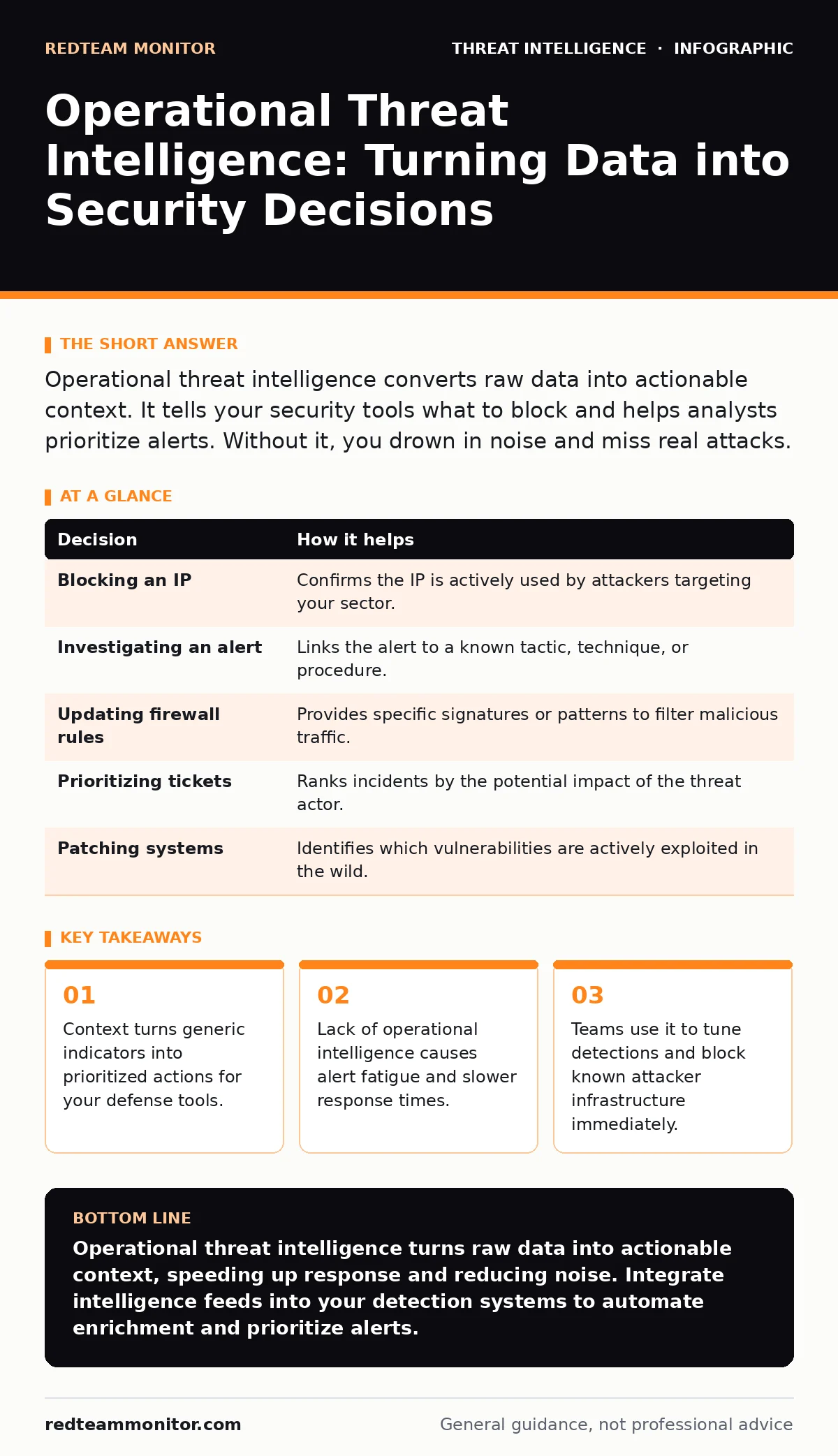
Operational threat intelligence converts raw data into actionable context. It tells your security tools what to block and helps analysts prioritize alerts. Without it, you drown in noise and miss real attacks.
The Gap Between Data and Action
Raw data is not intelligence. A list of IP addresses or hash values tells you nothing about intent or risk. Operational threat intelligence adds context to that raw data. It explains who is behind the indicator, what they want, and how they move. This context allows you to act before damage occurs. You stop guessing and start responding with precision.
Without this layer, your security tools see only noise. Every login attempt looks the same. Every file hash is just a string of characters. You cannot distinguish a curious student from a targeted attacker. Operational intelligence provides the narrative that makes data useful. It turns a database entry into a security decision.
Contrast in Response Speed
Imagine two teams facing the same network intrusion. Team A has no operational intelligence. They see a new process running on a server. They spend hours researching the file hash manually. By the time they confirm it is malicious, the attacker has moved laterally. Team B receives an alert enriched with intelligence. The system flags the hash as part of a known campaign targeting their industry. They isolate the host within minutes. The difference is not technology. It is context.
The speed of response determines the extent of the breach. Operational intelligence compresses the time between detection and containment. It allows your team to focus on containment rather than identification. You do not need to know everything. You need to know what matters right now.
Decisions Informed by Context
Your daily security work relies on making choices under pressure. Operational intelligence informs those choices by providing historical and tactical data. It helps you decide whether to block, monitor, or ignore an event. It also guides resource allocation. You can prioritize investigations based on the severity of the threat actor’s capabilities. This prevents wasted effort on low-risk events.
| Decision | How it helps |
|---|---|
| Blocking an IP | Confirms the IP is actively used by attackers targeting your sector. |
| Investigating an alert | Links the alert to a known tactic, technique, or procedure. |
| Updating firewall rules | Provides specific signatures or patterns to filter malicious traffic. |
| Prioritizing tickets | Ranks incidents by the potential impact of the threat actor. |
| Patching systems | Identifies which vulnerabilities are actively exploited in the wild. |
These decisions shape your security posture. Each choice reduces risk or consumes resources. Operational intelligence ensures your choices are based on facts, not fear. It aligns your defensive actions with the attacker’s actual behavior. You build a defense that adapts to real threats.
What Goes Wrong Without It
Lack of operational intelligence creates a blind spot. Your tools generate alerts, but you lack the context to interpret them. This leads to alert fatigue. Your analysts ignore warnings because most are false positives. When a real attack occurs, it gets buried in the noise. You also face slow response times. Every incident requires manual research. This delays containment and increases damage.
Another hidden cost is missed patterns. Without intelligence linking indicators, you see isolated events. You do not see the campaign. An attacker might use different tools across different days. Without context, these look like unrelated incidents. Operational intelligence connects the dots. It reveals the broader strategy. You stop fighting symptoms and start treating the cause.
How Teams Use the Data
Security teams integrate operational intelligence into their workflows. They feed indicators into their security information and event management systems. This automates the enrichment of alerts. When an alert fires, the system checks the data against known threats. If there is a match, the alert is escalated. This reduces manual effort. Analysts spend less time looking up hashes and more time responding.
Teams also use this data to tune their detection rules. If intelligence shows a new technique, you update your signatures. You might block specific domains or file types. This proactive stance prevents attacks that match known patterns. You also use it for hunting. Analysts search for behaviors described in intelligence reports. This finds threats that automated tools miss.
This integration creates a feedback loop. Your team observes new tactics. You share this with your intelligence sources. The sources update their data. Your team receives the updated context. This cycle keeps your defenses current. You stay ahead of evolving threats.
See also: IOC Enrichment: Why Context Beats Raw Data in Threat Hunting
Beyond Basic Indicators
Indicators of compromise are just the start. Operational intelligence includes tactics, techniques, and procedures. These describe how an attacker operates. Knowing the method is more valuable than knowing the tool. Tools change. Methods persist. If you know an attacker uses living-off-the-land attacks, you look for unusual system command usage. You do not just look for malware signatures.
This depth allows you to detect novel attacks. An attacker might use a new tool, but the behavior remains the same. Your defenses catch the behavior. This is why understanding the "how" matters more than the "what". You build resilience against change. You focus on the attacker’s intent and process. This makes your defense harder to bypass.
The Role of External Sources
You cannot generate all intelligence internally. You need external sources to fill gaps. Threat intelligence reports provide deep analysis of specific campaigns. They offer context that raw data lacks. Open-source intelligence (OSINT) helps you gather public data about threats. This includes forum posts or leaked documents. Threat intelligence feeds provide continuous streams of indicators. You combine these sources for a complete picture.
Some teams use deception technology to gather intelligence. These tools create fake assets. When an attacker interacts with them, you learn their methods. This is active intelligence. It gives you unique data. You also track initial access brokers to understand how attacks start. This helps you harden your entry points. You protect the most vulnerable paths.
You must validate external data. Not all intelligence is accurate. Some feeds contain low-quality data. This causes false positives. You waste time investigating benign events. Verification is key. You cross-reference indicators with your own data. You ensure the threat is relevant to you. This keeps your defenses focused and effective.
Building a Sustainable Process
Operational intelligence is not a one-time task. It requires a continuous process. You must update your data regularly. Threats evolve quickly. Old data becomes irrelevant. You need fresh context to stay protected. This means integrating new feeds and updating your rules. It also means training your team. They must understand how to use the intelligence. They need to know where to find it and how to apply it.
You also need to measure effectiveness. Track how many alerts are reduced. Measure response times. See if you catch more attacks. This data proves the value of your program. It helps you justify resources. You build a case for better tools and more staff. Operational intelligence is an investment. It pays off in reduced risk and faster responses. You build a defense that works.
Your process should be automated where possible. Manual lookup is slow and error-prone. Automation ensures consistency. It applies the same logic to every alert. This reduces human error. You also need to share intelligence internally. Break down silos. Ensure all teams have access. This creates a unified defense. Everyone works from the same information. You move as one unit.
Key takeaways
- Context turns generic indicators into prioritized actions for your defense tools.
- Lack of operational intelligence causes alert fatigue and slower response times.
- Teams use it to tune detections and block known attacker infrastructure immediately.
Operational threat intelligence turns raw data into actionable context, speeding up response and reducing noise. Integrate intelligence feeds into your detection systems to automate enrichment and prioritize alerts.
Frequently asked questions
How is operational threat intelligence different from strategic intelligence?
Strategic intelligence focuses on long-term trends and business risk. Operational intelligence focuses on immediate threats and specific tactics to stop active attacks.
Can I use open-source intelligence for operational defense?
Yes, but you must verify the data. OSINT is free but can be unverified. Use it to supplement commercial feeds and validate findings before blocking traffic.
How do I avoid alert fatigue when using threat intelligence?
Filter indicators by relevance to your industry and environment. Only act on threats that target
How this guide was produced: written by the RedTeam Monitor editorial team with AI assistance, checked against the public references listed below, and reviewed when the facts change. See our editorial policy or report an error.