
DNS Spoofing Prevention Checklist: Block Fake Resolutions
Validating cryptographic signatures for every DNS response stops attackers from redirecting traffic to malicious servers, even if they control local network infrastructure.
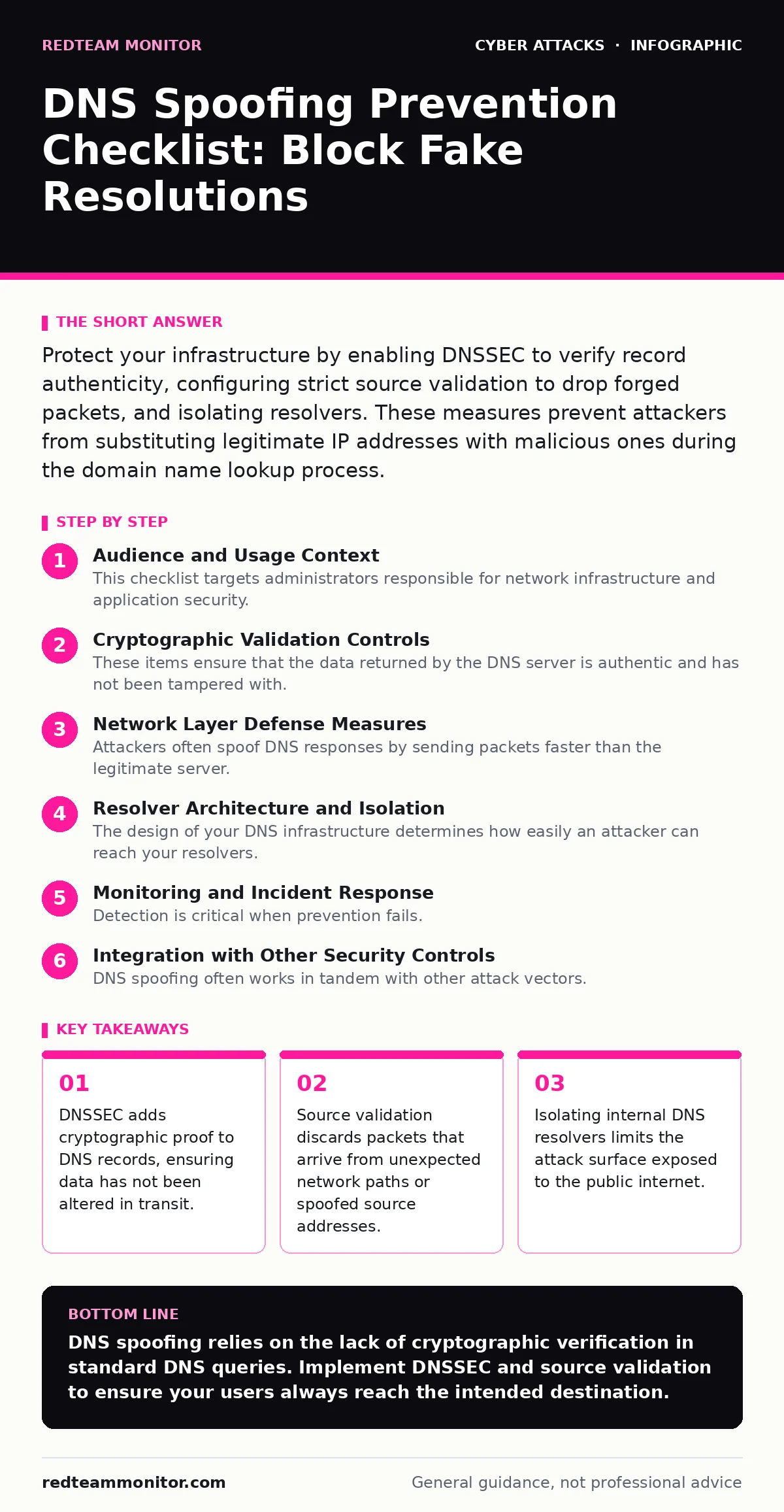
Protect your infrastructure by enabling DNSSEC to verify record authenticity, configuring strict source validation to drop forged packets, and isolating resolvers. These measures prevent attackers from substituting legitimate IP addresses with malicious ones during the domain name lookup process.
Audience and Usage Context
This checklist targets administrators responsible for network infrastructure and application security. Use it to audit your current Domain Name System configuration. The Domain Name System translates human-readable domain names into machine-readable IP addresses. Attackers exploit this translation step by injecting false records. They intercept queries and return malicious IP addresses. Your users then connect to attacker-controlled servers instead of legitimate destinations.
Imagine a user typing a banking URL. The resolver returns an IP address owned by a criminal. The user enters credentials on a fake login page. The attacker captures the data. This guide provides specific technical controls to break this chain. Review each item against your current setup. Mark items as complete only when the control is active and verified.
Cryptographic Validation Controls
These items ensure that the data returned by the DNS server is authentic and has not been tampered with.
- Enable DNSSEC on authoritative zones: Cryptographic signatures prove that the DNS records originate from the true zone owner, preventing injection of fake records.
- Configure recursive resolvers to require validation: The resolver checks the digital signature of every response, rejecting any answer that lacks valid cryptographic proof.
- Publish DNSKEY and DS records correctly: Proper key management allows parent zones to vouch for your child zone keys, creating a chain of trust from the root.
- Monitor for algorithm rotation: Regularly updating cryptographic keys prevents attackers from exploiting weak or compromised signing keys that could forge valid responses.
Network Layer Defense Measures
Attackers often spoof DNS responses by sending packets faster than the legitimate server. These controls make it harder for them to guess transaction IDs or source ports.
- Implement source address validation: Drop packets with forged source IP addresses at the network edge, reducing the ability of attackers to send replies from outside the expected path.
- Use DNS over HTTPS or TLS: Encrypting the DNS query and response prevents on-path attackers from reading or modifying the traffic in transit.
- Randomize query identifiers and source ports: Making these values unpredictable forces attackers to guess correctly, significantly lowering their success rate in a race condition.
- Rate-limit recursive queries: Slowing down responses to excessive queries mitigates amplification attacks and reduces the volume of spoofed responses an attacker can inject.
Resolver Architecture and Isolation
The design of your DNS infrastructure determines how easily an attacker can reach your resolvers. These items focus on reducing exposure and limiting the blast radius of a compromise.
- Deploy dedicated internal resolvers: Separate internal DNS traffic from external queries, ensuring that internal applications do not trust public resolver responses directly.
- Restrict resolver access by IP: Only allow trusted internal subnets to query your recursive resolvers, blocking unauthorized external queries that could be used for amplification.
- Disable unnecessary DNS features: Turn off features like DNS wildcards or dynamic updates on public-facing servers, as they can be exploited to map network topology or inject records.
- Use split-horizon DNS: Serve different DNS responses for internal and external queries, keeping internal server names hidden from the public internet.
Monitoring and Incident Response
Detection is critical when prevention fails. These items help you identify spoofing attempts and respond quickly.
- Log all DNS queries and responses: Maintain detailed logs to analyze traffic patterns and identify anomalies such as sudden spikes in query volume or unusual response times.
- Set up alerts for NXDOMAIN spikes: A sudden increase in non-existent domain responses can indicate a malware campaign or a misconfigured application attempting to resolve fake names.
- Correlate DNS logs with firewall events: Combine DNS data with connection logs to spot discrepancies, such as a DNS response pointing to an IP address that the firewall blocks.
- Validate certificate transparency logs: Monitor for certificates issued for your domain, as attackers may register fake certificates for domains they control via DNS spoofing.
Integration with Other Security Controls
DNS spoofing often works in tandem with other attack vectors. Strengthening these related areas reduces the overall risk.
- Enforce phishing-resistant authentication: Even if an attacker spoofs your domain, strong authentication methods prevent them from accessing accounts with stolen credentials.
- Configure firewalls to block known malicious IPs: Update firewall rules to block IP addresses associated with malicious activity, limiting the impact of successful DNS redirection.
- Educate users on session hijacking signs: Train users to recognize browser warnings and unusual behavior, as these may indicate that their session has been hijacked via a spoofed connection.
- Implement bot protection on critical endpoints: Prevent automated tools from abusing your DNS infrastructure or attempting to exploit vulnerabilities in your public-facing services.
Verification and Maintenance
Security is not a one-time setup. Regular verification ensures that your controls remain effective against evolving techniques.
- Test DNSSEC validation regularly: Use external tools to verify that your zones are signed correctly and that resolvers validate them properly.
- Audit DNS server configurations annually: Review server settings for misconfigurations, disabled features, or outdated software that could introduce vulnerabilities.
- Review access controls for DNS management: Ensure that only authorized personnel can modify DNS records, reducing the risk of insider threats or accidental misconfiguration.
- Update DNS server software promptly: Apply security patches to your DNS software to fix known vulnerabilities that could be exploited for remote code execution or denial of service.
Key takeaways
- DNSSEC adds cryptographic proof to DNS records, ensuring data has not been altered in transit.
- Source validation discards packets that arrive from unexpected network paths or spoofed source addresses.
- Isolating internal DNS resolvers limits the attack surface exposed to the public internet.
DNS spoofing relies on the lack of cryptographic verification in standard DNS queries. Implement DNSSEC and source validation to ensure your users always reach the intended destination.
Frequently asked questions
Does DNS over HTTPS prevent DNS spoofing entirely?
DNS over HTTPS encrypts the traffic between the client and resolver, but it does not verify the authenticity of the response. You still need DNSSEC to ensure the resolver returns correct data.
Can a firewall stop DNS spoofing attacks?
A firewall can block traffic from known malicious IPs, but it cannot easily distinguish between a legitimate DNS response and a spoofed one. Source validation and DNSSEC are more effective for this specific threat.
Why is randomizing query identifiers important?
Attackers often guess transaction IDs to inject fake responses. Randomizing these identifiers makes it statistically improbable for an attacker to guess the correct ID, reducing the success rate of spoofing attempts.
How do I know if my DNSSEC is working?
Use public DNS diagnostic tools to check if your domain has valid DNSSEC signatures. If the tools report validation failures, your configuration is incorrect and users may be vulnerable to spoofing.
How this guide was produced: written by the RedTeam Monitor editorial team with AI assistance, checked against the public references listed below, and reviewed when the facts change. See our editorial policy or report an error.