Session Hijacking in Cyber Security: Mechanics, Risks, and Mitigation
Attackers bypass login controls by stealing the active token that proves identity, rendering password strength irrelevant during the session window.
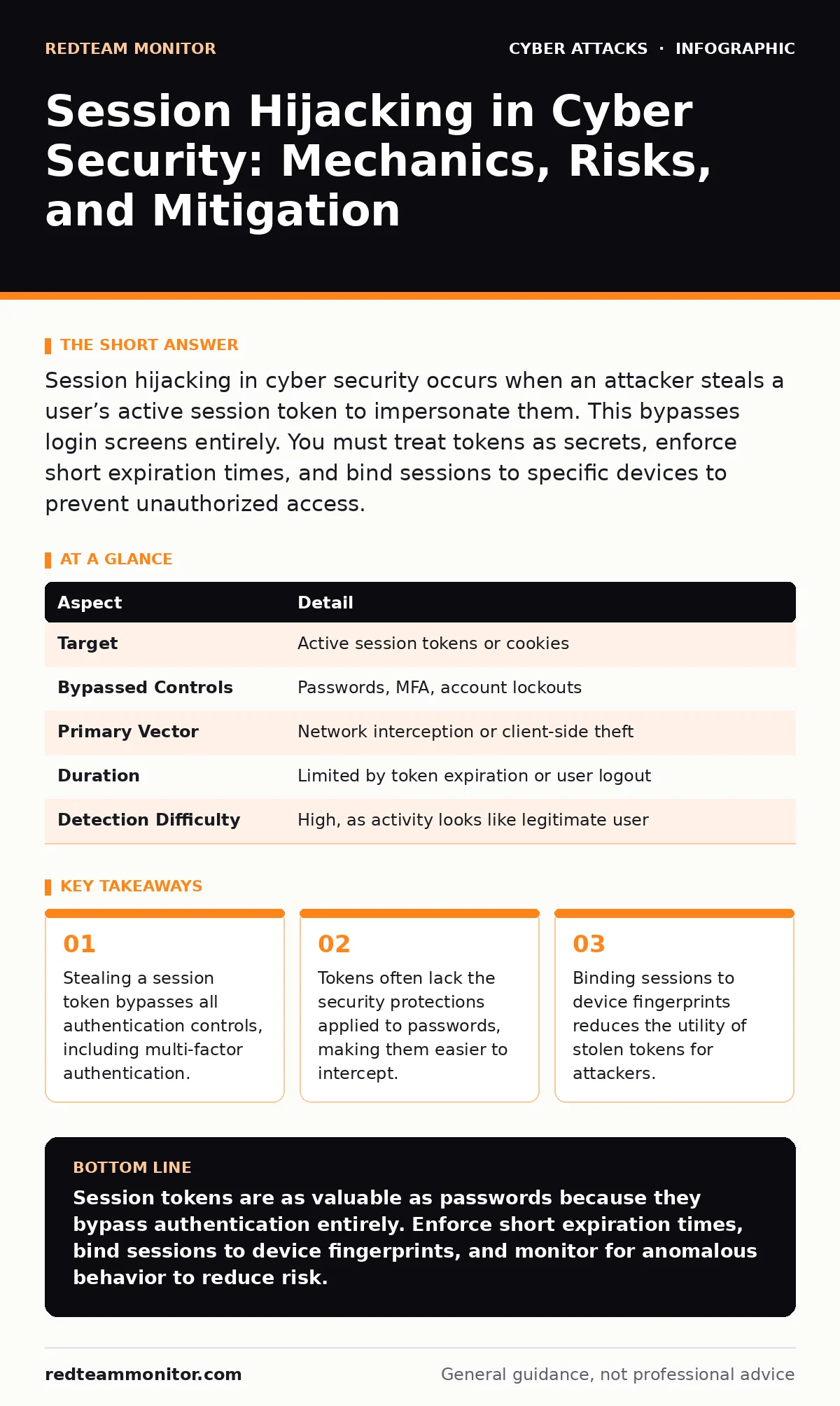
Session hijacking in cyber security occurs when an attacker steals a user’s active session token to impersonate them. This bypasses login screens entirely. You must treat tokens as secrets, enforce short expiration times, and bind sessions to specific devices to prevent unauthorized access.
The Analogy: Keys vs. Wristbands
Imagine a high-security building. The front door requires a keycard and a PIN. Once inside, you receive a wristband that grants access to internal rooms. The wristband is easier to lose than the keycard. An attacker who steals the wristband does not need to pick the lock at the front door. They simply walk through the open internal doors. Session hijacking works the same way. The attacker bypasses the initial login by stealing the credential that proves you are already inside.
What Is Session Hijacking in Cyber Security
Session hijacking in cyber security is the theft of a valid session identifier to gain unauthorized access to a user’s account. The session identifier is a string of characters the server uses to recognize your browser or application as authenticated. When you log in, the server creates this token and sends it to your client. Every subsequent request includes the token. The server checks the token and grants access if it matches its records. The attacker intercepts or guesses this token. They then send requests using the stolen token. The server treats the attacker as the legitimate user. No password is required for this impersonation.
| Aspect | Detail |
|---|---|
| Target | Active session tokens or cookies |
| Bypassed Controls | Passwords, MFA, account lockouts |
| Primary Vector | Network interception or client-side theft |
| Duration | Limited by token expiration or user logout |
| Detection Difficulty | High, as activity looks like legitimate user |
How Attackers Steal Session Tokens
Attackers use several methods to obtain these tokens. Cross-site scripting remains a common vector. Malicious scripts injected into a vulnerable web application run in the victim’s browser. These scripts read the browser’s cookie store and send the session token to the attacker’s server. This happens without the user noticing. Network sniffing targets unencrypted connections.
If an application transmits tokens over HTTP instead of HTTPS, anyone on the same network can capture the traffic. They extract the token from the unencrypted data stream. Session fixation is another technique. The attacker generates a valid token and tricks the victim into using it. When the victim logs in, the server associates their credentials with the attacker’s token. The attacker then uses that token to access the account.
Who Is Affected and Why It Matters
Every organization that uses web applications or APIs is affected. E-commerce platforms, banking systems, and internal corporate tools all rely on session management. The impact is severe because the attacker has already passed the authentication gate. Multi-factor authentication does not protect the session. The attacker does not need to verify identity; they already have proof of identity.
This makes session hijacking more dangerous than brute force attacks. Brute force attempts are noisy and often trigger lockouts. Session hijacking is silent. The attacker acts exactly like the user. Financial loss, data exfiltration, and reputation damage follow. Users lose trust when their accounts are compromised despite strong passwords.
What People Usually Get Wrong
Many security teams believe that enforcing HTTPS solves session hijacking. HTTPS encrypts data in transit, preventing network sniffing. It does not protect against cross-site scripting or client-side malware. If an attacker injects a script into your page, HTTPS cannot stop that script from reading cookies. Another common mistake is assuming that long-lived sessions are convenient and safe.
Long expiration times increase the window of opportunity for attackers. If a token is stolen, it remains valid for days or weeks. This gives the attacker ample time to act before the session expires. Teams also often neglect server-side session management. They rely on the browser to handle token storage securely. Servers must enforce strict security attributes on cookies.
Mitigation Strategies for Operations Teams
Defending against session hijacking requires layers of control. Start with secure cookie attributes. Set the HttpOnly flag to prevent JavaScript from accessing the token. This mitigates cross-site scripting attacks that try to read cookies. Set the Secure flag to ensure the token is only sent over HTTPS. Use the SameSite attribute to restrict cookie sending to same-site requests.
This helps prevent cross-site request forgery. Implement short session lifetimes. Force re-authentication for sensitive actions. If a user performs a transaction or changes settings, require a password or MFA again. This limits the damage if a token is stolen. Monitor for impossible travel. If a user logs in from New York and then from London within minutes, flag the session. Terminate the session and notify the user.
Advanced Protection Techniques
Bind sessions to device fingerprints. Collect hardware and software characteristics at login. Compare these characteristics with each request. If the browser version changes or the screen resolution differs, suspect hijacking. This adds friction for attackers who use different devices. Use rotating session tokens. Generate a new token after each login or after a period of inactivity. This reduces the lifespan of any single token.
If an attacker steals a token, it becomes invalid quickly. Implement rate limiting on session creation. This prevents attackers from generating many tokens to increase their chances of success. Combine these measures with phishing-resistant authentication. Even if users are tricked into logging in on a fake site, the stolen credentials may not generate valid tokens on the real server if the fake site cannot replicate the session logic.
Integrating with Broader Security Frameworks
Session security does not exist in isolation. It connects to email security and identity protection. Phishing attacks often aim to steal session tokens directly. Attackers create fake login pages that capture cookies. Training users to recognize brand impersonation reduces this risk. However, technical controls are more reliable. Implement DMARC to prevent email spoofing. This reduces the success rate of phishing campaigns that lead to token theft.
Monitor for password spraying attempts. If attackers gain access through weak passwords, they can initiate sessions that are then hijacked. Strengthening initial authentication reduces the attack surface. Use bot protection to filter automated requests. Bots often scan for vulnerable endpoints or attempt session fixation. Blocking malicious bot traffic reduces the volume of hijacking attempts.
Monitoring and Response
Detecting session hijacking requires behavioral analysis. Look for anomalies in user activity. Sudden changes in location, device, or behavior patterns indicate compromise. Set alerts for multiple concurrent sessions. If a user logs in from two distant locations at the same time, investigate. Provide easy logout mechanisms. Allow users to terminate all active sessions from their account settings.
This helps recover from a compromised session. Educate users on the signs of hijacking. They may notice unexpected transactions or messages sent from their account. Encourage immediate reporting. Respond quickly by invalidating the session and forcing re-authentication. Review logs to understand how the token was stolen. Update defenses to address the specific vector used.
Key takeaways
- Stealing a session token bypasses all authentication controls, including multi-factor authentication.
- Tokens often lack the security protections applied to passwords, making them easier to intercept.
- Binding sessions to device fingerprints reduces the utility of stolen tokens for attackers.
Session tokens are as valuable as passwords because they bypass authentication entirely. Enforce short expiration times, bind sessions to device fingerprints, and monitor for anomalous behavior to reduce risk.
Frequently asked questions
Can a VPN prevent session hijacking?
A VPN encrypts traffic between your device and the VPN server. It protects against local network sniffing. It does not protect against cross-site scripting or malware on your device that steals tokens directly from the browser.
How long do session tokens usually last?
Duration varies by application design. Some expire after hours, others after days. Shorter lifetimes reduce the window for attackers. Critical applications should require re-authentication for sensitive actions regardless of token age.
Is session hijacking the same as account takeover?
Session hijacking is a method of account takeover. Account takeover is the broader result. It can occur via stolen passwords, phishing, or session hijacking. Session hijacking is distinct because it bypasses the login screen entirely.
Do mobile apps face session hijacking risks?
Yes. Mobile apps use tokens for authentication. If these tokens are stored insecurely on the device, malware can steal them. Developers must use secure storage mechanisms and validate tokens on the server side to mitigate this risk.
How this guide was produced: written by the RedTeam Monitor editorial team with AI assistance, checked against the public references listed below, and reviewed when the facts change. See our editorial policy or report an error.