
Cross Site Scripting vs CSRF: How to Tell Them Apart and Stop Both
XSS hijacks the user to execute code in their browser, while CSRF tricks the browser into sending requests the user already authorized for.
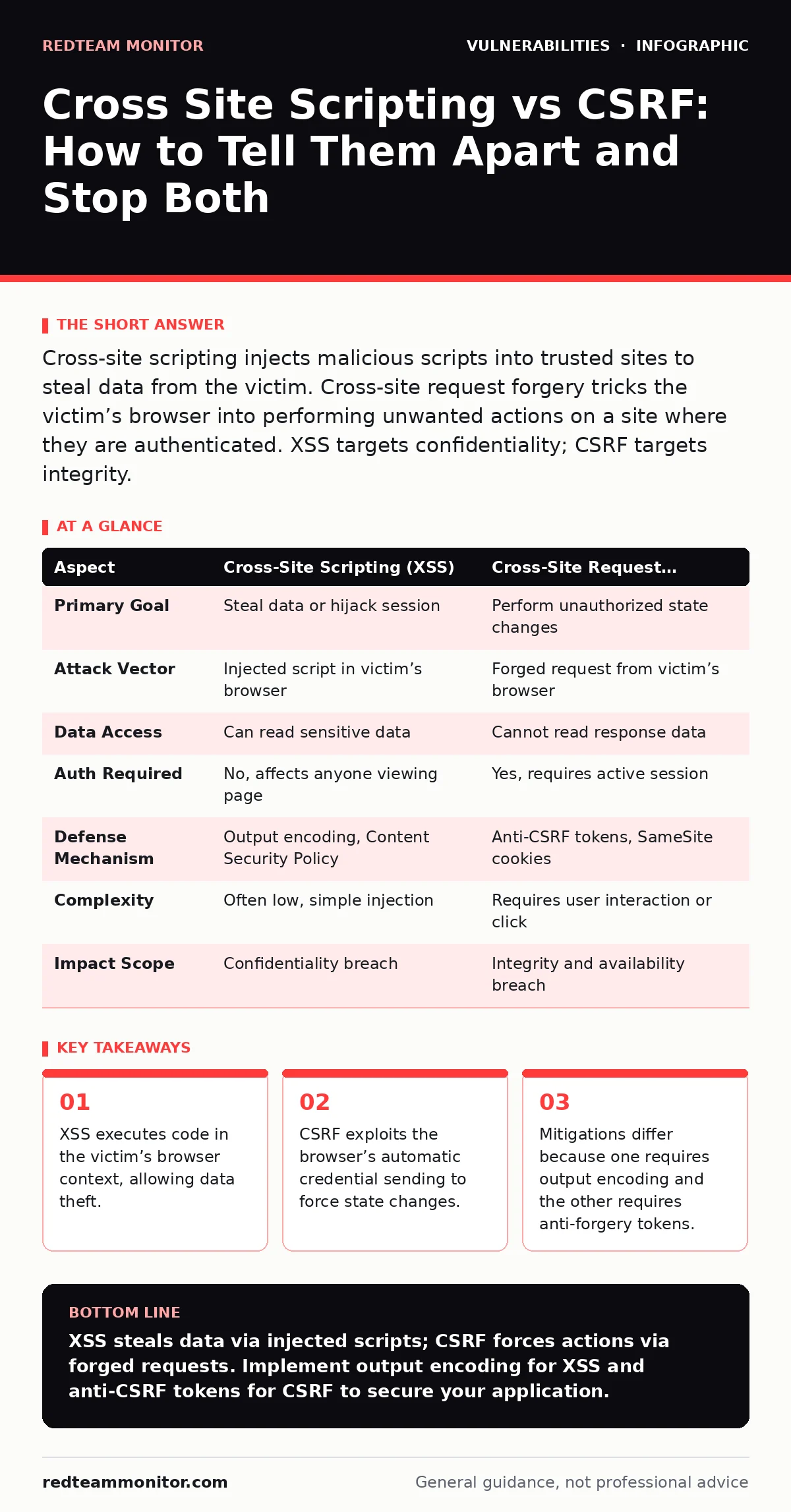
Cross-site scripting injects malicious scripts into trusted sites to steal data from the victim. Cross-site request forgery tricks the victim’s browser into performing unwanted actions on a site where they are authenticated. XSS targets confidentiality; CSRF targets integrity.
The Core Difference Between Cross Site Scripting and CSRF
Cross-site scripting (XSS) and cross-site request forgery (CSRF) are distinct web vulnerabilities with different mechanics and goals. XSS involves injecting malicious client-side scripts into web pages viewed by other users. The attacker needs the victim to load a compromised page. CSRF involves tricking an authenticated user into submitting a malicious request to a trusted site. The attacker needs the victim’s browser to automatically send credentials. One steals data; the other forces actions. Understanding this split determines your defense strategy.
What Is Cross-Site Scripting (XSS)?
Cross-site scripting occurs when an application includes untrusted data in a web page without proper validation or escaping. The browser treats this data as executable code. Imagine a comment field that renders HTML. An attacker posts a script tag. When another user reads the comment, the script runs in their browser. This script can read cookies, access sensitive tokens, or redirect the user.
The vulnerability exists in how the server processes and returns input. It fails to distinguish between data and code. Output encoding is the primary defense. You must escape special characters like angle brackets and quotes. This prevents the browser from interpreting the data as HTML or JavaScript. XSS variants include reflected, stored, and DOM-based types. Each requires slightly different detection methods.
What Is Cross-Site Request Forgery (CSRF)?
Cross-site request forgery exploits the trust a site places in a user’s browser. Browsers automatically attach authentication credentials, such as cookies, to requests for the domain. An attacker creates a page with a form that submits to the victim’s bank. When the victim visits the attacker’s page, the form submits automatically. The bank sees a valid request with valid cookies. It processes the action.
The user did not intend this action. CSRF targets state-changing operations like password changes or fund transfers. It does not allow reading data. The Same-Origin Policy prevents reading the response. Defenses include anti-CSRF tokens that the attacker cannot guess. You must include a unique, unpredictable token in every state-changing request. The server verifies this token before processing.
Cross Site Scripting vs CSRF Comparison Table
| Aspect | Cross-Site Scripting (XSS) | Cross-Site Request Forgery (CSRF) |
|---|---|---|
| Primary Goal | Steal data or hijack session | Perform unauthorized state changes |
| Attack Vector | Injected script in victim’s browser | Forged request from victim’s browser |
| Data Access | Can read sensitive data | Cannot read response data |
| Auth Required | No, affects anyone viewing page | Yes, requires active session |
| Defense Mechanism | Output encoding, Content Security Policy | Anti-CSRF tokens, SameSite cookies |
| Complexity | Often low, simple injection | Requires user interaction or click |
| Impact Scope | Confidentiality breach | Integrity and availability breach |
When to Choose XSS Defenses
Choose XSS-specific defenses when your application renders user input. If users can post comments, profiles, or search results, you face XSS risks. Focus on output encoding. Encode HTML entities before rendering any dynamic content. Implement Content Security Policy (CSP) headers. CSP restricts where scripts can load from. It limits the damage if an injection occurs.
You should also sanitize input to remove unexpected characters. This reduces the attack surface. Regular vulnerability scanning helps find injection points. Automated tools can detect unencoded outputs. Combine these methods for layered security. Do not rely on client-side checks alone. Servers must enforce encoding rules. This protects users with different browsers.
When to Choose CSRF Defenses
Choose CSRF-specific defenses when your application handles state changes. If users can update settings, transfer funds, or change emails, you face CSRF risks. Implement anti-CSRF tokens. Generate a unique token for each session or form. Include it in the request. The server validates it. Use SameSite cookie attributes.
This prevents browsers from sending cookies on cross-site requests. Modern browsers support SameSite=Lax or SameSite=Strict. This blocks many CSRF attacks without extra code. You must also verify the Origin or Referer header. Ensure requests come from your domain. This adds another layer of validation. These measures protect against automated attacks. They stop silent form submissions.
Where Defenses Overlap and Fail
Some defenses address both vulnerabilities. Strict input validation helps both XSS and CSRF. It reduces the attack surface. However, validation alone is insufficient. You need output encoding for XSS and tokens for CSRF. Web application firewalls can detect common patterns. They provide a safety net but are not a substitute for code fixes. Hardening a self-hosted GitLab server includes both XSS and CSRF protections. You must configure both sets of rules. Do not assume one measure covers both. They address different phases of the request. XSS happens during rendering. CSRF happens during submission. You need distinct checks for each phase. Overlapping risks require layered controls.
Practical Steps for Your Application
Audit your application for both risks. Check all input fields for XSS potential. Check all state-changing endpoints for CSRF potential. Implement a consistent encoding library. Use it for all dynamic output. Generate CSRF tokens for every form. Store them server-side. Verify them on submission. Update your dependencies regularly. Memory-safe programming languages reduce other vulnerabilities. They do not fix logic errors like XSS or CSRF. You still need proper web security practices. Conduct regular penetration testing. Find flaws before attackers do. Educate your team on both threats. They require different thinking. One is about data flow. The other is about trust.
Key takeaways
- XSS executes code in the victim’s browser context, allowing data theft.
- CSRF exploits the browser’s automatic credential sending to force state changes.
- Mitigations differ because one requires output encoding and the other requires anti-forgery tokens.
XSS steals data via injected scripts; CSRF forces actions via forged requests. Implement output encoding for XSS and anti-CSRF tokens for CSRF to secure your application.
Frequently asked questions
Can XSS be used to perform CSRF?
Yes, if an attacker injects a script that submits a form, it can trigger a CSRF-like action. However, this is technically XSS abusing the session, not pure CSRF.
Does SameSite cookie attribute stop XSS?
No, SameSite prevents cross-site request cookies. It does not stop script injection or execution within the same site context.
Are CSRF tokens needed for GET requests?
Generally no, as GET requests should be idempotent and safe. State changes should use POST, PUT, or DELETE methods with tokens.
Can vulnerability scanning find both issues?
Yes, comprehensive scanners test for input reflection (XSS) and missing token verification (CSRF). They complement manual code reviews.
How this guide was produced: written by the RedTeam Monitor editorial team with AI assistance, checked against the public references listed below, and reviewed when the facts change. See our editorial policy or report an error.