
Stop Host Header Injection: Practical Fixes That Actually Work
Canonical host validation at the application layer is the only reliable defense against host header injection, as network-level filters cannot distinguish legitimate multi-tenant traffic from malicious overrides.
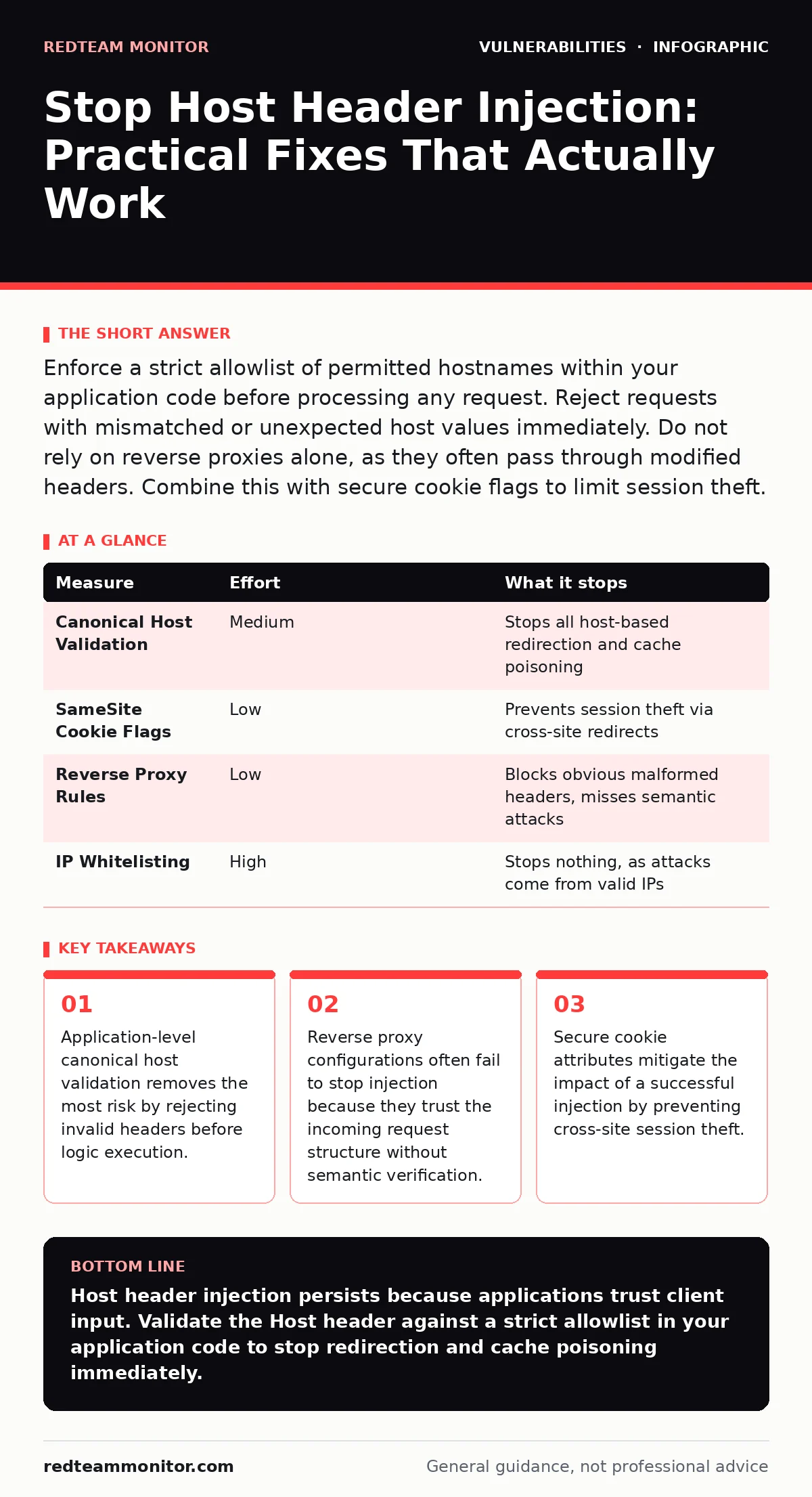
Enforce a strict allowlist of permitted hostnames within your application code before processing any request. Reject requests with mismatched or unexpected host values immediately. Do not rely on reverse proxies alone, as they often pass through modified headers. Combine this with secure cookie flags to limit session theft.
The Mechanics of Host Header Abuse
Host header injection exploits the way web servers handle multi-tenant environments. Modern web servers serve multiple domains from a single IP address. The server relies on the HTTP Host header to determine which website configuration to apply. An attacker sends a request with a manipulated Host header. The application processes this header as trusted input. This allows the attacker to redirect error messages, password reset links, or cache entries to a domain they control.
Imagine a user requests a password reset. The application generates a link using the Host header from the request. If the attacker changed the Host header to their own domain, the reset link points to them. The user clicks the link, thinking it is legitimate. The attacker captures the token. This works because the application assumes the Host header is always accurate. It is not. The header is supplied by the client. Clients can be malicious.
Why Network Filters Fail to Stop Injection
Many teams assume their reverse proxy or web application firewall blocks this attack. This assumption is incorrect. Reverse proxies like Nginx or Apache often forward the Host header to the backend application unchanged. They do not validate whether the Host value matches the expected canonical domain for the request path. Web application firewalls may lack the context to distinguish between a valid multi-tenant request and an injection attempt.
Suppose you configure your firewall to block requests with empty Host headers. An attacker simply sends a request with a valid-looking but malicious Host value. The firewall sees a standard HTTP request. It passes it through. The backend application then uses that malicious value. Network-level controls see syntax, not semantics. They cannot know if "evil.com" is a valid tenant or an attacker. Only the application knows which hosts are legitimate for a specific endpoint.
Application-Level Canonical Host Validation
The most effective defense is canonical host validation within the application code. This process checks the incoming Host header against a predefined allowlist of permitted hostnames. If the header matches an allowed host, the request proceeds. If it does not, the application returns a 400 Bad Request error immediately. This check must happen before any business logic runs. It must happen before the application generates URLs or accesses sensitive data.
This measure removes the root cause. The application no longer trusts the client-supplied header. It enforces its own truth. You must maintain the allowlist carefully. Include all valid subdomains and aliases. If you use a cloud load balancer, ensure the allowlist includes the internal hostnames used for health checks. A misconfigured allowlist can break legitimate traffic. The trade-off is operational overhead. You must update the allowlist when you add new domains.
Mitigating Impact with Secure Cookies
Even if an attacker injects a host header, they cannot always steal the session. Secure cookies mitigate the impact of this vulnerability. The SameSite attribute restricts how cookies are sent with cross-site requests. Setting SameSite to Strict or Lax prevents the browser from sending the session cookie to the attacker's domain. This breaks the chain of exploitation for many host header attacks.
Imagine the attacker redirects the password reset link to their domain. The user clicks it. The browser requests the attacker's site. If the session cookie has SameSite=Lax, the browser does not send it. The attacker receives the request but not the session token. They cannot hijack the user's account. This does not stop the injection itself. It stops the most common consequence. You should set Secure, HttpOnly, and SameSite flags on all session cookies.
What Does Not Work Against Injection
Relying on IP address filtering is ineffective. Host header injection works over standard HTTP ports. The attacker's IP address looks normal. Blocking specific User-Agent strings is also useless. Attackers easily spoof these strings. Some teams try to strip the Host header at the load balancer. This breaks the application. The backend needs the Host header to function. You cannot simply remove it.
Another common mistake is trusting the X-Forwarded-Host header. This header is also client-supplied in many architectures. If your application uses X-Forwarded-Host for URL generation, you are vulnerable to the same attack. Attackers can set both Host and X-Forwarded-Host. You must validate all header-based host inputs. Do not assume that headers added by infrastructure are safe. They often reflect the original client request.
| Measure | Effort | What it stops |
|---|---|---|
| Canonical Host Validation | Medium | Stops all host-based redirection and cache poisoning |
| SameSite Cookie Flags | Low | Prevents session theft via cross-site redirects |
| Reverse Proxy Rules | Low | Blocks obvious malformed headers, misses semantic attacks |
| IP Whitelisting | High | Stops nothing, as attacks come from valid IPs |
See also: Cross Site Scripting vs CSRF: How to Tell Them Apart and Stop Both · OWASP Top 10 Explained: The Broken Lock Metaphor for Web Security
Edge Cases in Microservices Architectures
Microservices complicate host validation. Services often communicate internally using internal hostnames. An external attacker cannot directly set the Host header for internal service-to-service calls. However, if an external-facing service proxies requests to internal services, it may pass the external Host header along. This can lead to internal cache poisoning or SSRF-like effects.
You must strip or override the Host header when forwarding requests internally. The internal service should use its own canonical hostname. Do not pass client headers blindly between services. This requires careful configuration of your service mesh or API gateway. The trade-off is complexity. You must ensure that debugging tools still work. Logging the original Host header for audit purposes is safe. Using it for logic is not.
Testing Your Defenses Effectively
You need to verify that your validation works. Automated scanners often miss host header injection. They test for common parameters, not header manipulation. You must include manual testing in your process. Send requests with modified Host headers to all endpoints that generate URLs. Check if the generated URLs contain the malicious host. Check if emails are sent to the attacker.
This testing is part of a broader security posture. You should also review your code for other input validation failures. Host header injection often coexists with other vulnerabilities. For example, if your application also suffers from cross-site scripting (XSS), the attacker can steal credentials directly without needing host redirection. Addressing input validation holistically reduces this risk.
Immediate Actions for Your Team
You can reduce risk today with three specific actions. First, audit your application code for places where the Host header is used to construct URLs. Add validation logic to these points. Second, check your cookie settings. Ensure SameSite is set to Lax or Strict. Third, review your reverse proxy configuration. Ensure it does not strip necessary headers but also does not blindly trust client input.
These steps address the most common exploitation paths. They do not require major architectural changes. They require discipline in configuration and coding. You must maintain these settings. If you add new features that generate URLs, you must apply the same validation. Security is not a one-time fix. It is a continuous process of validating assumptions.
- Implement canonical host validation in all public-facing endpoints.
- Set SameSite=Lax on all session cookies.
- Test URL generation endpoints with modified Host headers.
Key takeaways
- Application-level canonical host validation removes the most risk by rejecting invalid headers before logic execution.
- Reverse proxy configurations often fail to stop injection because they trust the incoming request structure without semantic verification.
- Secure cookie attributes mitigate the impact of a successful injection by preventing cross-site session theft.
Host header injection persists because applications trust client input. Validate the Host header against a strict allowlist in your application code to stop redirection and cache poisoning immediately.
Frequently asked questions
Does HTTPS prevent host header injection?
No. HTTPS encrypts the connection but does not validate the content of the headers. An attacker can send a malicious Host header over a secure connection. The server still processes the header as trusted input.
Can I use a web application firewall to block this?
You can block obvious malformed headers, but a WAF cannot distinguish between a valid multi-tenant request and a malicious one. Application-level validation is required for complete protection.
Why do modern frameworks still have this vulnerability?
Frameworks often default to trusting the Host header for convenience in development. Developers must explicitly configure canonical host validation. It is not always enabled by default to avoid breaking complex deployments.
How do I find vulnerable endpoints?
Look for endpoints that generate absolute URLs, send emails, or set cookies. Test these endpoints by sending requests with a modified Host header. If the response contains your malicious host, the endpoint is vulnerable.
How this guide was produced: written by the RedTeam Monitor editorial team with AI assistance, checked against the public references listed below, and reviewed when the facts change. See our editorial policy or report an error.