
How Bot Protection Works: The Hidden Mechanics of Web Traffic Filtering
Bot protection relies on behavioral biometrics and JavaScript challenges rather than simple IP blocking, creating a hidden layer of friction that legitimate users rarely notice.
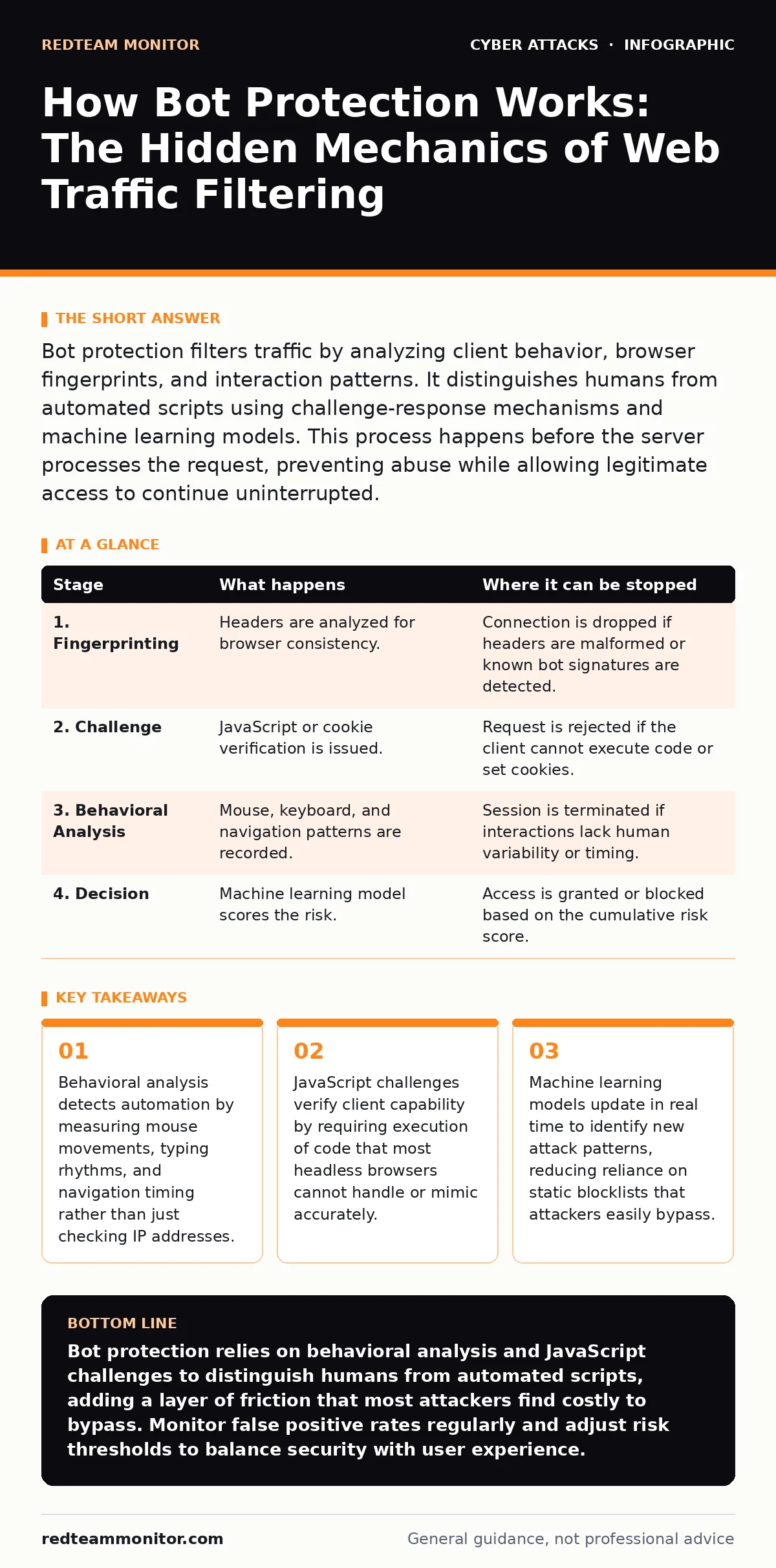
Bot protection filters traffic by analyzing client behavior, browser fingerprints, and interaction patterns. It distinguishes humans from automated scripts using challenge-response mechanisms and machine learning models. This process happens before the server processes the request, preventing abuse while allowing legitimate access to continue uninterrupted.
The Initial Request and Fingerprinting
When a user visits a website, the browser sends an HTTP request before any page content loads. The bot protection system intercepts this request immediately. It does not yet know if the client is human or machine. The system begins by examining the HTTP headers. These headers contain metadata about the browser, operating system, and network connection.
The protection layer extracts a browser fingerprint. This fingerprint is a unique identifier derived from the combination of software versions, installed fonts, screen resolution, and hardware capabilities. Humans rarely change these settings manually. Automated bots often use generic or incomplete header sets to avoid detection. The system compares the received fingerprint against known profiles.
If the fingerprint matches a known bot signature, the system drops the connection. This happens silently. The user sees no error message. The connection simply times out. If the fingerprint is ambiguous, the system proceeds to the next stage. This initial filter catches low-effort scrapers and automated scanners that do not bother to mimic real browser environments.
| Stage | What happens | Where it can be stopped |
|---|---|---|
| 1. Fingerprinting | Headers are analyzed for browser consistency. | Connection is dropped if headers are malformed or known bot signatures are detected. |
| 2. Challenge | JavaScript or cookie verification is issued. | Request is rejected if the client cannot execute code or set cookies. |
| 3. Behavioral Analysis | Mouse, keyboard, and navigation patterns are recorded. | Session is terminated if interactions lack human variability or timing. |
| 4. Decision | Machine learning model scores the risk. | Access is granted or blocked based on the cumulative risk score. |
The JavaScript Challenge Layer
Most basic bots cannot execute JavaScript. They are designed to send requests and receive responses quickly. They lack a rendering engine. The bot protection system exploits this limitation by issuing a JavaScript challenge. This is a small piece of code that the browser must execute.
The challenge typically asks the browser to perform a simple calculation or modify a cookie. The result is not mathematically complex. The complexity lies in the execution environment. A human browser runs the code instantly and returns the result. A headless browser or a script using a library like cURL cannot run the code.
This stage filters out the majority of automated traffic. It adds negligible latency for human users. The code executes in milliseconds. The user perceives no delay. For attackers, this is a significant barrier. They must use sophisticated browser automation tools to pass this check. These tools are resource-intensive and easier to detect.
Behavioral Biometrics and Interaction Analysis
Passing the JavaScript challenge does not guarantee access. Sophisticated bots use headless browsers to execute code. They can set cookies and mimic header structures. To distinguish these advanced bots from humans, the system analyzes behavioral biometrics. This involves tracking how the user interacts with the page.
The system records mouse movements, scroll patterns, and keystroke dynamics. Humans move their mice in curved, non-linear paths. They pause occasionally. They scroll at variable speeds. Bots often move cursors in straight lines at constant velocities. They may jump between coordinates instantly. These patterns are statistically distinct.
The analysis occurs in real time. The browser sends telemetry data back to the protection service. A machine learning model evaluates this data. It looks for anomalies in timing and precision. If the behavior matches a known automation profile, the system flags the session. This stage catches credential stuffing and account takeover attempts that bypass earlier filters.
Risk Scoring and Decision Engine
The data from fingerprinting, challenges, and behavioral analysis feeds into a risk scoring engine. This engine assigns a numerical score to each session. A low score indicates a likely human. A high score indicates a likely bot. The threshold for blocking is configurable.
The system considers context. A request from a known data center IP receives a higher base risk. A request for a login endpoint receives higher scrutiny than a request for a static image. The model weighs these factors dynamically. It updates its weights based on recent traffic patterns.
If the score exceeds the threshold, the system blocks the request. It may present a CAPTCHA for verification. This is a last resort. CAPTCHAs degrade user experience. The system aims to block bots without human intervention. If the score is low, the request proceeds to the origin server. The user sees the content immediately.
Limits and Bypass Techniques
Bot protection is not infallible. Attackers continuously adapt. They use residential proxy networks to mask their IP addresses. These proxies route traffic through real home computers. This makes the traffic appear to come from legitimate users. The IP reputation check becomes less effective.
Advanced bots use machine learning to mimic human behavior. They randomize mouse movements and typing speeds. They introduce deliberate delays. These techniques are computationally expensive. They slow down the attack. The defender gains time to detect and block the traffic. The arms race continues.
The system cannot distinguish between a human and a bot perfectly. There is always a margin of error. False positives occur. Legitimate users may be challenged or blocked. False negatives also occur. Some bots slip through. The goal is to raise the cost of attack. Making automation difficult and expensive deters casual attackers.
See also: Cross Site Scripting vs CSRF: How to Tell Them Apart and Stop Both · OWASP Top 10 Explained: The Broken Lock Metaphor for Web Security
Integration with Other Security Layers
Bot protection works best when integrated with other security measures. It complements firewalls by filtering traffic before it reaches the application logic. Firewalls block known bad IPs. Bot protection identifies bad behavior from good IPs. This layered approach reduces the attack surface.
It also mitigates credential stuffing attacks. These attacks use stolen credentials to gain access. Bot protection detects the rapid, automated login attempts. It blocks the session before the password is verified. This protects user accounts even if credentials are compromised.
Monitoring for session hijacking is another related concern. If a bot successfully authenticates, it may hijack the session. Bot protection reduces the likelihood of this by preventing unauthorized access in the first place. It does not replace session management best practices. It acts as a first line of defense.
Maintenance and Operational Costs
Running bot protection requires ongoing maintenance. The system consumes computational resources. It adds latency to the request chain. High-traffic sites must optimize the configuration. Caching static content reduces the load on the protection layer.
The cost is not just technical. It is operational. Security teams must monitor alerts. They must investigate false positives. They must update rules. This requires skilled personnel. The hidden cost is the time spent tuning the system.
Despite these costs, the benefits outweigh the drawbacks. Bot traffic consumes bandwidth and server resources. It distorts analytics. It enables fraud. Effective protection preserves infrastructure and data integrity. It allows legitimate business operations to proceed without interruption.
Key takeaways
- Behavioral analysis detects automation by measuring mouse movements, typing rhythms, and navigation timing rather than just checking IP addresses.
- JavaScript challenges verify client capability by requiring execution of code that most headless browsers cannot handle or mimic accurately.
- Machine learning models update in real time to identify new attack patterns, reducing reliance on static blocklists that attackers easily bypass.
Bot protection relies on behavioral analysis and JavaScript challenges to distinguish humans from automated scripts, adding a layer of friction that most attackers find costly to bypass. Monitor false positive rates regularly and adjust risk thresholds to balance security with user experience.
Frequently asked questions
Does bot protection slow down my website?
Modern bot protection adds minimal latency, often less than a millisecond. The JavaScript challenges execute quickly in the browser. Any perceived delay is usually due to network conditions or server processing, not the protection layer itself.
Can bot protection block legitimate users?
Yes, false positives can occur. Users on unusual networks, using outdated browsers, or employing assistive technologies may trigger challenges. Regular tuning and review of blocked traffic logs help minimize these occurrences.
How this guide was produced: written by the RedTeam Monitor editorial team with AI assistance, checked against the public references listed below, and reviewed when the facts change. See our editorial policy or report an error.