
Types of Brute Force Attack: Mechanics, Variants, and Countermeasures
Brute force attacks do not rely on clever hacking tricks but on systematic trial-and-error volume that overwhelms default security controls and account policies.
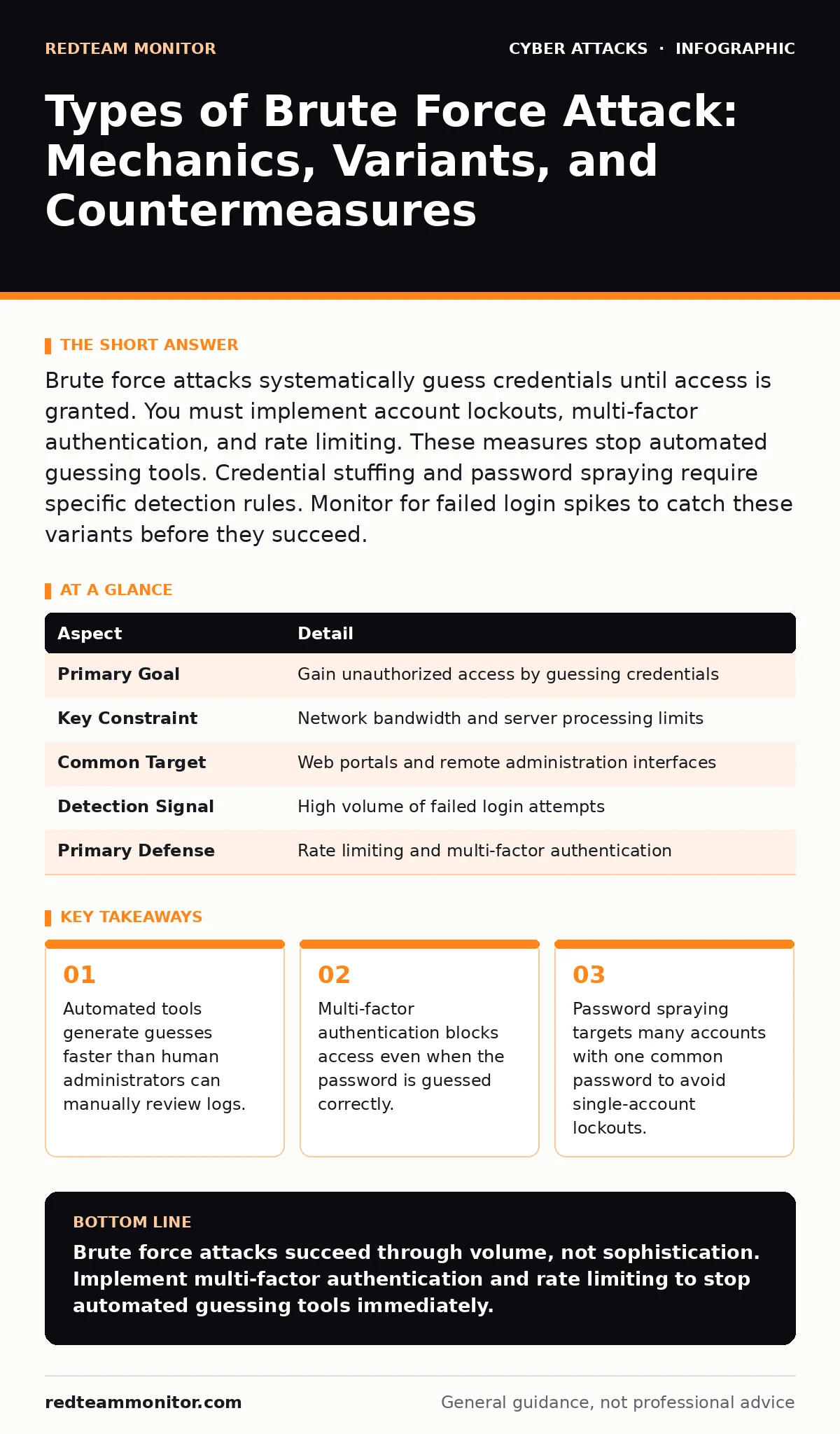
Brute force attacks systematically guess credentials until access is granted. You must implement account lockouts, multi-factor authentication, and rate limiting. These measures stop automated guessing tools. Credential stuffing and password spraying require specific detection rules. Monitor for failed login spikes to catch these variants before they succeed.
Understanding the Mechanism
Imagine a burglar trying every combination on a four-digit lock. They do not care about the logic of the numbers. They try 0000, then 0001, then 0002. They continue until the lock opens. A brute force attack operates on this same principle. An attacker uses software to submit vast numbers of login attempts. The software generates passwords from dictionaries or random character sets. The attacker waits for the system to accept one of these guesses.
This approach affects any system that relies on static secrets for authentication. Email accounts, administrative panels, and remote access tunnels are all targets. The attacker does not need a software vulnerability. They only need a login form and a lack of rate limiting. The attack succeeds when the volume of guesses exceeds the defense mechanisms.
| Aspect | Detail |
|---|---|
| Primary Goal | Gain unauthorized access by guessing credentials |
| Key Constraint | Network bandwidth and server processing limits |
| Common Target | Web portals and remote administration interfaces |
| Detection Signal | High volume of failed login attempts |
| Primary Defense | Rate limiting and multi-factor authentication |
How Brute Force Attacks Work
The attack begins with reconnaissance. The attacker identifies a login interface. They may use automated scanners to find web forms that accept input. Once the target is located, the attacker deploys a bot. This bot sends HTTP POST requests to the login endpoint. Each request contains a username and a guessed password. The server processes the request. If the credentials are wrong, the server returns an error code. If they are right, the server grants a session token.
The attacker’s software parses the response. It ignores errors and continues the loop. The speed of the attack depends on the network connection and the server’s tolerance for requests. A well-configured server will slow down requests after a few failures. A poorly configured server will accept thousands of requests per minute. The attacker stops when the software returns a success code.
Types of Brute Force Attack
Readers searching for types of brute force attack often expect a single method. In reality, attackers adapt their technique to bypass specific defenses. Understanding these variations helps you tune your monitoring rules.
- Classic Brute Force: The attacker tries every possible combination for a single account. This method is slow against long passwords. It is effective against short, simple passwords.
- Dictionary Attack: The software uses a list of common words and phrases. This list includes "password123" or "company2024". This method is faster than classic brute force. It succeeds if the user chose a common password.
- Password Spraying: The attacker takes one common password and tries it against many users. This avoids locking out a single account. It exploits the fact that many users share simple passwords. This technique relates closely to password spraying strategies used by credential harvesters.
- Credential Stuffing: The attacker uses a list of stolen usernames and passwords from other breaches. They test these pairs against your system. This works because users reuse passwords across services. This overlaps with the risks discussed in supply chain attacks when third-party credentials are compromised.
- Hybrid Attack: The software modifies dictionary words with numbers or symbols. It tries "Summer2024!" and "Winter2024!". This bridges the gap between dictionary and classic brute force.
What People Usually Get Wrong
Many teams believe that strong password policies stop brute force attacks. This is incorrect. A policy requiring 12 characters does not stop an automated bot. The bot will try 12-character combinations. The defense must be at the network or application layer.
Another common error is relying solely on account lockouts. If you lock an account after 5 failed attempts, you create a denial-of-service risk. An attacker can lock out all users in your database. They send one failed attempt per account. This disables access for legitimate users. You must balance security with availability.
Teams also ignore the success case. Monitoring for failed logins is standard. Monitoring for successful logins after a burst of failures is rare. The failure logs are noise. The success log is the signal. If you only watch for failures, you miss the actual breach.
Countermeasures and Mitigation
You need layered defenses to stop automated guessing. Multi-factor authentication is the single most effective control. It requires a second proof of identity. Even if the attacker guesses the password, they cannot access the account without the second factor. This is why phishing-resistant authentication is a critical upgrade for high-risk accounts.
Rate limiting restricts the number of login attempts per IP address. You can set a limit of 10 attempts per minute. If an IP exceeds this, the server blocks it. This slows down the attacker significantly. It forces them to rotate IP addresses. This adds friction to the attack.
Geographic blocking helps if your users are only in specific regions. If you see login attempts from countries where you have no customers, block those IP ranges. This reduces the attack surface.
Implement CAPTCHA challenges after a few failed attempts. This forces the attacker to solve a puzzle. Automated bots struggle with complex CAPTCHAs. This buys you time to detect and block the source.
Detection and Response
Your security information and event management system must parse authentication logs. Create a rule that alerts on high failure rates. Look for 50 failed logins from one IP in 10 minutes. This indicates an active attack.
Correlate failed attempts with successful ones. If an IP fails 100 times and then succeeds once, trigger a high-priority alert. This pattern indicates a successful breach. Investigate the session immediately. Check for data exfiltration or privilege escalation.
Monitor for lateral movement. An attacker who gains access via brute force often moves to other systems. They may try to use the stolen credentials on internal servers. This connects to the risks of session hijacking if the attacker steals active session tokens.
Regularly review your user accounts. Disable accounts that are not in use. An attacker may target dormant accounts because they are less likely to be noticed. Reduce the number of valid usernames to lower the attack surface.
Beyond Passwords
Brute force is not limited to login forms. Attackers use similar techniques against Wi-Fi networks. They capture the handshake and try to crack the pre-shared key. This is a form of offline brute force. You must use complex Wi-Fi passwords.
Attackers also target SSH keys and API tokens. If these secrets are short or predictable, they can be guessed. Treat all secrets as potential targets. Use key management systems to generate long, random secrets. Rotate them regularly.
Remember that insider threats can mimic brute force patterns. A disgruntled employee may try to access restricted areas. Your detection rules should not distinguish between internal and external sources. Monitor all authentication events equally.
Key takeaways
- Automated tools generate guesses faster than human administrators can manually review logs.
- Multi-factor authentication blocks access even when the password is guessed correctly.
- Password spraying targets many accounts with one common password to avoid single-account lockouts.
Brute force attacks succeed through volume, not sophistication. Implement multi-factor authentication and rate limiting to stop automated guessing tools immediately.
Frequently asked questions
Does changing passwords stop brute force attacks?
Changing passwords helps if the new password is strong and unique. It does not stop an active attack if the attacker is guessing in real time. You must also implement rate limiting.
Can I use a firewall to block brute force?
Yes, you can block IP addresses that show high failure rates. This is effective but can block legitimate users if they share an IP. Use geographic blocking and reputation lists for better accuracy.
Is two-factor authentication enough?
Two-factor authentication stops access even if the password is guessed. It is highly effective. However, you must protect the second factor from phishing-resistant authentication methods.
How do I know if a brute force attack succeeded?
Look for a successful login immediately following a series of failures from the same source. Alert on this specific pattern. Investigate the session for unusual activity or data access.
How this guide was produced: written by the RedTeam Monitor editorial team with AI assistance, checked against the public references listed below, and reviewed when the facts change. See our editorial policy or report an error.