
Data Leaks Explained: Mechanisms, Risks, and Prevention Strategies
Most data leaks stem from misconfigured access controls and human error rather than sophisticated external attacks, meaning detection relies on behavioral analysis rather than just perimeter defenses.
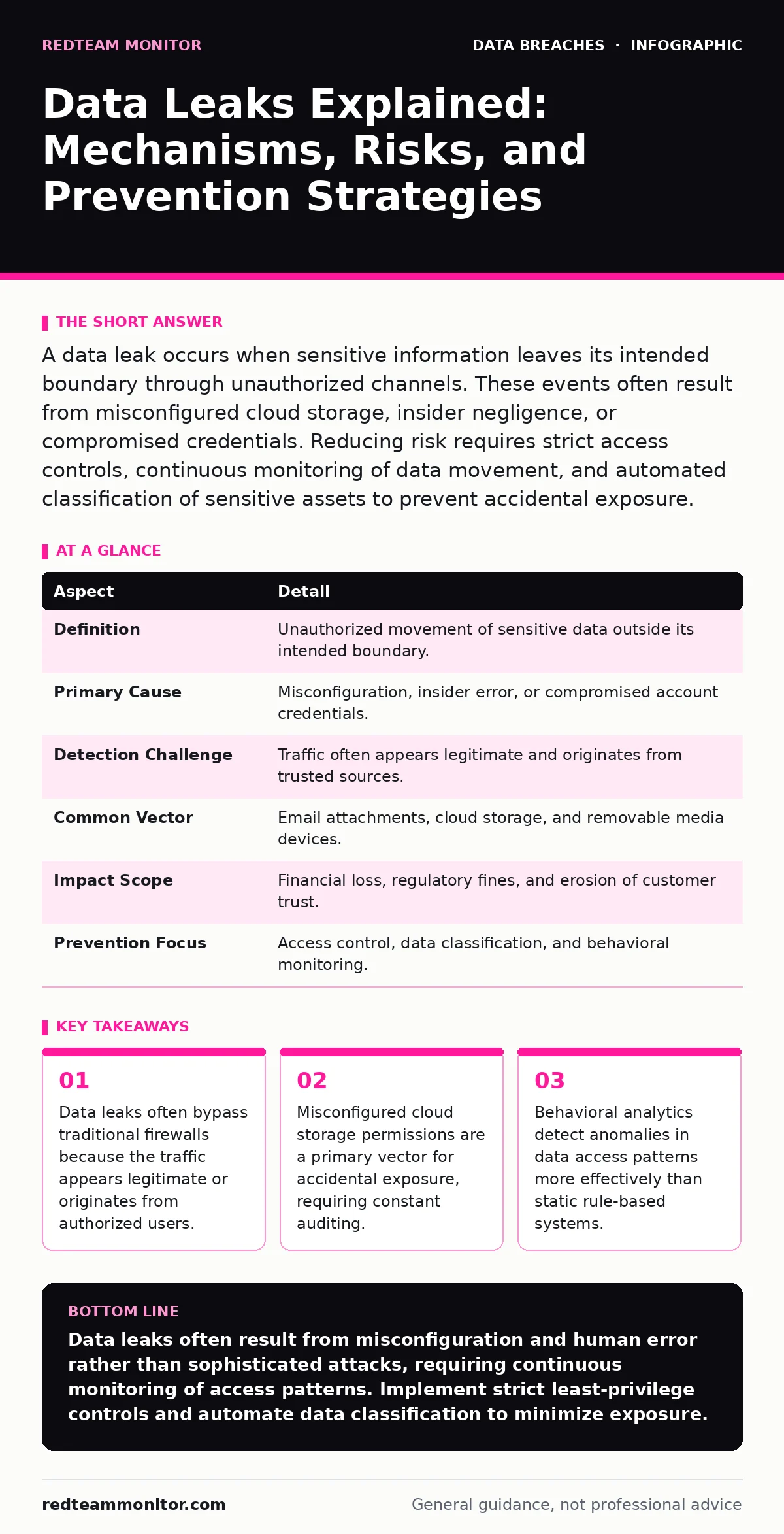
A data leak occurs when sensitive information leaves its intended boundary through unauthorized channels. These events often result from misconfigured cloud storage, insider negligence, or compromised credentials. Reducing risk requires strict access controls, continuous monitoring of data movement, and automated classification of sensitive assets to prevent accidental exposure.
The Mechanics of Unauthorized Data Exfiltration
Imagine a physical filing cabinet in a busy office. Anyone can walk in and take a document if the door is open. A data leak operates on the same principle, but at digital scale. It is the unauthorized or unintended transfer of sensitive information from an organization’s secure environment to an external or untrusted recipient. This transfer can be intentional, driven by malicious intent, or accidental, caused by configuration errors or human mistake.
The core issue is not always a breach of the outer perimeter. Often, the data moves through legitimate channels. An employee might upload a spreadsheet to a public cloud drive. A developer might accidentally commit code containing database credentials to a public repository. In these cases, the network security tools see valid traffic from an authorized user, so they do not block the transfer. The leak happens because the destination was unsafe, not because the path was blocked.
| Aspect | Detail |
|---|---|
| Definition | Unauthorized movement of sensitive data outside its intended boundary. |
| Primary Cause | Misconfiguration, insider error, or compromised account credentials. |
| Detection Challenge | Traffic often appears legitimate and originates from trusted sources. |
| Common Vector | Email attachments, cloud storage, and removable media devices. |
| Impact Scope | Financial loss, regulatory fines, and erosion of customer trust. |
| Prevention Focus | Access control, data classification, and behavioral monitoring. |
Common Vectors for Data Loss
Data leaves organizations through several predictable pathways. Email remains the most common vector. Users send sensitive attachments to the wrong recipient or to external partners who lack adequate security measures. Once the email leaves the corporate domain, the organization loses control over how that data is stored or shared.
Cloud storage services introduce a different set of risks. When teams use shared drives for collaboration, permission settings can become complex. A folder intended for internal review might be set to "anyone with the link can view." This misconfiguration exposes the data to the entire internet. The leak is not a hack; it is a simple error in access control settings that remains undetected until someone finds the link.
Removable media devices also facilitate leaks. A USB drive plugged into a corporate laptop can copy terabytes of data in minutes. If that drive is lost or stolen, the data is exposed. Even if the drive is encrypted, the metadata or unencrypted files on it can reveal sensitive information. Physical loss of a device is a data leak event that requires immediate incident response.
The Human Element and Insider Threats
People are often the weakest link in data security, not because they are malicious, but because they are busy. Employees under pressure may bypass security protocols to meet deadlines. They might use personal email accounts to send work files home. This action, known as shadow IT, moves data outside the organization’s monitoring tools. The security team cannot detect what it cannot see.
Insider threats also include negligent behavior. An employee might leave a laptop unlocked in a public space. A developer might hardcode passwords into application source code. These actions expose data to anyone who gains access to the device or the code repository. The leak occurs because the data was placed in an insecure location, not because an attacker broke in.
Malicious insiders pose a different risk. An employee with legitimate access might copy data before leaving the company. Because their access is authorized, standard security tools do not flag the activity. Detection here relies on behavioral analytics. The system looks for unusual patterns, such as large data downloads at odd hours or access to files unrelated to the user’s job role.
Misconfiguration and Infrastructure Gaps
Infrastructure misconfiguration is a silent driver of data leaks. Cloud services require careful setup of identity and access management (IAM) policies. If these policies are too broad, users may access more data than necessary. This is known as excessive privilege. When an account with excessive privileges is compromised, the attacker gains immediate access to vast amounts of sensitive data.
APIs (Application Programming Interfaces) also present risks. APIs allow different software systems to communicate. If an API lacks proper authentication or rate limiting, attackers can scrape large volumes of data through automated requests. The API might be functioning as designed, but the design itself fails to protect the data. This is a structural flaw rather than an exploit.
Detection Challenges and Behavioral Analysis
Detecting data leaks is difficult because the data often moves through legitimate channels. Traditional firewall rules block known malicious IPs or signatures. They do not stop an authorized user from sending a sensitive PDF to their personal email. To catch these leaks, you must monitor the content and context of the data movement.
Data Loss Prevention (DLP) tools scan outgoing traffic for sensitive patterns, such as credit card numbers or social security numbers. These tools reduce risk by blocking or quarantining messages that contain such patterns. However, DLP tools can generate false positives if the data classification is inaccurate. For example, a marketing document might contain a sample credit card number for testing, which the tool flags as a leak.
Behavioral analytics offer a deeper layer of detection. These systems learn the normal behavior of users and systems. If a user suddenly downloads a large number of files or accesses data from a new location, the system flags it as anomalous. This approach helps identify both insider threats and compromised accounts. It complements DLP by focusing on the "who" and "when" rather than just the "what."
See also: Infrastructure-as-Code Myths: Why Static Scanning Fails to Catch Errors · Service Mesh Security Misconceptions That Weaken Your Defense
What People Usually Get Wrong
Many organizations assume that if they have a firewall and antivirus, they are safe from data leaks. This is a false assumption. These tools protect against external attacks and malware. They do not prevent an authorized user from emailing a sensitive file to the wrong person. Data protection requires a different set of controls focused on access and monitoring.
Another common mistake is relying solely on perimeter security. The perimeter is no longer a clear line. With remote work and cloud services, data exists in many places. Security must extend to every endpoint and cloud service. Access control must be granular and dynamic. Static rules fail in dynamic environments.
Reducing Risk Through Control and Culture
Reducing the risk of data leaks requires a layered approach. Start with data classification. Identify what data is sensitive and where it resides. You cannot protect what you do not know exists. Classify data by sensitivity level and apply appropriate controls to each level.
Next, enforce least privilege access. Users should only have access to the data they need to do their jobs. Regularly review access rights to ensure they remain appropriate. Revoke access for employees who change roles or leave the organization. This reduces the impact of a compromised account.
Finally, educate users on data handling. Training should be specific and practical. Show examples of how leaks happen and how to avoid them. Encourage a culture where employees report mistakes without fear of punishment. Early reporting allows for faster containment and reduces the damage.
Key takeaways
- Data leaks often bypass traditional firewalls because the traffic appears legitimate or originates from authorized users.
- Misconfigured cloud storage permissions are a primary vector for accidental exposure, requiring constant auditing.
- Behavioral analytics detect anomalies in data access patterns more effectively than static rule-based systems.
Data leaks often result from misconfiguration and human error rather than sophisticated attacks, requiring continuous monitoring of access patterns. Implement strict least-privilege controls and automate data classification to minimize exposure.
Frequently asked questions
Can encryption stop a data leak?
Encryption protects data if it is stolen without being decrypted. However, it does not stop an authorized user from accessing and sharing the data. You need access controls to prevent the initial exposure.
What is the difference between a breach and a leak?
A breach implies unauthorized entry into a system. A leak is the unauthorized release of data, which can happen through authorized channels or misconfiguration. All leaks are not breaches, but all breaches can lead to leaks.
How long does it take to detect a leak?
Detection time varies based on your monitoring tools and processes. Rapid detection requires real-time monitoring of data movement and access patterns. Slower detection increases the impact of the leak.
How this guide was produced: written by the RedTeam Monitor editorial team with AI assistance, checked against the public references listed below, and reviewed when the facts change. See our editorial policy or report an error.