
Stop Data Leaks: Prevent Exfiltration with These Controls
Most data loss stems from identity misuse rather than perimeter breaches, making identity governance the primary defense layer against unauthorized access.
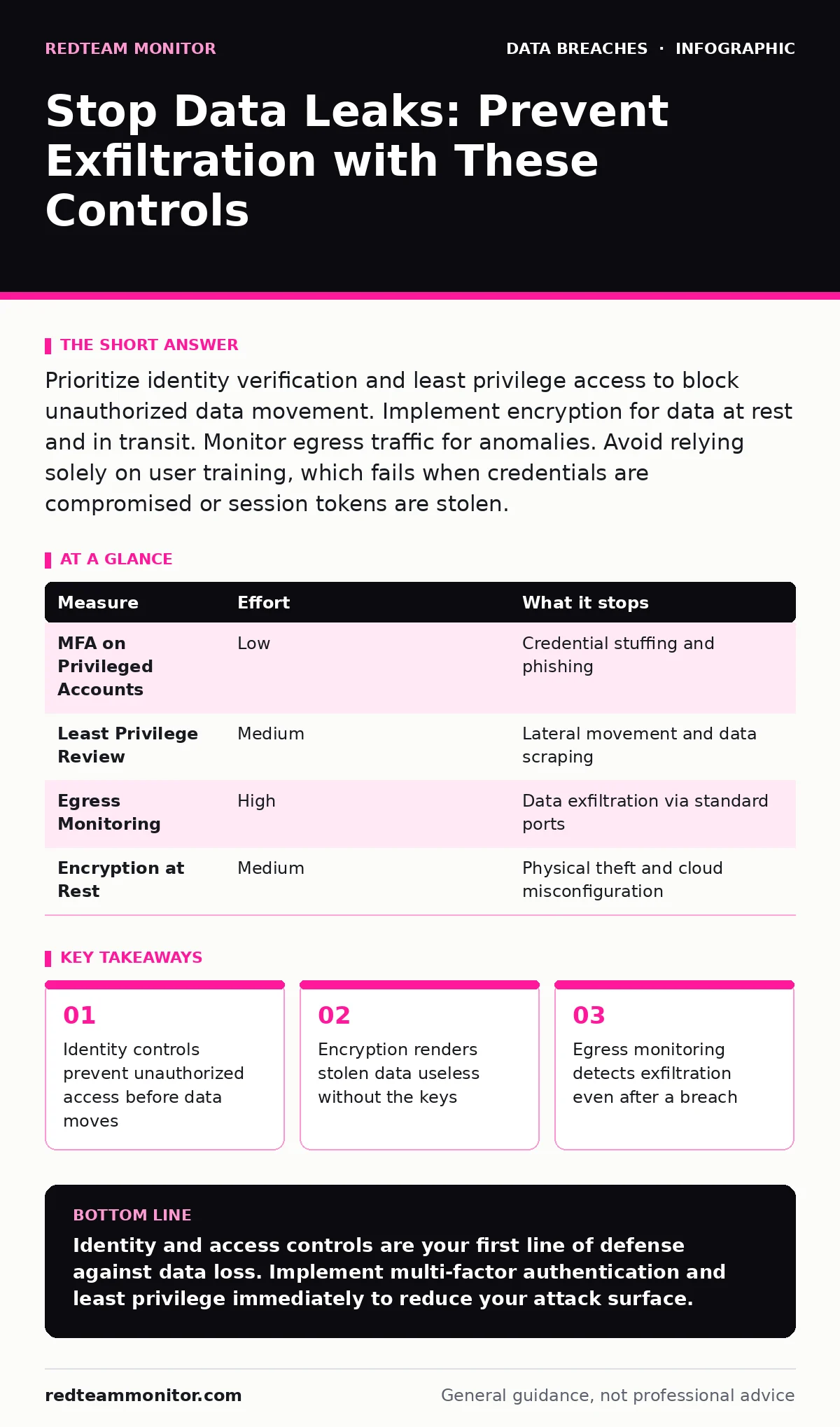
Prioritize identity verification and least privilege access to block unauthorized data movement. Implement encryption for data at rest and in transit. Monitor egress traffic for anomalies. Avoid relying solely on user training, which fails when credentials are compromised or session tokens are stolen.
Identity as the Perimeter
The traditional network perimeter has dissolved. You can no longer trust traffic simply because it originates from inside your firewall. Modern architecture treats every request as untrusted until verified. This shift requires zero trust principles, where access is granted based on identity, device health, and context, not just IP address.
When an attacker gains entry, they rarely steal data immediately. They move laterally, seeking accounts with higher privileges. If your systems rely on static passwords or weak multi-factor authentication, they can impersonate legitimate users. You must verify who is accessing the data, not just where they are connecting from.
Implement conditional access policies that block logins from unfamiliar locations or devices. This stops many automated attacks before they reach your sensitive repositories. It also reduces the noise in your security operations center, allowing analysts to focus on genuine threats rather than routine anomalies.
Least Privilege Enforcement
Users often hold more access rights than they need for their daily tasks. This excess privilege creates a wide attack surface. When an account is compromised, the attacker inherits all those unnecessary permissions. They can read, copy, or delete data they never needed to see.
Audit access rights regularly. Remove permissions for employees who have changed roles or left the organization. Use role-based access control to assign permissions based on job function rather than individual request. This ensures that even if a credential is leaked, the damage is contained to a specific scope.
Imagine a marketing employee whose account is hijacked. With least privilege, they cannot access financial records or source code. The attacker hits a wall quickly. This containment strategy significantly reduces the potential impact of any single compromise event.
Data Encryption Standards
Encryption transforms readable data into ciphertext, which is unintelligible without the correct decryption key. You must encrypt data both at rest, such as in databases and on servers, and in transit, as it moves across networks. This dual approach protects against physical theft of hardware and interception of network traffic.
Without encryption, a backup tape left in a truck or a cloud storage bucket misconfigured for public access results in immediate exposure. With encryption, that same data remains secure. The keys must be managed separately from the data itself. If an attacker steals the encrypted files but not the keys, the data is useless to them.
Egress Traffic Monitoring
Most data exfiltration happens over standard channels like HTTPS or DNS. Attackers disguise their stolen data as normal web traffic or domain lookups. Standard firewalls often allow this traffic because it appears legitimate. You need specialized monitoring tools that inspect the content and behavior of outbound connections.
Look for anomalies in volume and timing. A sudden spike in data leaving a specific server at 3 AM is suspicious. Detecting these patterns allows you to block the connection in real time. This stops the theft even if the attacker has already bypassed identity and access controls.
This measure is critical because it addresses the final stage of the attack chain. It does not prevent the initial breach, but it prevents the loss. Combine this with data loss prevention software that scans for sensitive patterns, such as credit card numbers or social security numbers, in outgoing emails and uploads.
What Does Not Work
User awareness training is often touted as a primary defense. While it helps, it is insufficient on its own. Phishing emails are becoming increasingly sophisticated and difficult to distinguish from legitimate messages. Even trained users can be tricked by well-crafted scams.
Relying solely on training assumes that humans are perfect gatekeepers. They are not. Fatigue, urgency, and social engineering bypass cognitive defenses. You must assume that some clicks will happen. Your technical controls must catch the fallout from those clicks.
Similarly, perimeter-only defenses fail against insider threats. An employee with legitimate access can copy data without triggering external alerts. You need internal controls that monitor user behavior and restrict data movement regardless of where the request originates.
See also: Cyber Insurance: Real Coverage vs Hidden Gaps
Quick Wins for Today
You can reduce risk immediately without major infrastructure changes. Start by enforcing multi-factor authentication on all privileged accounts. This single step blocks the majority of credential-based attacks. It adds a layer of verification that passwords alone cannot provide.
Next, disable unused accounts and applications. Every active account is a potential entry point. Review your cloud storage permissions and remove public access where it is not required. This closes common misconfiguration gaps that lead to exposure.
Finally, enable logging on your critical systems. You cannot protect what you cannot see. Ensure that access logs, login attempts, and data transfers are recorded and stored securely. This provides the evidence needed for digital forensics if a breach occurs.
| Measure | Effort | What it stops |
|---|---|---|
| MFA on Privileged Accounts | Low | Credential stuffing and phishing |
| Least Privilege Review | Medium | Lateral movement and data scraping |
| Egress Monitoring | High | Data exfiltration via standard ports |
| Encryption at Rest | Medium | Physical theft and cloud misconfiguration |
Closing Checklist
Use this list to verify your immediate posture. These actions take less than an hour but address the most common failure points.
- Verify that multi-factor authentication is enabled for all administrative accounts.
- Check cloud storage buckets and ensure none are publicly accessible.
- Confirm that logs are being collected for all critical data repositories.
Key takeaways
- Identity controls prevent unauthorized access before data moves
- Encryption renders stolen data useless without the keys
- Egress monitoring detects exfiltration even after a breach
Identity and access controls are your first line of defense against data loss. Implement multi-factor authentication and least privilege immediately to reduce your attack surface.
Frequently asked questions
Does multi-factor authentication stop all data leaks?
No, MFA prevents unauthorized account access but does not stop insiders with valid credentials from stealing data. It must be paired with monitoring and least privilege controls.
How do I detect if data has been exfiltrated?
Monitor for unusual outbound traffic volumes and patterns. Look for large data transfers occurring outside of business hours or from unexpected devices.
Is encryption enough to protect my backups?
Encryption protects the data itself, but you must also secure the decryption keys and ensure the backup infrastructure is not publicly accessible.
What is the biggest risk for small organizations?
Misconfigured cloud storage and weak credentials are the most common causes of exposure for smaller teams with limited security resources.
How this guide was produced: written by the RedTeam Monitor editorial team with AI assistance, checked against the public references listed below, and reviewed when the facts change. See our editorial policy or report an error.