
Cyber Insurance: Real Coverage vs Hidden Gaps
Policies often exclude the costs of digital forensics and remediation, leaving you to pay for the investigation that proves your loss.
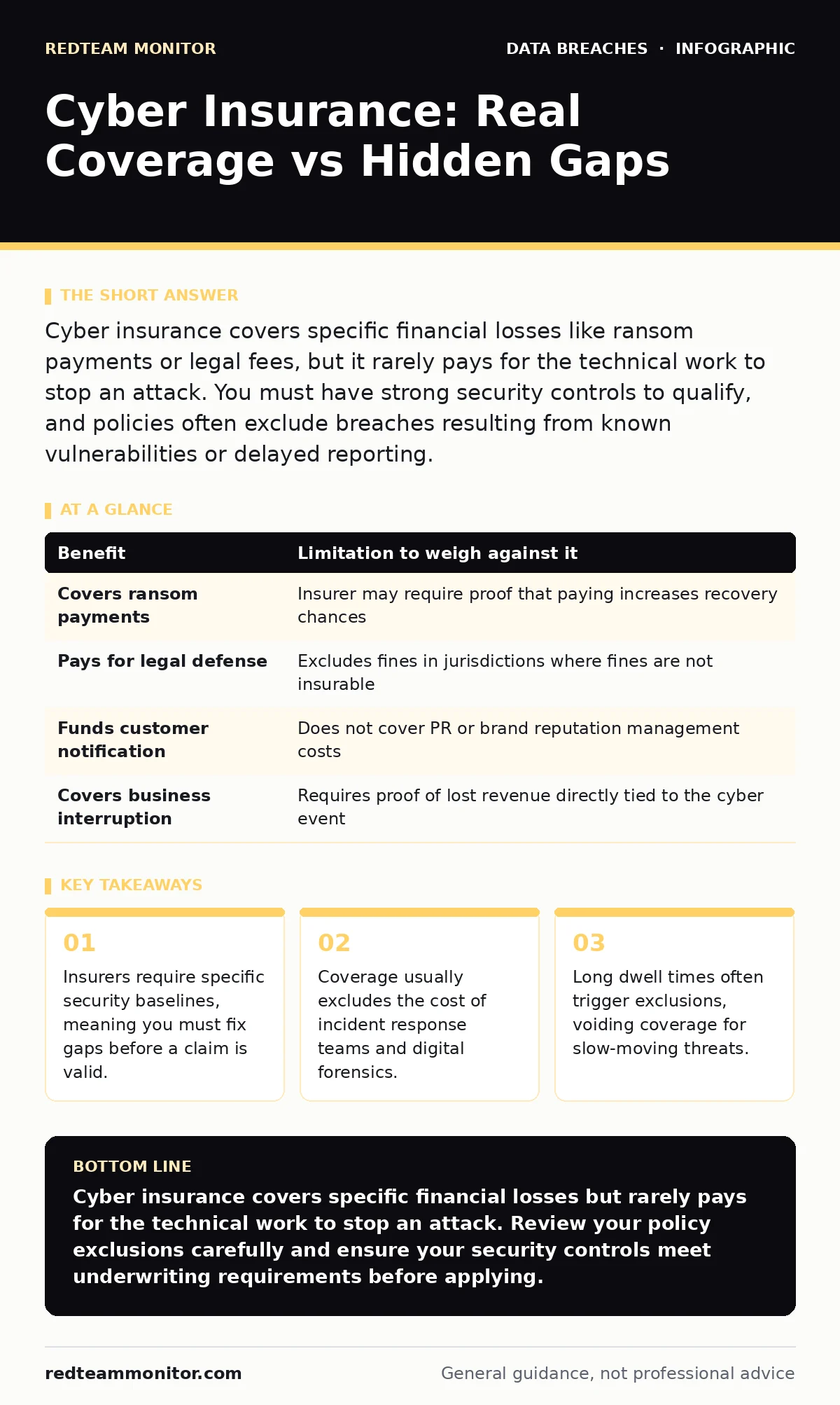
Cyber insurance covers specific financial losses like ransom payments or legal fees, but it rarely pays for the technical work to stop an attack. You must have strong security controls to qualify, and policies often exclude breaches resulting from known vulnerabilities or delayed reporting.
The Mechanics of Risk Transfer
Cyber insurance shifts financial risk from your balance sheet to an insurer. It does not prevent attacks, nor does it fix broken systems. You are buying a payout for specific, predefined events. The policy language dictates exactly what triggers a claim. Most policies cover first-party costs like business interruption and third-party costs like liability from data leaks.
You must understand the difference between coverage and prevention. Insurance is a financial backstop, not a security control. If you rely on insurance to solve security problems, you will face coverage denials. Insurers expect you to maintain a baseline of security hygiene. This baseline changes as threats evolve. What was acceptable five years ago may now be considered negligent.
Concrete Financial Benefits
The primary benefit is liquidity during a crisis. A ransomware attack can freeze operations and drain cash reserves. Insurance provides immediate funds to pay for crisis management, legal counsel, and notification costs. This prevents bankruptcy while you restore systems. It also covers regulatory fines in jurisdictions where such payments are insurable.
Another benefit is access to expert resources. Many policies include pre-approved vendors for incident response. These vendors understand the insurer’s requirements and can produce the documentation needed for a claim. This speeds up the payout process. You avoid the delay of vetting new vendors while under attack.
| Benefit | Limitation to weigh against it |
|---|---|
| Covers ransom payments | Insurer may require proof that paying increases recovery chances |
| Pays for legal defense | Excludes fines in jurisdictions where fines are not insurable |
| Funds customer notification | Does not cover PR or brand reputation management costs |
| Covers business interruption | Requires proof of lost revenue directly tied to the cyber event |
The Hidden Costs of Coverage
Insurance introduces operational friction. You must disclose your security posture during underwriting. This disclosure becomes part of the contract. If you lie or omit details, the insurer can void the policy. This creates a tension between transparency and competitive secrecy. You must share vulnerability scan results and architecture diagrams.
There is also the cost of exclusions. Most policies exclude coverage for attacks that exploit known vulnerabilities. If you failed to patch a system for a month, the insurer may deny the claim. This forces you to maintain rigorous patch management. The insurance premium is only one cost; the cost of compliance is higher.
When Technical Realities Void Claims
Coverage often fails when technical realities contradict policy assumptions. Suppose an attacker uses stolen session tokens to bypass multi-factor authentication. Many policies exclude losses from authenticated sessions, assuming the user authorized the access. You may find that identity theft is not covered if it involves valid credentials.
Another common gap is backup data exposure. If your backups are online and encrypted by ransomware, the cost to restore from offline media is often excluded. Insurers view offline backups as a standard control. If you did not implement them, you are responsible for the recovery cost. This exclusion pushes you to invest in immutable storage.
Consider the issue of breach dwell time. If an attacker remains in your network for months, insurers may argue you failed to detect the threat. Long dwell times suggest inadequate monitoring. The policy may require continuous monitoring tools. Without them, you bear the cost of the extended intrusion.
When It Is Worth It
Insurance is worth it when you face high liability risks. If you process sensitive data like medical records, the potential fines and lawsuits are massive. Insurance caps your financial exposure. It is also valuable if you have limited cash reserves. A single attack could bankrupt a small firm without a payout.
It is also worth it when you have mature security practices. If you already use multi-factor authentication, endpoint detection, and regular backups, your risk is lower. Insurers offer better rates to secure organizations. You pay a premium for peace of mind, not for a security fix. The policy acts as a final layer of defense.
See also: What Does Red Teaming Mean: A Practical Breakdown
When It Is Not Worth It
Insurance is not worth it if your security posture is weak. Insurers will either reject your application or offer limited coverage with high deductibles. You cannot buy your way out of poor security. If you lack basic controls, you are uninsurable. The effort to secure your environment will exceed the cost of the premium.
It is also not worth it if you do not understand the exclusions. If the policy excludes the most likely threats you face, you are paying for nothing. For example, if you rely on remote access but the policy excludes remote work vulnerabilities, the coverage is useless. You must read the exclusions carefully.
The Underwriting Reality Check
Underwriters look for specific controls. They want to see multi-factor authentication on all administrative accounts. They expect encryption for data at rest and in transit. They require regular vulnerability scanning. If you cannot prove these controls, you will not get coverage. The application process is a security audit.
Preparing for the Claim Process
A claim is not automatic. You must notify the insurer within a strict timeframe, often 24 to 48 hours. Delayed notification can void the policy. You must preserve evidence. Do not reboot servers or delete logs. The insurer will send a forensic team. Their report determines the payout.
You must also manage credential dumps carefully. If attackers exfiltrate credentials, you must rotate them immediately. Failure to do so can be seen as negligence. The insurer will expect you to mitigate further damage. Your actions during the incident affect the claim outcome.
Key takeaways
- Insurers require specific security baselines, meaning you must fix gaps before a claim is valid.
- Coverage usually excludes the cost of incident response teams and digital forensics.
- Long dwell times often trigger exclusions, voiding coverage for slow-moving threats.
Cyber insurance covers specific financial losses but rarely pays for the technical work to stop an attack. Review your policy exclusions carefully and ensure your security controls meet underwriting requirements before applying.
Frequently asked questions
Does cyber insurance cover ransomware payments?
Many policies cover ransom payments, but insurers often require proof that paying increases the likelihood of data recovery and may refuse if paying violates local laws.
Is cyber insurance required by law?
No, cyber insurance is not legally required in most jurisdictions, though some contracts with large clients may mandate it as a condition of service.
How long does it take to get a payout?
Payout times vary widely, ranging from weeks to months, depending on the complexity of the incident and the completeness of your documentation.
Can I get insurance if I have already had a breach?
It is difficult to get coverage after a breach, as insurers view you as high-risk; some may offer coverage with higher premiums and stricter exclusions.
How this guide was produced: written by the RedTeam Monitor editorial team with AI assistance, checked against the public references listed below, and reviewed when the facts change. See our editorial policy or report an error.