
Strategic vs Tactical Threat Intelligence: Differences and Use Cases
Strategic intelligence shapes long-term risk budgets and architecture, while tactical intelligence drives immediate detection rules and incident response playbooks.
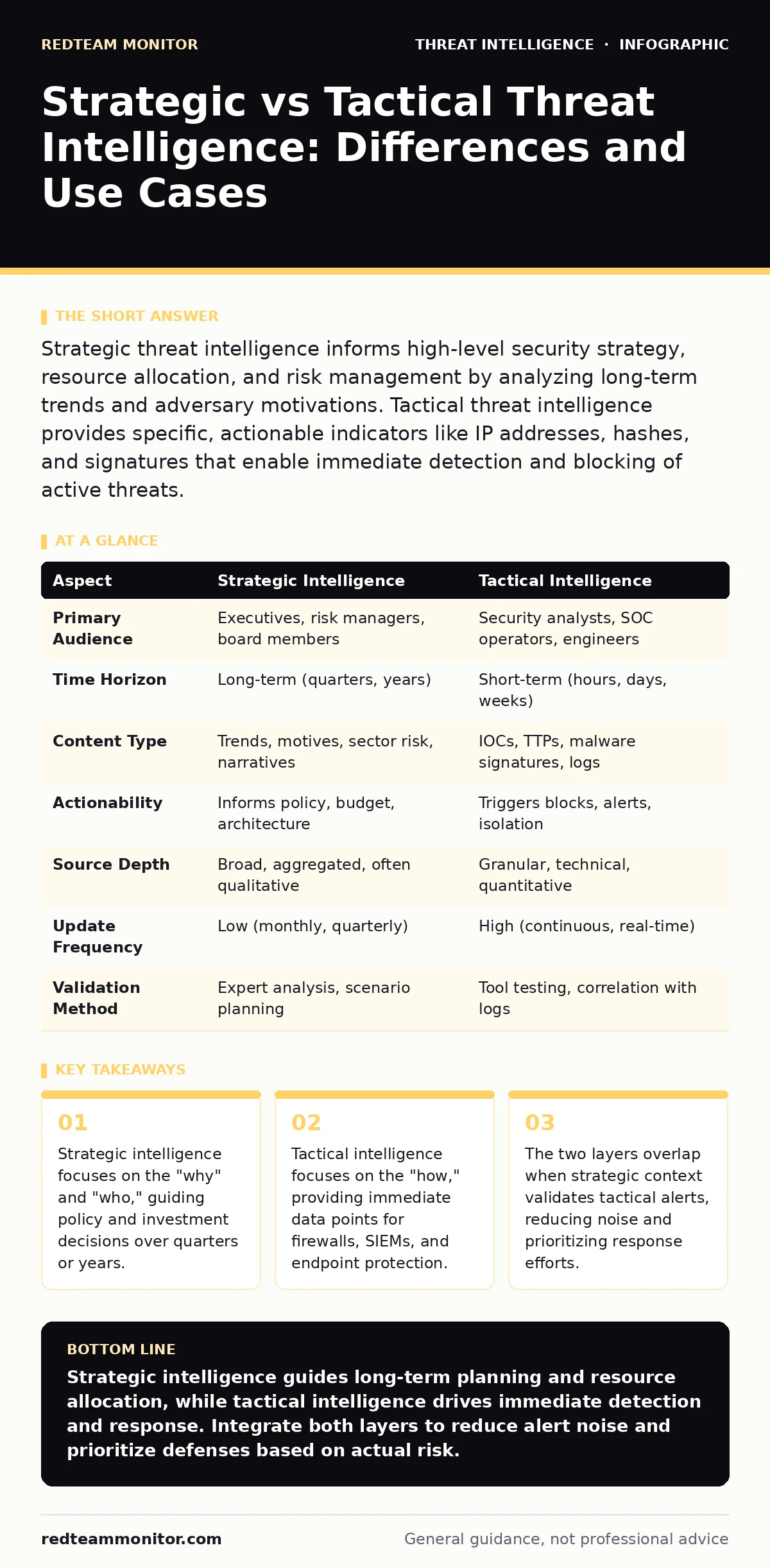
Strategic threat intelligence informs high-level security strategy, resource allocation, and risk management by analyzing long-term trends and adversary motivations. Tactical threat intelligence provides specific, actionable indicators like IP addresses, hashes, and signatures that enable immediate detection and blocking of active threats.
Defining Strategic Threat Intelligence
Strategic threat intelligence addresses the broader context of the threats facing your organization. It answers questions about who is attacking, why they are attacking, and what their long-term goals are. This type of intelligence relies heavily on open-source intelligence (OSINT) and analysis of geopolitical or economic factors. It does not provide specific indicators of compromise. Instead, it helps leadership understand which sectors are under pressure and how adversaries might shift their focus.
Imagine your security budget is fixed. Strategic intelligence tells you whether to invest in email filtering or endpoint detection. It highlights the rise of specific threat actor profiles without naming specific incidents. This layer of intelligence supports decision-making at the executive level. It connects technical risks to business outcomes.
Defining Tactical Threat Intelligence
Tactical threat intelligence deals with the specific methods and tools used by attackers to breach defenses. It provides actionable data such as IP addresses, domain names, file hashes, and attack patterns. This intelligence is short-lived and highly specific. It feeds directly into security tools like intrusion prevention systems and antivirus software. The goal is immediate mitigation of an active or likely attack.
Tactical intelligence often derives from observing attacker behavior on cybercrime forums or analyzing malware samples. It identifies the specific initial access brokers selling access to networks. While strategic intelligence looks at the horizon, tactical intelligence looks at the ground beneath your feet. It allows defenders to block known bad traffic and detect living-off-the-land attacks that use legitimate system tools.
Point-by-Point Comparison
| Aspect | Strategic Intelligence | Tactical Intelligence |
|---|---|---|
| Primary Audience | Executives, risk managers, board members | Security analysts, SOC operators, engineers |
| Time Horizon | Long-term (quarters, years) | Short-term (hours, days, weeks) |
| Content Type | Trends, motives, sector risk, narratives | IOCs, TTPs, malware signatures, logs |
| Actionability | Informs policy, budget, architecture | Triggers blocks, alerts, isolation |
| Source Depth | Broad, aggregated, often qualitative | Granular, technical, quantitative |
| Update Frequency | Low (monthly, quarterly) | High (continuous, real-time) |
| Validation Method | Expert analysis, scenario planning | Tool testing, correlation with logs |
Where Strategic Meets Tactical
The boundary between strategic and tactical intelligence is not rigid. Strategic insights often originate from tactical observations. When analysts notice a surge in a specific malware variant, that tactical data may indicate a broader strategic shift in adversary capability. Conversely, strategic assessments of a targeted sector help analysts prioritize which tactical alerts matter most.
Without strategic context, tactical data is just noise. Thousands of IP addresses appear in logs daily. Knowing which adversaries are actively targeting your industry helps you ignore the rest. This integration reduces alert fatigue. It ensures that response efforts focus on threats that align with known strategic risks.
Choosing Strategic Intelligence
Choose strategic intelligence when you need to justify security investments to leadership. It is the right tool for answering questions about long-term risk exposure. Use it to understand the evolving threat posture of your industry. It helps in planning for future vulnerabilities before they are exploited.
Select this approach when building security policies. It informs the development of incident response plans. It also guides the selection of security frameworks. Strategic intelligence helps you prepare for attacker persistence techniques that may not be immediately detectable. It provides the narrative needed to secure buy-in for new security initiatives.
See also: Attacker Dwell Time: How to Detect and Reduce Intrusion Duration
Choosing Tactical Intelligence
Choose tactical intelligence when you need to stop an attack in progress. It is essential for configuring firewalls and updating intrusion detection rules. Use it to enrich security logs with context. It helps in identifying compromised assets quickly.
Select this approach for immediate incident response. It supports the hunt for indicators of compromise within your network. It is vital for blocking malicious domains and IP addresses. Tactical intelligence also helps in identifying canary tokens that have been triggered. It provides the granular data needed to contain and eradicate threats.
Integrating Both Layers
Effective security operations require both layers of intelligence. Strategic intelligence sets the direction, while tactical intelligence executes the defense. They overlap in the analysis phase. Analysts use strategic context to interpret tactical data. This combination improves the accuracy of threat detection.
Integration ensures that resources are allocated efficiently. It prevents wasted effort on low-risk alerts. It also ensures that long-term risks are addressed while immediate threats are mitigated. This balanced approach builds a resilient security program. It adapts to changes in the threat environment.
Leveraging Frameworks for Alignment
Aligning strategic and tactical intelligence requires a common language. Frameworks like the MITRE ATT&CK Navigator help map tactics and techniques to your defenses. This mapping bridges the gap between high-level strategy and low-level tactics. It allows you to see which strategic risks are covered by your tactical controls.
Using a shared framework ensures consistency. It helps in identifying gaps in your defense. It also facilitates communication between different teams. This alignment is critical for mature security operations. It turns disparate data into a coherent defense strategy.
Key takeaways
- Strategic intelligence focuses on the "why" and "who," guiding policy and investment decisions over quarters or years.
- Tactical intelligence focuses on the "how," providing immediate data points for firewalls, SIEMs, and endpoint protection.
- The two layers overlap when strategic context validates tactical alerts, reducing noise and prioritizing response efforts.
Strategic intelligence guides long-term planning and resource allocation, while tactical intelligence drives immediate detection and response. Integrate both layers to reduce alert noise and prioritize defenses based on actual risk.
Frequently asked questions
Can tactical intelligence become strategic over time?
Yes, patterns observed in tactical data can reveal broader trends that inform strategic assessments.
Is strategic intelligence useful for technical teams?
It helps technical teams understand the "why" behind threats, improving their ability to prioritize and contextualize alerts.
How often should strategic intelligence be updated?
It should be reviewed regularly, typically quarterly, to reflect changes in the threat environment and business goals.
What is the biggest risk of ignoring tactical intelligence?
Ignoring tactical intelligence leaves you vulnerable to known threats that could be easily blocked or detected.
How this guide was produced: written by the RedTeam Monitor editorial team with AI assistance, checked against the public references listed below, and reviewed when the facts change. See our editorial policy or report an error.