
Stolen Session Tokens: How Attackers Bypass MFA and Keep Access
Session hijacking allows attackers to bypass multi-factor authentication entirely by reusing valid, authenticated browser states rather than stealing passwords.
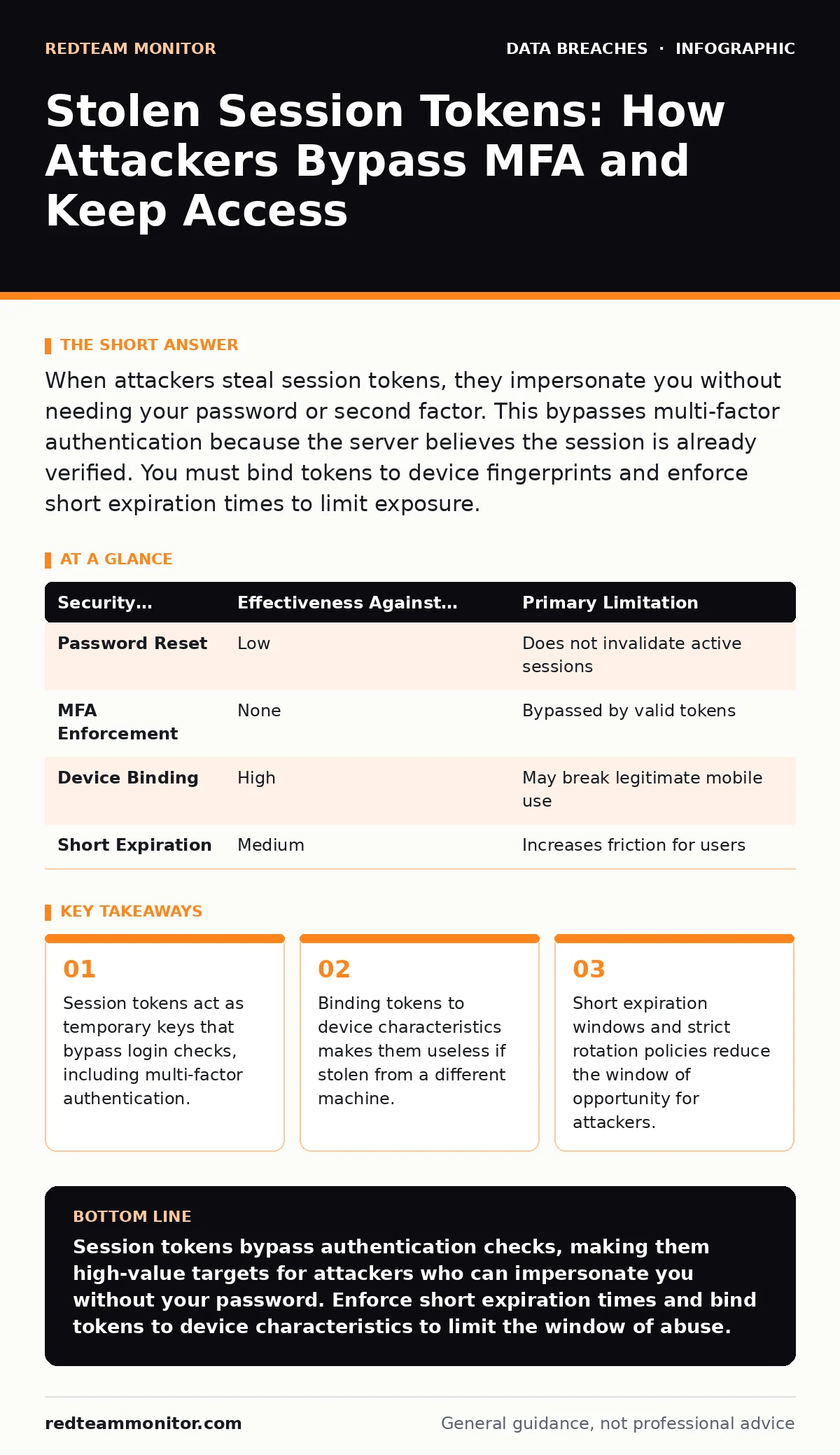
When attackers steal session tokens, they impersonate you without needing your password or second factor. This bypasses multi-factor authentication because the server believes the session is already verified. You must bind tokens to device fingerprints and enforce short expiration times to limit exposure.
What is a session token and why is it valuable?
A session token is a cryptographic string issued by a server after successful authentication, allowing the client to maintain state without re-entering credentials. Attackers value these tokens because they represent a trusted, authenticated session. Possessing a valid token grants immediate access to protected resources. The server treats the token holder as the legitimate user, ignoring standard login security controls.
Can stolen tokens bypass multi-factor authentication?
Yes, session hijacking completely bypasses multi-factor authentication because the authentication event has already occurred. The token proves the user passed all verification steps at the time of issuance. The server does not re-challenge the user for a second factor during the session’s lifetime. This makes token theft more dangerous than password theft in environments relying heavily on login-time MFA.
How do attackers actually steal session tokens?
Attackers typically intercept tokens via cross-site scripting flaws in web applications or through malicious browser extensions. They may also harvest tokens from unencrypted network traffic on public Wi-Fi networks. Another method involves accessing local storage on compromised devices where browsers cache these credentials. Once obtained, the attacker injects the token into their own browser to impersonate the victim.
Why don't standard password resets stop token abuse?
Changing a password does not invalidate existing session tokens unless the application explicitly revokes them. The server continues to accept the old token because it remains cryptographically valid. This creates a persistence mechanism that survives credential rotation. Users often assume a password change secures their account, but the active session remains open to the attacker. This gap is a common oversight in incident response, often extending the overall breach dwell time.
What is session fixation and how does it work?
Session fixation occurs when an attacker forces a victim to use a specific, known session identifier. The attacker sets this ID via a crafted link or URL parameter before the victim logs in. Once the victim authenticates, the server associates the valid credentials with the attacker’s known ID. The attacker can then hijack the session immediately without needing to intercept the token later. This technique exploits the stateless nature of HTTP protocols.
See also: Least Privilege for Small Teams: Cut Risk Without Slowing Work · GDPR Breach Notification Requirements: Timelines, Scope and Compliance Steps
How can you detect active session hijacking?
Anomalous login patterns are the primary indicator of stolen token usage. Look for simultaneous sessions from geographically impossible locations or incompatible device types. Unusual request rates or access to sensitive endpoints not typical for the user are also red flags. Monitoring for changes in user-agent strings associated with an existing session ID can reveal the swap. These signals require real-time analysis to be effective, often overlapping with techniques used in credential dumps.
Does binding tokens to devices help?
Binding tokens to device fingerprints significantly raises the barrier for attackers. This mechanism ties the token’s validity to specific hardware or browser characteristics like screen resolution or installed fonts. If an attacker moves the token to a different machine, the server rejects it. This prevents simple copy-paste attacks and forces the adversary to replicate the victim’s environment. It adds a layer of security that does not rely solely on secret knowledge.
| Security Measure | Effectiveness Against Token Theft | Primary Limitation |
|---|---|---|
| Password Reset | Low | Does not invalidate active sessions |
| MFA Enforcement | None | Bypassed by valid tokens |
| Device Binding | High | May break legitimate mobile use |
| Short Expiration | Medium | Increases friction for users |
What is the best defense strategy?
Implement short token expiration times and strict rotation policies. Force re-authentication for sensitive actions regardless of session status. Use secure, httpOnly cookies to prevent JavaScript access to tokens. This mitigates cross-site scripting risks. Regularly auditing session management logic is necessary to ensure these controls remain effective. This approach reduces the impact of data leaks containing session cookies.
Can you recover access after token theft?
You can regain control by manually terminating active sessions from your account settings. This forces the attacker’s browser to disconnect. However, this does not prevent future theft if the underlying vulnerability remains. You must also change your password to invalidate any cached credentials. Combining session termination with credential updates ensures full containment.
How do tokens differ from API keys?
Session tokens are short-lived and tied to a specific user’s interactive session. API keys are long-lived identifiers for service-to-service communication. Tokens usually expire quickly, while keys remain valid until manually revoked. This difference means token theft offers a narrow window, whereas key theft provides persistent access. Understanding this distinction helps prioritize monitoring efforts.
What role does encryption play here?
Encryption protects tokens in transit but not once they are in the browser. HTTPS prevents network sniffers from capturing tokens during transmission. It does not stop malicious scripts running on the page from accessing them. Therefore, encryption is necessary but insufficient for token security. You must combine transport security with application-level controls. This layered approach is critical for preventing backup data exposure when sessions are cached in logs.
How does this relate to identity theft?
Stolen session tokens facilitate immediate identity theft by granting access to personal data. Attackers can view financial records, change contact details, or make purchases. This happens faster than traditional phishing because no social engineering is needed. The speed of access increases the potential damage. This vector is particularly dangerous in sectors handling sensitive information, such as those prone to medical identity theft.
What is the long-term impact of poor session management?
Poor session management leads to persistent access that survives standard security updates. Attackers can maintain footholds for extended periods, moving laterally through the network. This increases the complexity of digital forensics during an incident. It also erodes trust in the platform, as users feel their credentials are insufficient. Consistent review of session policies is required to maintain security posture.
Key takeaways
- Session tokens act as temporary keys that bypass login checks, including multi-factor authentication.
- Binding tokens to device characteristics makes them useless if stolen from a different machine.
- Short expiration windows and strict rotation policies reduce the window of opportunity for attackers.
Session tokens bypass authentication checks, making them high-value targets for attackers who can impersonate you without your password. Enforce short expiration times and bind tokens to device characteristics to limit the window of abuse.
Frequently asked questions
Do I need to change my password if I suspect session hijacking?
Yes, changing your password is necessary to invalidate cached credentials, but you must also manually terminate active sessions to stop the attacker.
Can two-factor authentication stop session token theft?
No, two-factor authentication only protects the initial login. Once a token is issued and
How this guide was produced: written by the RedTeam Monitor editorial team with AI assistance, checked against the public references listed below, and reviewed when the facts change. See our editorial policy or report an error.