Breach Dwell Time: What the Clock Really Means for Defense
Dwell time measures detection delay, not attack duration, and shrinking it requires changing how you define normal network behavior.
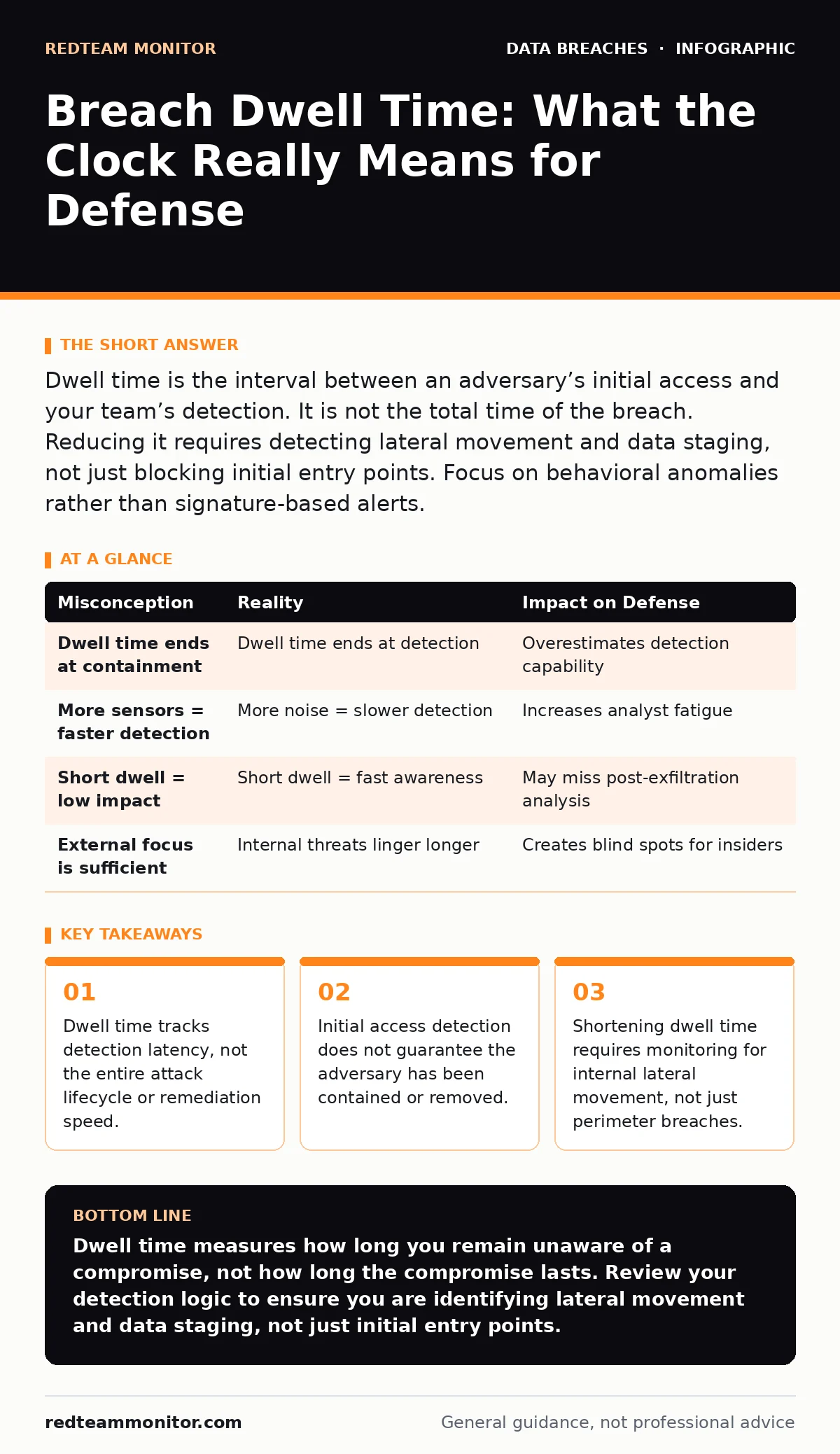
Dwell time is the interval between an adversary’s initial access and your team’s detection. It is not the total time of the breach. Reducing it requires detecting lateral movement and data staging, not just blocking initial entry points. Focus on behavioral anomalies rather than signature-based alerts.
Misreading: Dwell Time Equals Total Breach Duration
Correct reading: Dwell time is strictly the period between the adversary’s successful entry and your organization’s detection of that entry. It does not include the time spent containing the threat, eradicating malware, or restoring systems. Many security programs confuse the total incident lifecycle with dwell time. This confusion leads to misaligned metrics. You might celebrate a short dwell time while ignoring a long remediation phase. The clock stops when you know you are compromised. It does not stop when the threat is gone.
Misreading: Detecting Initial Access Ends the Clock
Correct reading: Finding the initial exploit or phishing link does not mean the adversary is gone. An attacker often establishes persistence immediately after entry. They may plant backdoors, create hidden accounts, or steal credential hashes. If you detect the initial vector but miss the subsequent lateral movement, your dwell time for the active threat is still running. The adversary remains inside. You must verify that all footholds are identified. Otherwise, you are measuring the time to find the door, not the time to find the intruder. See the guide on stolen session tokens to understand how attackers maintain access without re-authenticating.
Misreading: Lower Dwell Time Guarantees Less Data Loss
Correct reading: A short dwell time does not automatically mean less data was exfiltrated. An adversary can move terabytes of data in minutes using high-bandwidth connections. If your detection triggers after the exfiltration phase has completed, the dwell time is short, but the impact is severe.
Conversely, a long dwell time might involve an adversary who is still mapping the network and has not yet accessed sensitive databases. The metric measures speed of awareness, not volume of loss. You must correlate dwell time with data classification and access patterns. This relationship is often explored in discussions about backup data exposure, where attackers target offline copies to ensure success.
Misreading: More Alerts Reduce Dwell Time
Correct reading: Increasing alert volume often increases dwell time due to alert fatigue. When analysts are bombarded with low-fidelity signals, they miss the high-fidelity indicators hiding in the noise. This phenomenon is known as signal-to-noise ratio degradation. You might deploy dozens of new sensors, but if the correlation logic is poor, the team becomes desensitized.
The real threat blends in with the routine chatter. Effective reduction of dwell time requires tuning detection logic for precision, not just quantity. Quality of telemetry matters more than quantity. This principle applies even when analyzing credential dumps, where distinguishing brute force from valid login is critical.
Misreading: Dwell Time Is a Static Metric
Correct reading: Dwell time is dynamic and depends heavily on your definition of "normal." As your environment changes, so does the baseline for detection. A behavior that was anomalous last month may be standard today due to new applications or remote work patterns. If you do not update your detection rules, your effective dwell time increases because the adversary adapts to your static defenses.
You must continuously recalibrate what constitutes suspicious activity. This requires ongoing digital forensics to understand recent attack patterns. Static rules create blind spots that adversaries exploit. The metric is a reflection of your detection maturity, not a fixed property of your network.
See also: Stop Denial-of-Wallet Attacks: Response and Recovery Steps
Misreading: Dwell Time Applies Only to External Attacks
Correct reading: Insider threats and compromised credentials often have much longer dwell times than external breaches. External attacks often trigger perimeter alerts quickly. Internal actors already have valid credentials and expected network access. Their actions look like normal business operations.
Detecting malicious insiders requires behavioral analytics, not just signature matching. If you focus only on external ingress, you ignore the slow, methodical theft happening inside. This is particularly relevant in scenarios involving medical identity theft, where attackers use legitimate access to alter records over long periods. The dwell time for these threats can span months or years.
| Misconception | Reality | Impact on Defense |
|---|---|---|
| Dwell time ends at containment | Dwell time ends at detection | Overestimates detection capability |
| More sensors = faster detection | More noise = slower detection | Increases analyst fatigue |
| Short dwell = low impact | Short dwell = fast awareness | May miss post-exfiltration analysis |
| External focus is sufficient | Internal threats linger longer | Creates blind spots for insiders |
Misreading: Dwell Time Is Easy to Calculate
Correct reading: Accurately calculating dwell time requires precise timestamp correlation across multiple systems. You need logs from firewalls, endpoints, identity providers, and data loss prevention tools. If these systems have clock skew or missing logs, your calculation is wrong. You might think you detected an attack in days when it actually took weeks. This inaccuracy undermines trust in your metrics. Ensure time synchronization across all infrastructure. Without accurate timestamps, dwell time is just a guess. This accuracy is vital when assessing cyber insurance claims, where precise timelines determine liability and coverage.
Key takeaways
- Dwell time tracks detection latency, not the entire attack lifecycle or remediation speed.
- Initial access detection does not guarantee the adversary has been contained or removed.
- Shortening dwell time requires monitoring for internal lateral movement, not just perimeter breaches.
- Alert fatigue caused by high-volume monitoring can paradoxically increase actual dwell time.
Dwell time measures how long you remain unaware of a compromise, not how long the compromise lasts. Review your detection logic to ensure you are identifying lateral movement and data staging, not just initial entry points.
Frequently asked questions
How does dwell time differ from mean time to respond?
Dwell time is the duration of undetected presence. Mean time to respond is the time taken to contain and remediate after detection. They measure different phases of the incident lifecycle.
Can dwell time be zero?
Theoretically, yes, if detection is simultaneous with entry. In practice, this is rare. Most systems have a slight delay between the event occurring and the alert being generated and reviewed.
Does reducing dwell time prevent data leaks?
It reduces the window of opportunity for exfiltration, but it does not prevent it. Attackers can move data quickly. You must also implement data loss prevention controls to stop the actual transfer.
How do I improve my dwell time metrics?
Focus on improving detection fidelity for lateral movement and privilege escalation. Reduce alert noise to ensure analysts review high-priority signals promptly. Correlate logs from multiple sources to get a complete timeline.
How this guide was produced: written by the RedTeam Monitor editorial team with AI assistance, checked against the public references listed below, and reviewed when the facts change. See our editorial policy or report an error.