
Privacy Impact Assessments for Small Businesses: Practical Steps
Small teams avoid regulatory fines by mapping data flows and limiting access rights before a breach exposes customer records.
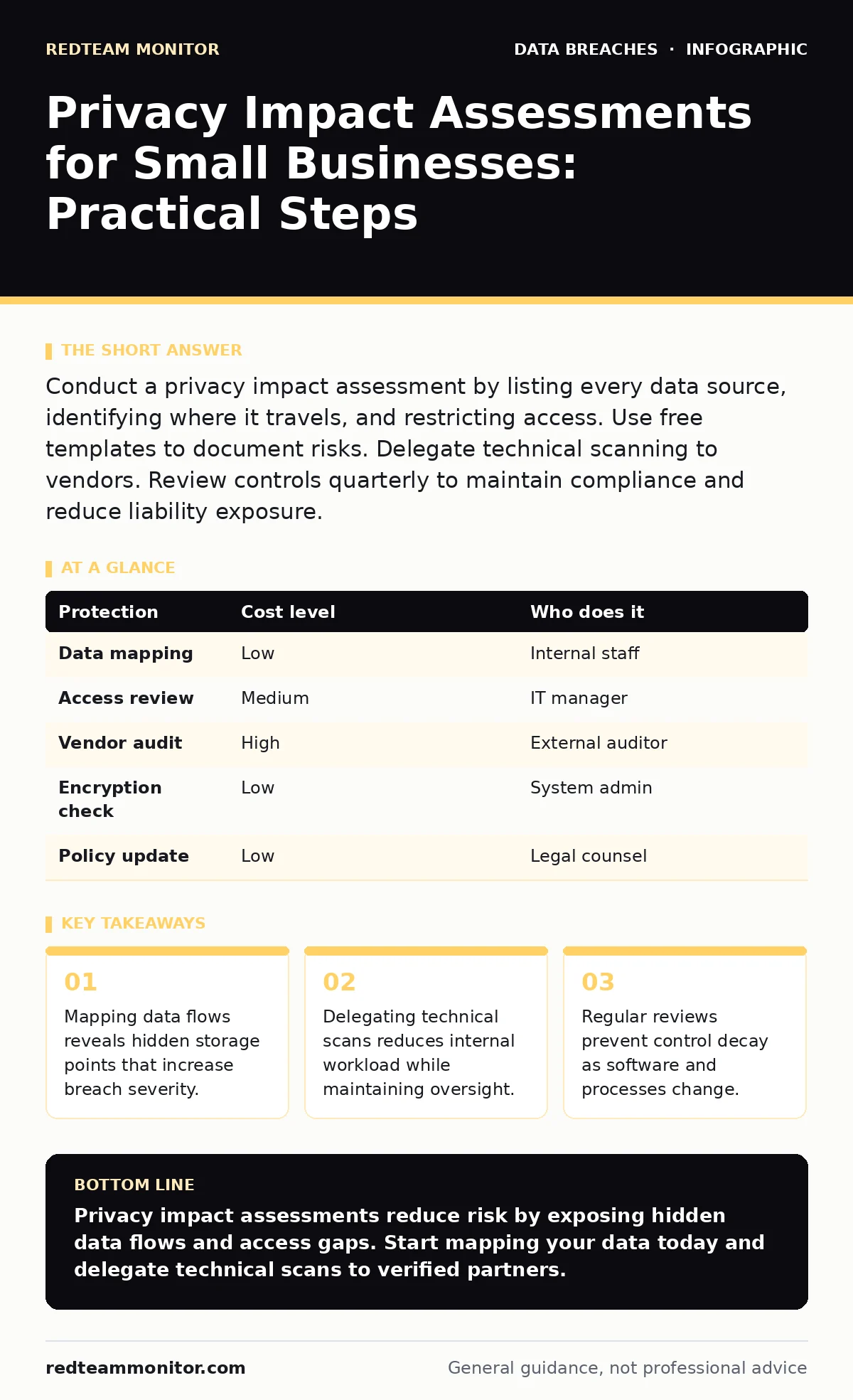
Conduct a privacy impact assessment by listing every data source, identifying where it travels, and restricting access. Use free templates to document risks. Delegate technical scanning to vendors. Review controls quarterly to maintain compliance and reduce liability exposure.
Why Small Teams Need Formal Privacy Reviews
Small organizations often assume they are too small to attract attackers or regulators. This assumption fails because data value does not correlate with company size. Attackers target small entities as entry points to larger partners. A privacy impact assessment identifies where personal data resides. It highlights gaps in protection before an incident occurs.
The process forces a team to document data handling practices. Documentation creates accountability. It shows regulators that care was taken. It also clarifies internal responsibilities. Without this map, teams react to breaches instead of preventing them. The cost of a review is low compared to legal defense.
Mapping Data Flows Reveals Hidden Risks
You must identify every point where data enters, moves, and exits your systems. Start with collection forms. Trace the data to the database. Follow it to backup locations. Check third-party integrations. Many teams forget about analytics tools or customer support tickets. These hidden stores often lack the same security controls as primary databases.
A data flow diagram visualizes these paths. It shows who has access at each stage. It reveals unnecessary copies. For instance, a marketing team might keep customer emails in a local spreadsheet while the CRM holds the master record. The spreadsheet lacks encryption. Deleting it reduces risk. This mapping exercise is the core of the assessment.
Affordable Methods for Resource-Constrained Teams
You do not need expensive software to start. Use a spreadsheet to list data types. Include fields for purpose, retention period, and access rights. Assign a risk score to each flow. High risk means sensitive data like health or financial records. Low risk means public contact information. This manual method costs nothing but time.
Free templates from public frameworks provide structure. Look for standards that align with your industry. Adapt the language to fit your context. Do not copy complex enterprise models. Keep it simple. The goal is clarity, not complexity. A simple map that everyone understands is better than a complex one that gathers dust.
| Protection | Cost level | Who does it |
|---|---|---|
| Data mapping | Low | Internal staff |
| Access review | Medium | IT manager |
| Vendor audit | High | External auditor |
| Encryption check | Low | System admin |
| Policy update | Low | Legal counsel |
What to Delegate to External Partners
Not every task requires internal expertise. Delegate technical scans to specialized providers. They can test for vulnerabilities in your infrastructure. They check for misconfigurations that expose data. This saves your team from learning complex security tools. You retain oversight of the results.
Delegate legal interpretation to counsel. Privacy laws vary by region and industry. A lawyer ensures your policies meet specific requirements. They help draft retention schedules. They advise on consent mechanisms. Do not delegate decision-making. You must approve the risk levels. You must decide on remediation priorities. The external partner provides facts. You provide judgment.
Questions to Ask Your IT Provider
When outsourcing technical aspects, you need clear metrics. Ask your provider specific questions. These questions ensure they understand your privacy goals. They prevent vague promises. They align technical work with business risk.
- How do you verify that deleted data is unrecoverable?
- Which logs capture access to sensitive records?
- How often do you test backup integrity?
- What is the process for reporting a suspected leak?
- Do you share access credentials with subcontractors?
These answers reveal their operational maturity. They show if they follow the principle of least privilege. They indicate if they monitor for credential dumps. A provider who cannot answer clearly is a risk.
See also: Password Reuse Prevention Checklist for Secure Identity Management · Least Privilege for Small Teams: Cut Risk Without Slowing Work
Integrating Privacy into Daily Operations
Privacy is not a one-time project. It must become part of your workflow. Integrate checks into software development. Require a privacy review before launching a new feature. Update assessments when processes change. A new marketing tool might introduce new data collection points. A change in vendor contracts might alter data sharing.
Train staff to recognize data handling errors. They are the first line of defense. They notice unusual requests for data. They spot misconfigured permissions. Regular training reinforces the importance of privacy. It reduces human error. It creates a culture of care. This culture protects the organization better than any tool.
Common Pitfalls in Small Business Assessments
Many teams stop at documentation. They create a map but do not act on it. This is a common mistake. The value lies in risk reduction. Identify high-risk flows. Implement controls to mitigate them. Encrypt sensitive data at rest and in transit. Restrict access to need-to-know bases.
Another pitfall is ignoring third-party risks. Your vendors hold your data. They must meet similar standards. Review their security practices. Check their incident response plans. Ensure contracts include privacy clauses. Do not assume they are secure. Verify their claims. This diligence prevents supply chain breaches.
Maintaining Compliance Over Time
Regulations evolve. Your practices must evolve with them. Schedule regular reviews. Update your maps when systems change. Reassess risks when threats emerge. This continuous improvement keeps you protected. It demonstrates commitment to privacy. It builds trust with customers.
Document every change. Keep records of decisions. This paper trail helps during audits. It shows due diligence. It proves you took reasonable steps. This documentation is your best defense. It reduces liability. It shows regulators you care. Privacy is a journey, not a destination. Stay engaged.
Key takeaways
- Mapping data flows reveals hidden storage points that increase breach severity.
- Delegating technical scans reduces internal workload while maintaining oversight.
- Regular reviews prevent control decay as software and processes change.
Privacy impact assessments reduce risk by exposing hidden data flows and access gaps. Start mapping your data today and delegate technical scans to verified partners.
Frequently asked questions
How often should a small business repeat the assessment?
Review the assessment annually or whenever significant changes occur in data handling, software, or vendor relationships.
Can a small team use free tools for privacy impact assessments?
Yes, many public frameworks offer free templates. Spreadsheets and basic diagrams are sufficient for initial mapping and risk scoring.
What is the first step in a privacy impact assessment?
Identify all data sources and map how the data moves through your systems and third-party services.
Do small businesses really need legal counsel for this?
Legal counsel helps interpret specific regulations. However, initial mapping and technical controls can be handled internally with public templates.
How this guide was produced: written by the RedTeam Monitor editorial team with AI assistance, checked against the public references listed below, and reviewed when the facts change. See our editorial policy or report an error.