
CVSS vs EPSS: Which Vulnerability Score Actually Matters
EPSS predicts real-world attack likelihood, while CVSS measures technical severity; relying solely on CVSS often wastes remediation efforts on unexploitable flaws.
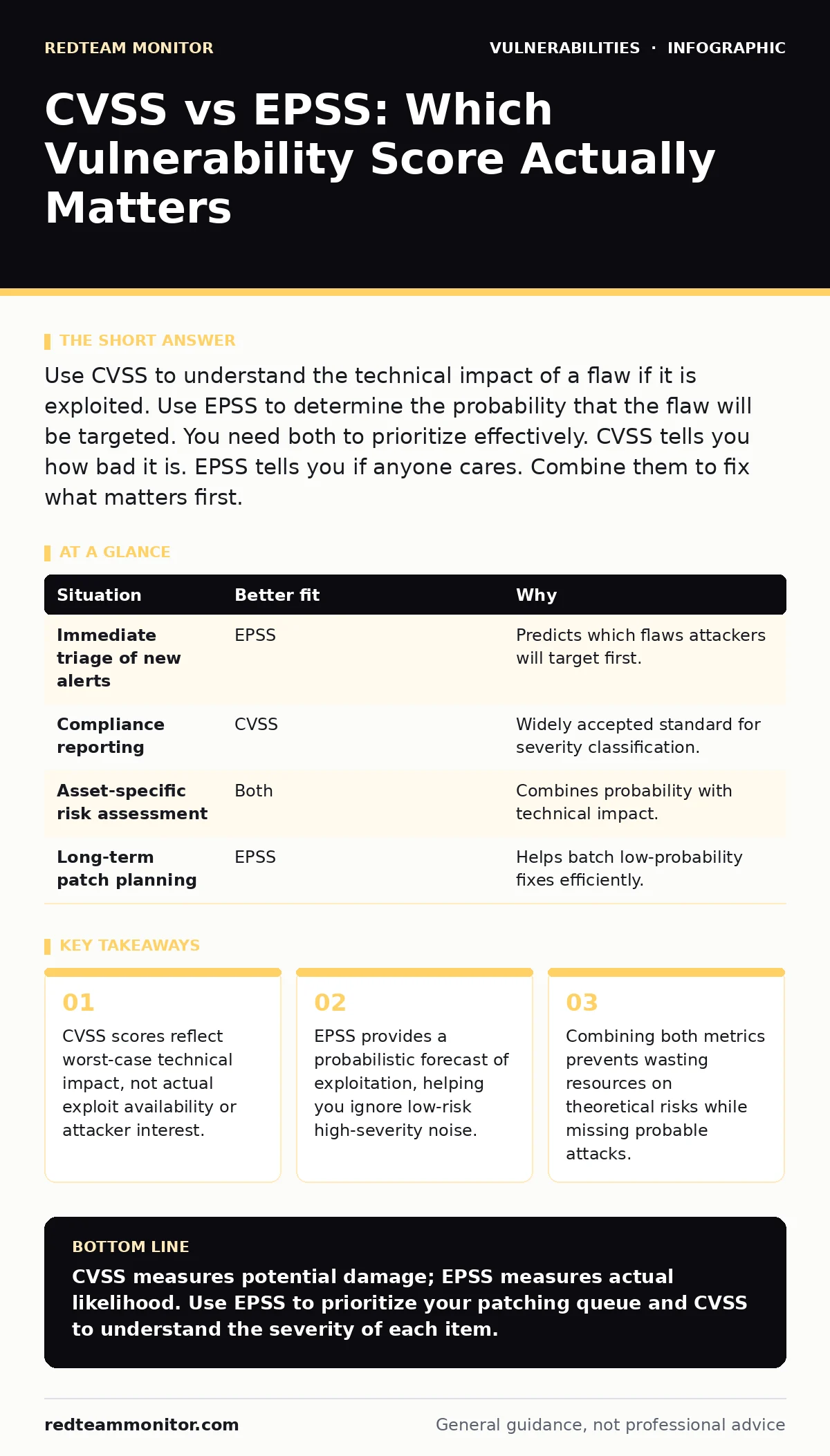
Use CVSS to understand the technical impact of a flaw if it is exploited. Use EPSS to determine the probability that the flaw will be targeted. You need both to prioritize effectively. CVSS tells you how bad it is. EPSS tells you if anyone cares. Combine them to fix what matters first.
Does the flaw have a known exploit?
CVSS scores often remain high even when no public exploit exists. The Common Vulnerability Scoring System measures the maximum potential damage. It does not account for exploit complexity or availability. A score of 9.8 means the flaw is technically severe. It does not mean attackers are currently using it.
EPSS, or the Exploit Prediction Scoring System, estimates the likelihood of exploitation. It uses historical data to predict future activity. If a flaw has a high CVSS but a near-zero EPSS, it is likely safe to defer remediation. You gain time to address more probable threats. This distinction saves bandwidth. It prevents teams from chasing ghosts in the log files.
Is the asset exposed to the internet?
Context changes risk dramatically. A flaw in an internal database server differs from one in a public-facing web app. CVSS base metrics include network vector. However, they often assume a default network exposure. They do not reflect your specific architecture.
EPSS considers the global population of exposed systems. It weights likelihood based on how many similar assets are visible to attackers. If your asset is air-gapped, the EPSS prediction may still be high globally. You must adjust for local context. Relying purely on external scores ignores your defensive perimeter.
Imagine a critical flaw in a legacy printer protocol. The CVSS is high because the protocol allows remote code execution. The EPSS might be low because few modern networks use that protocol. If you still use it, your local risk spikes. The score is a starting point, not a final verdict.
How complex is the fix?
Remediation effort matters. Patching a server might require downtime. Updating a library might break an application. CVSS gives no insight into fix difficulty. It only quantifies impact.
EPSS helps you triage. High EPSS scores demand immediate attention. Low EPSS scores allow you to batch fixes. You can group low-probability patches with scheduled maintenance. This reduces operational friction. It balances security with business continuity.
Consider a vulnerability in a widely used library. The CVSS is moderate. The EPSS is high because attackers have written simple scripts. You patch immediately. Now consider a different flaw with high CVSS but high exploit complexity. The EPSS is low. You schedule the fix for the next release cycle. This approach is sustainable.
| Situation | Better fit | Why |
|---|---|---|
| Immediate triage of new alerts | EPSS | Predicts which flaws attackers will target first. |
| Compliance reporting | CVSS | Widely accepted standard for severity classification. |
| Asset-specific risk assessment | Both | Combines probability with technical impact. |
| Long-term patch planning | EPSS | Helps batch low-probability fixes efficiently. |
Do you need to justify risk to stakeholders?
Stakeholders care about business impact. They do not care about buffer overflows. CVSS provides a standardized language for severity. It helps you explain why a flaw is dangerous.
EPSS provides a language for probability. It helps you explain why you are not fixing everything today. It grounds decisions in data. It moves the conversation from opinion to prediction.
When you present a risk report, use CVSS to define the worst case. Use EPSS to define the likely case. This dual approach builds trust. It shows you are not just reacting to noise. You are managing actual risk.
How do you combine both metrics?
Using both requires a matrix approach. Plot CVSS on the Y-axis and EPSS on the X-axis. This creates four quadrants. High CVSS and high EPSS are critical. Fix these first. They are severe and likely to be exploited.
High CVSS and low EPSS are deferred. They are severe but unlikely. Schedule them. Low CVSS and high EPSS are tactical. They are less severe but likely. Fix them quickly to reduce attack surface. Low CVSS and low EPSS are ignored. Monitor them.
This method prevents alert fatigue. It ensures you spend time on what matters. It aligns technical reality with attacker behavior. You stop patching everything. You start patching what counts.
See also: WordPress Plugin Vulnerability Prevention Checklist · Vulnerability Scanning in Cyber Security: What It Misses and How to Fix It
What about specialized contexts?
Some contexts require deeper analysis. Web applications face unique threats. Understanding the OWASP Top 10 helps you interpret CVSS scores in web contexts. A SQL injection might have a moderate CVSS but high business impact.
For infrastructure, consider default credentials. These are not vulnerabilities in the CVSS sense. They are misconfigurations. EPSS does not cover them. You must track these separately.
When dealing with complex software, fuzz testing can reveal flaws before they are scored. This proactive step reduces reliance on reactive scoring. It shifts left in the development cycle.
Security operations must also watch for security advisories. These often contain context that scores miss. They explain workaround options. They clarify affected versions. Scores are static. Advisories are dynamic. Use both to stay current.
Key takeaways
- CVSS scores reflect worst-case technical impact, not actual exploit availability or attacker interest.
- EPSS provides a probabilistic forecast of exploitation, helping you ignore low-risk high-severity noise.
- Combining both metrics prevents wasting resources on theoretical risks while missing probable attacks.
CVSS measures potential damage; EPSS measures actual likelihood. Use EPSS to prioritize your patching queue and CVSS to understand the severity of each item.
Frequently asked questions
Can EPSS replace CVSS entirely?
No. EPSS predicts exploitation likelihood but does not quantify technical severity. You still need CVSS to understand the impact if exploitation occurs.
Is EPSS accurate for zero-day vulnerabilities?
EPSS relies on historical data. It may underpredict brand-new zero-days. Use CVSS and manual triage for newly disclosed flaws until EPSS data matures.
How often do EPSS scores update?
EPSS scores update daily. This allows you to react quickly to emerging trends in attacker behavior and exploit availability.
Do all vendors support EPSS?
Not all tools support EPSS natively. You may need to integrate data via APIs or manual import. Check your platform capabilities.
How this guide was produced: written by the RedTeam Monitor editorial team with AI assistance, checked against the public references listed below, and reviewed when the facts change. See our editorial policy or report an error.