Java Deserialization Vulnerabilities: How Object Streams Break Security
Java deserialization flaws allow attackers to execute arbitrary code by tricking applications into reconstructing malicious object states from untrusted data.
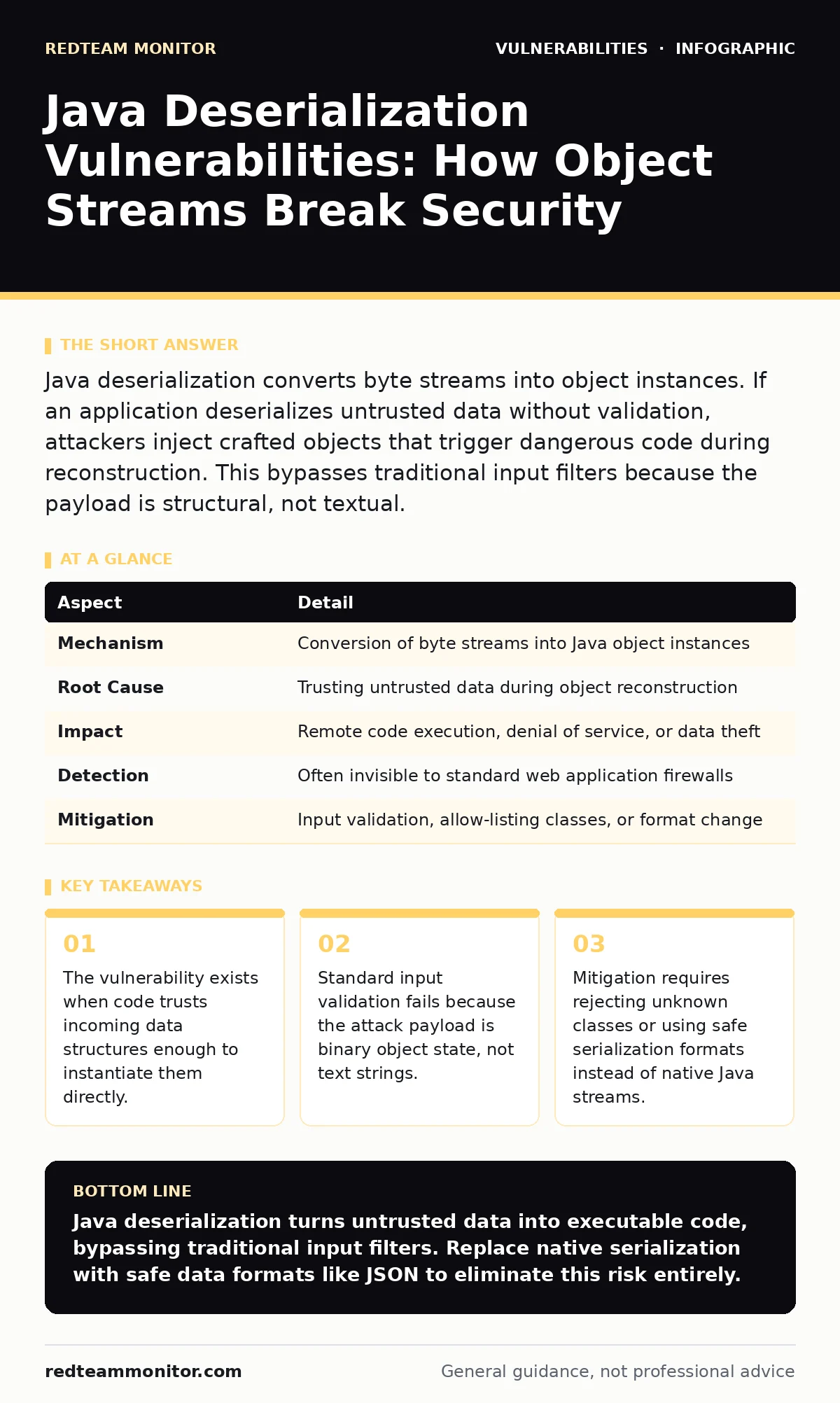
Java deserialization converts byte streams into object instances. If an application deserializes untrusted data without validation, attackers inject crafted objects that trigger dangerous code during reconstruction. This bypasses traditional input filters because the payload is structural, not textual.
The Concept of Object Reconstruction
Imagine sending a blueprint for a car instead of the car itself. The receiver builds the vehicle from the instructions. Java deserialization works similarly. It converts a stream of bytes back into a live object in memory. This process restores the object’s state, including private fields and complex relationships. The application treats the reconstructed object as if it were created internally.
This mechanism is efficient for caching data or communicating between Java services. It avoids the overhead of parsing text formats like JSON or XML. The trade-off is trust. The deserialization process assumes the incoming byte stream is safe. It executes initialization code defined in the object’s class during reconstruction. Attackers exploit this assumption by providing blueprints that build weapons instead of cars.
| Aspect | Detail |
|---|---|
| Mechanism | Conversion of byte streams into Java object instances |
| Root Cause | Trusting untrusted data during object reconstruction |
| Impact | Remote code execution, denial of service, or data theft |
| Detection | Often invisible to standard web application firewalls |
| Mitigation | Input validation, allow-listing classes, or format change |
How the Attack Chain Forms
The attack begins with a vulnerable endpoint that accepts serialized data. Many older Java applications use HTTP endpoints that accept raw binary payloads. These endpoints often lack strict type checking. They accept any byte stream that matches the format of a serialized object. The attacker crafts a specific sequence of bytes. This sequence represents a chain of objects that, when reconstructed, perform harmful actions.
The harm occurs during the readObject method execution. This method is part of the Serializable interface. When the JVM reads the stream, it instantiates the classes defined in the stream. If one of those classes has a dangerous readObject method or a static initializer, that code runs immediately. The attacker does not need to control the application logic. They only need to find a class already present in the application’s classpath that can do damage.
The Role of Gadget Chains
Attackers rely on "gadget chains" to execute code. A gadget is a harmless class in a standard library that performs a specific action. Alone, a gadget does nothing dangerous. Together, they form a chain. One gadget triggers another, which triggers a third, until a dangerous action occurs. This technique is known as Return-Oriented Programming in serialization. It reuses existing code fragments to achieve a goal.
Finding these chains is difficult for defenders. The classpath of a Java application can contain hundreds of libraries. Each library adds potential gadgets. Even if the application code itself is clean, a third-party logging library might contain a gadget. The attacker searches the classpath for classes that have side effects during initialization. They then craft the serialization stream to invoke those classes in the correct order.
Common Forms and Entry Points
Java deserialization vulnerabilities appear in several common forms. The most frequent is direct HTTP parameter injection. The attacker places the malicious byte stream in a request parameter. The server reads the parameter and deserializes it without checking the content type. Another form is file upload vulnerabilities. The application saves uploaded files and later reads them as serialized objects. If the upload validation is weak, the attacker uploads a malicious serialized file.
Message-oriented middleware also presents risks. Systems using Java Messaging Service or Apache ActiveMQ may deserialize messages from untrusted clients. If the message broker does not validate the sender or the payload structure, it becomes an attack vector. Remote procedure call frameworks are another common entry point. These frameworks often use serialization to transfer arguments and return values between client and server.
Who Is Affected and Why
Any Java application that deserializes untrusted data is at risk. This includes web applications, enterprise service buses, and distributed systems. The risk increases with the age of the application. Older frameworks often default to insecure deserialization practices. Modern frameworks may still have legacy modules that accept serialized data. The impact varies based on the environment.
In a containerized environment, the impact might be limited to the container. However, if the container runs with elevated privileges, the attacker can escape to the host. This relates to container escape vulnerabilities, where a breach in one layer compromises the underlying infrastructure. In cloud environments, the attacker might steal credentials stored in environment variables. These credentials can then be used to access other services.
What People Usually Get Wrong
Many teams believe that input validation solves the problem. They check for SQL injection patterns or cross-site scripting tags. This fails because serialization payloads are binary. They do not look like text. Standard web application firewalls often miss these attacks because they do not inspect the binary structure of the payload. Another common mistake is assuming that only external inputs are dangerous. Internal microservices that deserialize data from each other are also vulnerable if one service is compromised.
Some developers think that using a whitelist of allowed classes is sufficient. While better than nothing, implementation flaws often leave gaps. Complex inheritance hierarchies can bypass simple class name checks. Additionally, some frameworks allow deserialization of objects that implement interfaces rather than specific classes. This makes whitelist enforcement harder. The assumption that "internal" traffic is safe is particularly dangerous in large organizations with many teams.
How to Reduce the Risk
The most effective mitigation is to avoid Java serialization entirely. Replace it with safe data formats like JSON or Protocol Buffers. These formats separate data from code. They do not execute arbitrary code during parsing. If you must use serialization, implement strict class whitelisting. Only allow classes that are explicitly needed for business logic. Reject any stream that contains classes outside this list.
Use security libraries that provide safe deserialization. These libraries often include default deny policies and detailed logging. Regularly update your dependencies. New gadget chains are discovered frequently. Updating libraries removes known gadgets from the classpath. This reduces the attack surface. Also, monitor for unusual object instantiation patterns. Sudden spikes in CPU usage or unexpected file access can indicate a deserialization attack.
Related considerations include automatic software updates, which help patch known gadget chains in libraries. For web applications, reviewing the OWASP Top 10 provides a broader context for securing input handling. If you use Kubernetes, ensure that pod security policies limit what containers can do, reducing the impact of a successful breach.
Validation and Testing Strategies
Static application security testing tools can identify insecure deserialization patterns. Look for calls to ObjectInputStream.readObject without proper validation. Dynamic testing is also necessary. Use fuzzing tools to send malformed serialized objects to endpoints. Observe how the application handles errors. Does it crash? Does it execute unexpected code?
Runtime application self-protection tools can block deserialization attacks in real-time. These tools monitor the JVM and detect suspicious object creation. They can stop the execution before damage occurs. Combine these technical controls with code review practices. Train developers to recognize the risks of binary data handling. Make safe serialization a standard part of the development lifecycle.
Key takeaways
- The vulnerability exists when code trusts incoming data structures enough to instantiate them directly.
- Standard input validation fails because the attack payload is binary object state, not text strings.
- Mitigation requires rejecting unknown classes or using safe serialization formats instead of native Java streams.
Java deserialization turns untrusted data into executable code, bypassing traditional input filters. Replace native serialization with safe data formats like JSON to eliminate this risk entirely.
Frequently asked questions
Can a web application firewall stop Java deserialization attacks?
Standard web application firewalls often miss these attacks because the payload is binary, not text. Specialized rules or deep packet inspection are required to detect malicious object structures.
Is JSON serialization completely safe from code execution?
JSON is generally safer because it separates data from code. However, some JSON libraries can be configured to execute code during parsing. Ensure your library configuration disables any automatic object instantiation features.
How do I know if my application uses Java serialization?
Search your codebase for `ObjectInputStream`, `ObjectOutputStream`, or the `Serializable` interface. Also check dependencies in your build files for libraries that use serialization by default.
Does moving to microservices fix this problem?
No. Microservices often communicate using serialized data. If each service deserializes untrusted data, the risk increases. You must secure the communication layer and enforce strict validation between services.
How this guide was produced: written by the RedTeam Monitor editorial team with AI assistance, checked against the public references listed below, and reviewed when the facts change. See our editorial policy or report an error.