Web Application Firewalls: Real Benefits and Hard Limits
Web application firewalls filter traffic patterns but cannot fix broken code or prevent logic flaws that bypass signature checks.
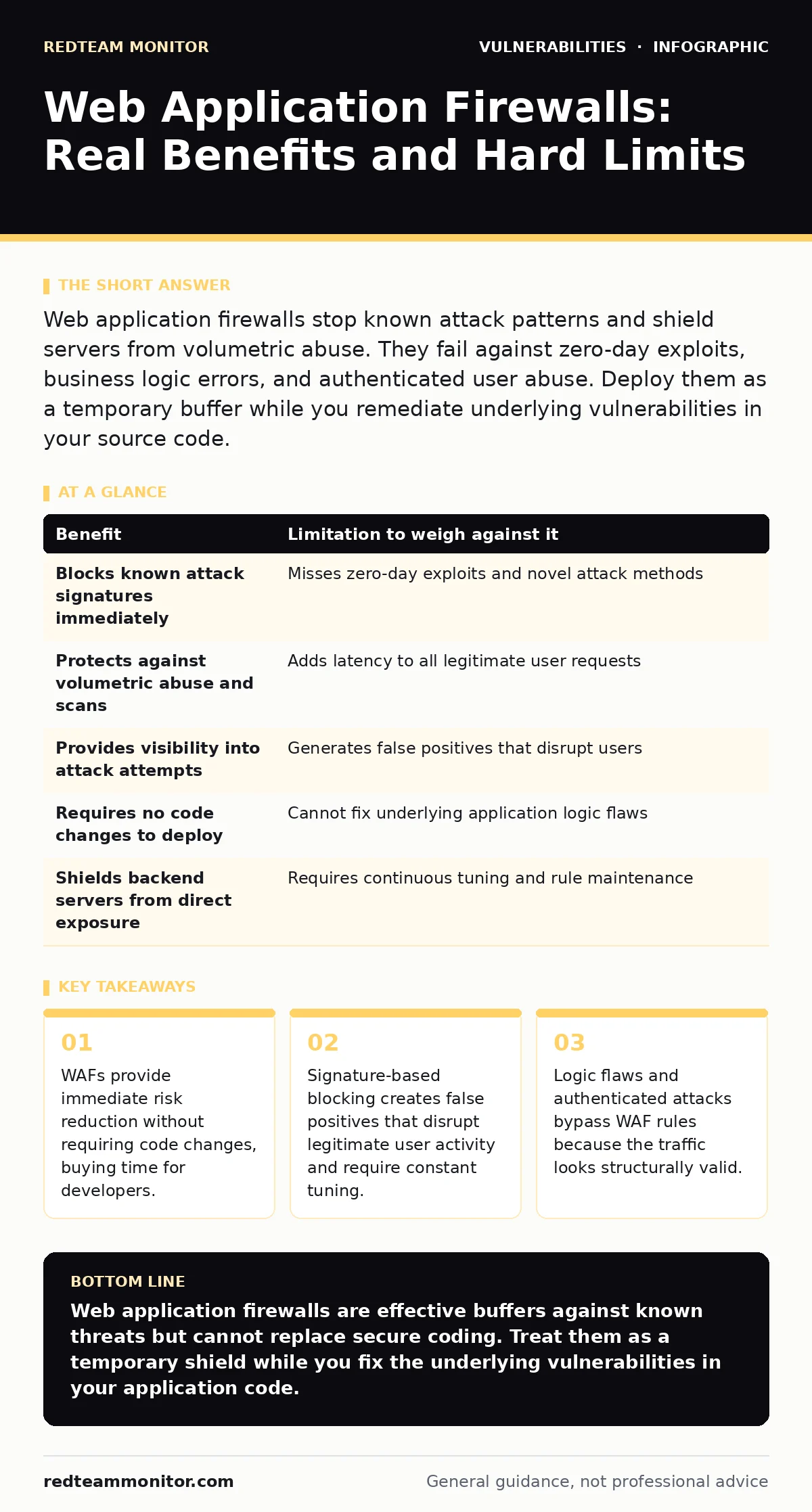
Web application firewalls stop known attack patterns and shield servers from volumetric abuse. They fail against zero-day exploits, business logic errors, and authenticated user abuse. Deploy them as a temporary buffer while you remediate underlying vulnerabilities in your source code.
The Buffer Layer Concept
A web application firewall sits between your users and your application servers. It inspects incoming HTTP requests before they reach your backend code. Think of it as a bouncer checking IDs at the door rather than fixing the broken locks inside the building. This positioning allows you to block malicious traffic without altering your application’s source code.
You gain immediate protection against known attack vectors. The device matches incoming requests against a database of known malicious patterns. When a match occurs, it drops the connection or returns an error page. This mechanism stops automated scanners and simple exploit attempts from ever touching your infrastructure.
However, this layer adds latency to every request. Every packet must be inspected before forwarding. In high-throughput environments, this inspection overhead can become a bottleneck. You trade raw speed for security screening. The trade-off becomes visible when your application experiences sudden traffic spikes.
Concrete Benefits for Operations
The primary benefit is immediate risk mitigation. You can deploy rules to block SQL injection attempts within minutes. This stops attackers from extracting database contents via crafted input fields. It also blocks cross-site scripting attempts that try to inject scripts into pages viewed by other users.
WAFs provide visibility into attack traffic. You see exactly what attackers are trying and how they are trying it. This logging helps you understand your threat profile. You can identify which endpoints are targeted most frequently. This data informs your patching priorities and development roadmap.
They also shield against volumetric abuse. Basic rate limiting features prevent brute-force login attempts. This protects your authentication systems from being overwhelmed. You reduce the load on your servers during distributed attacks. The firewall absorbs the initial shock of the traffic surge.
The Limits of Pattern Matching
Pattern matching fails when the attacker changes the syntax. If you block a specific sequence of characters, an attacker can encode them differently. URL encoding, double encoding, or using different character sets can bypass simple signatures. The firewall sees valid characters, not a malicious payload.
This leads to the problem of false positives. Legitimate user input often resembles attack patterns. A user entering a long string of text or special characters might trigger a block. Your real customers get locked out while you troubleshoot the rule. Tuning these rules requires constant manual effort.
Logic flaws remain invisible to standard WAFs. A firewall checks the structure of the request, not the intent. If an attacker uses valid credentials to access a resource they should not see, the firewall allows it. The request looks normal. The vulnerability exists in your business logic, not the network packet.
Balancing Protection and Friction
Every security control introduces friction. A WAF is no exception. You must weigh the protection gained against the operational cost of maintenance. Rules that are too strict break your application. Rules that are too loose let threats through. Finding the balance requires continuous monitoring and adjustment.
Consider the maintenance burden. New vulnerabilities emerge constantly. You must update your rules to address new threats. This is not a set-and-forget solution. Your security team must dedicate time to reviewing logs and updating configurations. Ignoring this maintenance leads to drift and decreased effectiveness.
The hidden cost is developer dependency. Teams may rely on the WAF to fix security issues. They might skip input validation in code because the firewall handles it. This creates a fragile security posture. If the WAF fails or is misconfigured, your application is exposed. Defense in depth requires security at every layer.
| Benefit | Limitation to weigh against it |
|---|---|
| Blocks known attack signatures immediately | Misses zero-day exploits and novel attack methods |
| Protects against volumetric abuse and scans | Adds latency to all legitimate user requests |
| Provides visibility into attack attempts | Generates false positives that disrupt users |
| Requires no code changes to deploy | Cannot fix underlying application logic flaws |
| Shields backend servers from direct exposure | Requires continuous tuning and rule maintenance |
When It Is Worth It
Deploy a WAF when you have legacy applications that cannot be patched quickly. These systems often contain known vulnerabilities that are difficult to fix. The WAF acts as a virtual patch, blocking exploitation until a proper fix is deployed. This buys you time to plan a migration or rewrite.
It is also worth it for public-facing endpoints that attract automated abuse. Login pages and search forms are common targets. A WAF can filter out bot traffic and simple exploit attempts. This reduces noise in your logs and protects your authentication systems. You keep your resources focused on real threats.
Consider it for compliance requirements. Many standards require network-level filtering for web applications. A WAF helps demonstrate due care. It shows you have implemented controls to protect sensitive data. Ensure your configuration aligns with the specific requirements of your regulatory framework.
See also: Stop Host Header Injection: Practical Fixes That Actually Work · How Bot Protection Works: The Hidden Mechanics of Web Traffic Filtering
When It Is Not
Do not rely on a WAF as a substitute for secure coding practices. If your application is built with memory-safe programming languages and rigorous input validation, the WAF adds less value. You are paying for a shield when you have already built a fortress. Focus your budget on code reviews and testing instead.
It is not worth it for internal tools with no external exposure. If your application is only accessible via a secure internal network, the threat model changes. The risk of automated web attacks drops significantly. You can achieve better protection through network segmentation and strict access controls.
Avoid it if you lack the resources for tuning. A WAF requires active management. If your team cannot dedicate time to reviewing false positives and updating rules, it will become a liability. It will either block your users or fail to stop attackers. In this case, basic network firewalls are a better use of resources.
Integrating with Development
Security works best when integrated into the development lifecycle. Use fuzz testing to find edge cases in your input handling. This helps you identify inputs that might bypass WAF rules or cause crashes. Fix these issues in the code, not just in the firewall configuration.
Review security advisories regularly. When new vulnerabilities are disclosed, check if your WAF rules address them. If not, update your code to prevent the exploit. Do not wait for the vendor to release a signature update. Proactive code fixes are more reliable than reactive firewall rules.
Ensure your deployment pipeline includes security checks. Catch issues before they reach production. This reduces the load on your WAF. You only need to handle unexpected threats, not known bugs that slipped through. This approach leads to a more resilient and maintainable system.
Key takeaways
- WAFs provide immediate risk reduction without requiring code changes, buying time for developers.
- Signature-based blocking creates false positives that disrupt legitimate user activity and require constant tuning.
- Logic flaws and authenticated attacks bypass WAF rules because the traffic looks structurally valid.
Web application firewalls are effective buffers against known threats but cannot replace secure coding. Treat them as a temporary shield while you fix the underlying vulnerabilities in your application code.
Frequently asked questions
Can a WAF stop zero-day attacks?
No. Zero-day attacks exploit unknown vulnerabilities. Since there is no known signature, the WAF cannot recognize the malicious traffic. It may catch generic anomalies if configured for behavioral analysis, but it is not reliable for zero-days.
Does a WAF protect against DDoS attacks?
It can mitigate low-volume application-layer DDoS attacks by blocking malicious requests. However, it cannot handle high-volume volumetric attacks that saturate your network bandwidth. You need dedicated DDoS mitigation services for that.
How do I reduce false positives?
Start in logging mode to identify legitimate traffic that triggers rules. Whitelist specific patterns or endpoints that are safe. Regularly review logs and adjust rules to match your application’s unique behavior.
Should I use a cloud-based or on-premise WAF?
Cloud-based WAFs are easier to manage and scale automatically. On-premise WAFs offer more control over data and integration with internal systems. Choose based on your compliance needs and infrastructure preferences.
How this guide was produced: written by the RedTeam Monitor editorial team with AI assistance, checked against the public references listed below, and reviewed when the facts change. See our editorial policy or report an error.