Difference Between Data Controllers and Data Processors Explained
The data controller bears full liability for privacy compliance, while the data processor only answers to the contract signed with the controller.
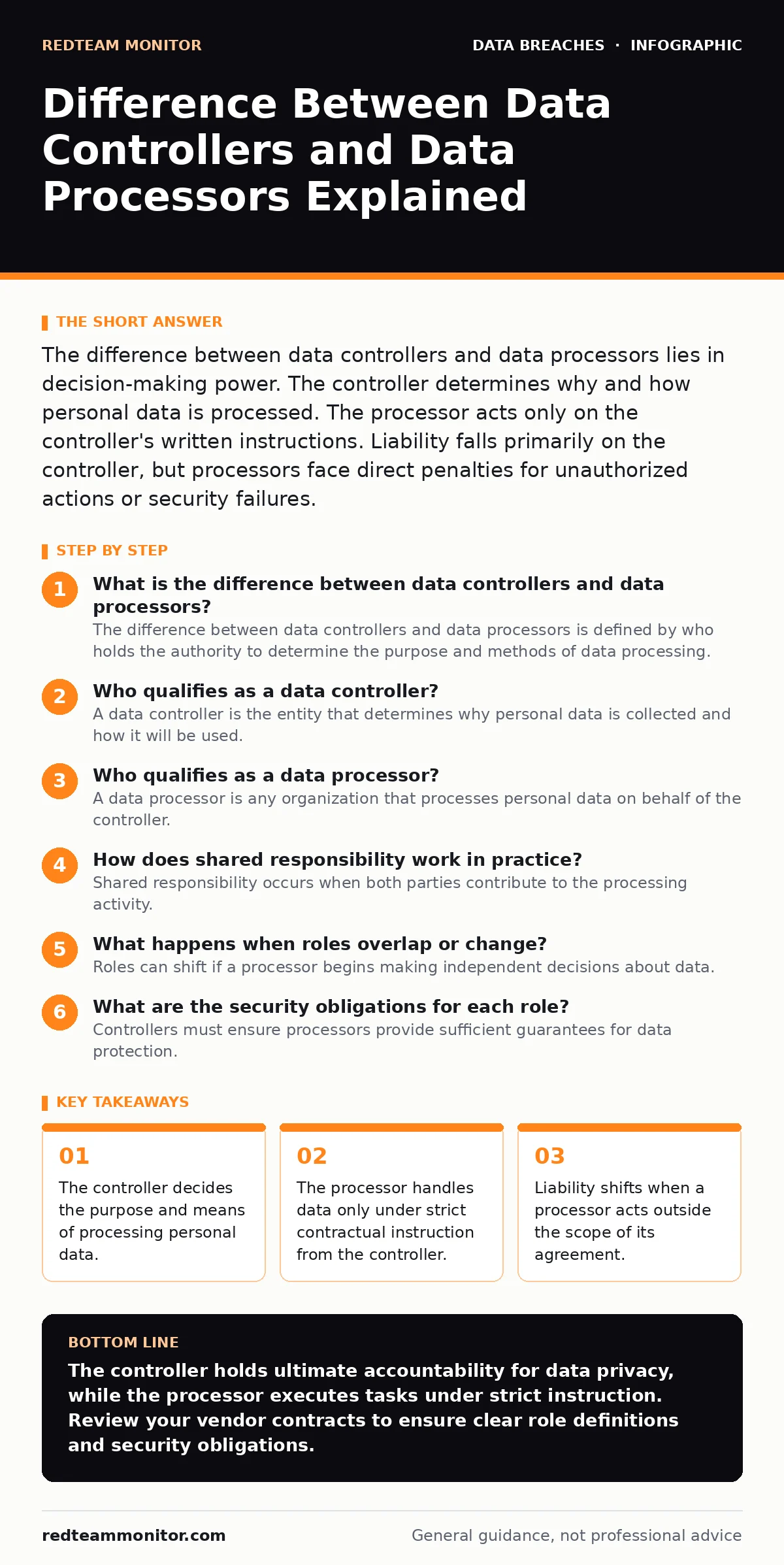
The difference between data controllers and data processors lies in decision-making power. The controller determines why and how personal data is processed. The processor acts only on the controller's written instructions. Liability falls primarily on the controller, but processors face direct penalties for unauthorized actions or security failures.
What is the difference between data controllers and data processors?
The difference between data controllers and data processors is defined by who holds the authority to determine the purpose and methods of data processing. The controller sets the rules, selects the data fields, and decides retention periods. The processor executes these tasks without independent discretion. This distinction dictates legal responsibility, security obligations, and breach notification duties. Understanding this split prevents compliance gaps during audits.
Who qualifies as a data controller?
A data controller is the entity that determines why personal data is collected and how it will be used. You are a controller if you decide to collect customer emails for marketing newsletters. You define the data fields, the storage duration, and the access controls. The controller maintains the primary relationship with the data subject. This role carries the burden of proving lawful basis for processing, such as consent or legitimate interest.
Who qualifies as a data processor?
A data processor is any organization that processes personal data on behalf of the controller. You are a processor if you host a controller's database or run their email marketing platform. You do not decide why the data exists. You follow the controller's documented instructions. Your liability is limited to the terms of your service agreement and applicable laws. You must implement technical safeguards but lack autonomy over data usage.
How does shared responsibility work in practice?
Shared responsibility occurs when both parties contribute to the processing activity. Imagine a cloud provider offering storage that also offers automated data analysis tools. If the customer configures the analysis, they may become a joint controller for that specific function. The boundary blurs when the processor has significant influence over the processing parameters. Clear contracts must delineate where controller authority ends and processor execution begins.
| Role | Decision Authority | Primary Liability | Contractual Duty |
|---|---|---|---|
| Controller | Determines purpose and means | Full legal liability | Select compliant processors |
| Processor | Follows written instructions | Liability for breaches of contract | Implement security measures |
What happens when roles overlap or change?
Roles can shift if a processor begins making independent decisions about data. Suppose a vendor uses your customer data to train their own AI models without your explicit permission. They have effectively assumed controller responsibilities for that new purpose. This creates dual liability. You must monitor vendor behavior to ensure they do not drift into controller territory. Privacy impact assessments help identify these role shifts before they cause compliance failures.
See also: Privacy Impact Assessments for Small Businesses: Practical Steps · Password Reuse Prevention Checklist for Secure Identity Management
What are the security obligations for each role?
Controllers must ensure processors provide sufficient guarantees for data protection. This requires due diligence during vendor selection. Processors must implement appropriate technical and organizational measures. These measures include encryption, access controls, and staff training. The principle of least privilege applies strictly to processor staff. They should only access data necessary for their specific task. Excessive access increases the risk of insider threats and credential dumps.
How do breach notifications differ?
Processors must notify the controller of any personal data breach without undue delay. They do not notify the data subjects or regulators directly. The controller assesses the risk and decides whether to notify authorities. This chain of communication ensures the party with the full context makes the final call. Delays in processor notification can hinder the controller's ability to meet legal deadlines. Timely reporting is a contractual and legal requirement for processors.
What mistakes do organizations commonly make?
Organizations often assume that signing a standard data processing agreement transfers all liability. This assumption is incorrect. Controllers remain liable for processor failures if they failed to perform adequate due diligence. Processors often assume they are not liable for security incidents. They face direct fines for violating security mandates. Misunderstanding these boundaries leads to gaps in incident response and digital forensics capabilities.
How do you manage third-party risk effectively?
You manage risk by treating processors as extensions of your own security perimeter. Conduct regular audits and review their security certifications. Ensure your contracts include the right to audit their facilities. Monitor for signs of password reuse or backup data exposure in their environment. Require processors to report sub-processors before they engage them. This visibility prevents hidden supply chain vulnerabilities. Cyber insurance may cover some losses, but it does not absolve you of regulatory penalties.
Key takeaways
- The controller decides the purpose and means of processing personal data.
- The processor handles data only under strict contractual instruction from the controller.
- Liability shifts when a processor acts outside the scope of its agreement.
The controller holds ultimate accountability for data privacy, while the processor executes tasks under strict instruction. Review your vendor contracts to ensure clear role definitions and security obligations.
Frequently asked questions
Can a company be both a controller and a processor?
Yes, a company can act as a controller for its own data and as a processor for data it handles on behalf of clients. The roles are defined by the specific data processing activity.
Who pays for a data breach?
The controller typically bears the primary financial burden for regulatory fines and victim compensation. The processor may be liable for damages resulting from its own negligence or breach of contract.
Do processors need to comply with GDPR?
Yes, processors must comply with specific provisions of the GDPR, including security requirements and record-keeping. They are directly subject to regulatory enforcement for violations.
How do I identify if I am a controller?
You are a controller if you determine the reasons for collecting data and the methods used to process it. If you set the policies and rules for data usage, you hold controller status.
How this guide was produced: written by the RedTeam Monitor editorial team with AI assistance, checked against the public references listed below, and reviewed when the facts change. See our editorial policy or report an error.