
Public vs Private Cloud Security: Where Control and Risk Shift
Public clouds shift infrastructure liability to providers but introduce shared responsibility gaps that private clouds avoid through physical isolation.
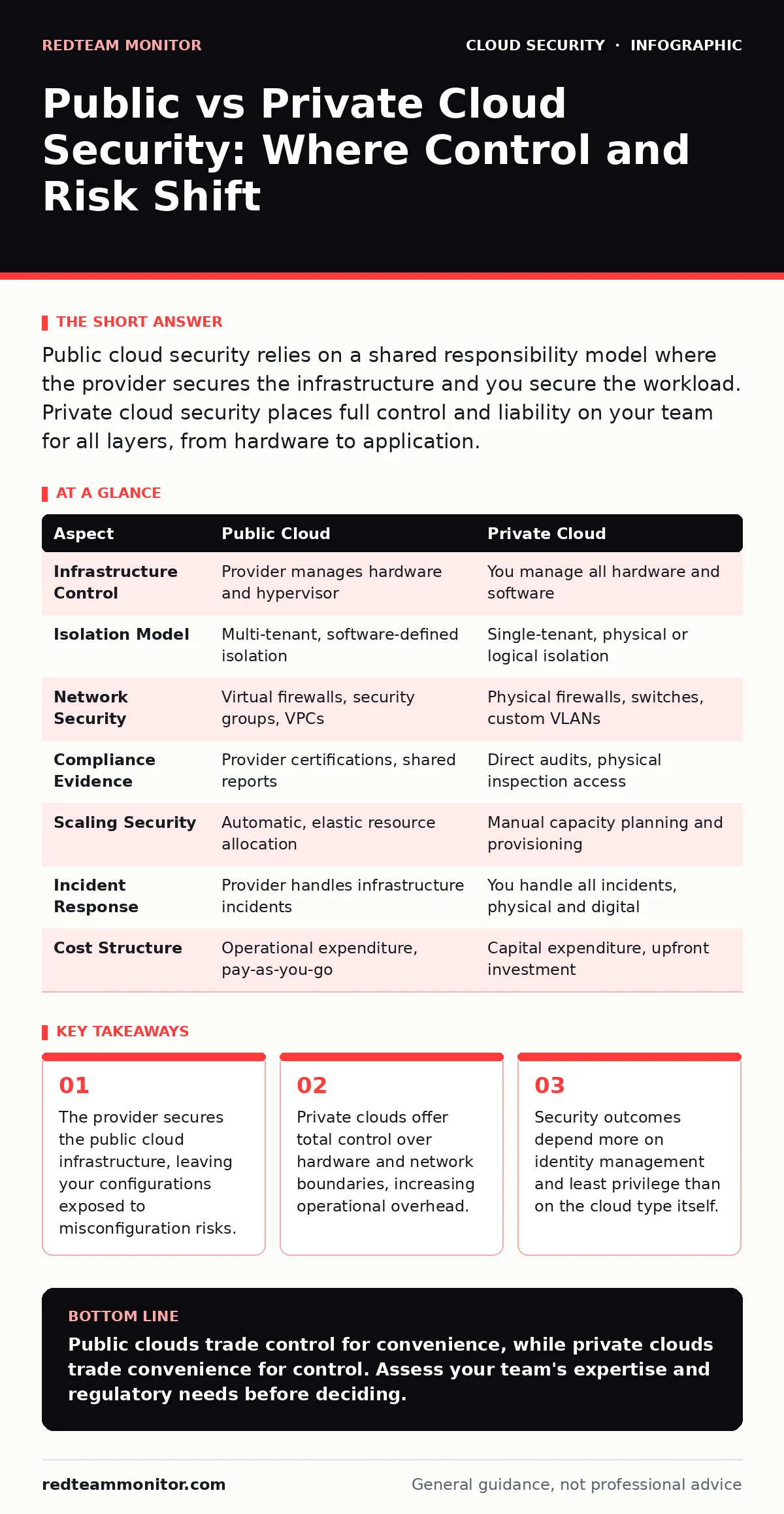
Public cloud security relies on a shared responsibility model where the provider secures the infrastructure and you secure the workload. Private cloud security places full control and liability on your team for all layers, from hardware to application.
The Shared Responsibility Divide
The fundamental difference lies in who controls the underlying infrastructure. In a public cloud, the provider manages the physical servers, networking, and hypervisors. You manage the guest operating system, applications, and data. In a private cloud, your organization owns or leases the entire stack. You are responsible for every layer, from the rack power supply to the application code. This shift in liability changes how you detect and respond to threats.
Imagine a database server in a public cloud. If the physical disk fails, the provider replaces it. If you leave the database port open to the internet, that is your fault. In a private cloud, if the disk fails, your team replaces it. If you leave the port open, it is still your fault, but you also control the physical access to the server room. The boundary of trust moves inward.
Architecture and Isolation
Public clouds use multi-tenant architecture. Your workload shares physical hardware with other customers. The provider uses virtualization to isolate your data from theirs. This isolation relies on software correctness. A flaw in the hypervisor could theoretically allow one tenant to access another's memory. Private clouds use single-tenant or dedicated hardware. Your workloads run on servers that no one else touches. This eliminates the risk of noisy neighbors and cross-tenant attacks. However, it also means you cannot benefit from the provider's economies of scale in security research.
Network Boundary Control
In a public cloud, the network boundary is virtual. You define security groups and network access control lists to filter traffic. These rules are software-defined and can change instantly. In a private cloud, the network boundary is physical and virtual. You manage firewalls, intrusion detection systems, and physical switches. You have deeper visibility into packet flows but also more complexity to manage. The public cloud abstracts the network, making it easier to scale but harder to inspect at the wire level.
Identity and Access Management
Identity is the new perimeter in both models. Public clouds provide integrated identity services that scale automatically. You can enforce multi-factor authentication and conditional access policies easily. Private clouds require you to build or integrate these services. You must ensure that your identity provider supports the protocols your applications need. The risk in public clouds is often poor configuration of these services. The risk in private clouds is often lack of integration or outdated protocols.
Compliance and Data Residency
Regulatory requirements often dictate where data must reside. Public clouds offer regions and availability zones to meet data residency laws. You must verify that the provider's data centers in those regions actually comply with local regulations. Private clouds allow you to place data exactly where you want it. You can keep data on-premises or in a colocation facility. This gives you direct evidence for auditors. However, you must also maintain the physical security controls required by those regulations.
See also: Implement Single Sign-On: A Step-by-Step Rollout Plan · Stop Denial-of-Wallet Attacks: Response and Recovery Steps
Operational Overhead and Expertise
Public cloud security requires expertise in cloud-native tools. You must understand IAM roles, logging services, and cloud-specific encryption keys. Private cloud security requires expertise in traditional infrastructure. You must manage server hardening, patch management, and network segmentation. The public cloud shifts the burden of infrastructure maintenance to the provider. The private cloud keeps that burden on your team. This affects your hiring strategy and training needs.
| Aspect | Public Cloud | Private Cloud |
|---|---|---|
| Infrastructure Control | Provider manages hardware and hypervisor | You manage all hardware and software |
| Isolation Model | Multi-tenant, software-defined isolation | Single-tenant, physical or logical isolation |
| Network Security | Virtual firewalls, security groups, VPCs | Physical firewalls, switches, custom VLANs |
| Compliance Evidence | Provider certifications, shared reports | Direct audits, physical inspection access |
| Scaling Security | Automatic, elastic resource allocation | Manual capacity planning and provisioning |
| Incident Response | Provider handles infrastructure incidents | You handle all incidents, physical and digital |
| Cost Structure | Operational expenditure, pay-as-you-go | Capital expenditure, upfront investment |
Where They Overlap
Both models face the same application-level threats. SQL injection, cross-site scripting, and insecure APIs exist regardless of where the server runs. Both require secrets managers to protect credentials. Both benefit from single sign-on to reduce password fatigue. Both need monitoring for anomalous behavior. The difference is in the underlying platform, not the application logic. You must secure your code and data in both environments.
Choosing Your Path
Choose the public cloud when:
- You need rapid scaling and global reach.
- You want to offload infrastructure maintenance.
- Your team lacks deep hardware security expertise.
- You need to integrate with cloud-native services.
Choose the private cloud when:
- You have strict regulatory or data sovereignty requirements.
- You need total control over the hardware stack.
- Your workloads are predictable and stable.
- You have the team to manage complex infrastructure.
The choice is not binary. Many organizations use a hybrid approach. They keep sensitive data in a private cloud and run scalable applications in a public cloud. This requires careful attention to cloud migration security and cloud security groups to protect data in transit. You must also guard against cloud account hijacking in the public side and Kubernetes misconfigurations if you use containers. Ensure that exposed Kubernetes dashboards are never left open to the internet, regardless of the environment.
Key takeaways
- The provider secures the public cloud infrastructure, leaving your configurations exposed to misconfiguration risks.
- Private clouds offer total control over hardware and network boundaries, increasing operational overhead.
- Security outcomes depend more on identity management and least privilege than on the cloud type itself.
Public clouds trade control for convenience, while private clouds trade convenience for control. Assess your team's expertise and regulatory needs before deciding.
Frequently asked questions
Is private cloud more secure than public cloud?
Not necessarily. Private clouds offer more control, but public clouds have more resources dedicated to security. Security depends on configuration, not just the model.
Can I use public cloud for sensitive data?
Yes, if you encrypt the data and manage keys yourself. The provider cannot read encrypted data, even if they access the storage.
What is the biggest risk in public cloud?
Misconfiguration. Leaving storage buckets or databases open to the internet is the most common cause of data leaks.
Does private cloud cost more?
It has higher upfront costs and operational overhead. Public cloud has lower upfront costs but can become expensive at scale.
How this guide was produced: written by the RedTeam Monitor editorial team with AI assistance, checked against the public references listed below, and reviewed when the facts change. See our editorial policy or report an error.