
Linux Kernel Privilege Escalation: Step-by-Step Attack Flow
Kernel exploits bypass application boundaries by manipulating memory structures, granting attackers full system control that survives reboots and ignores file permissions.
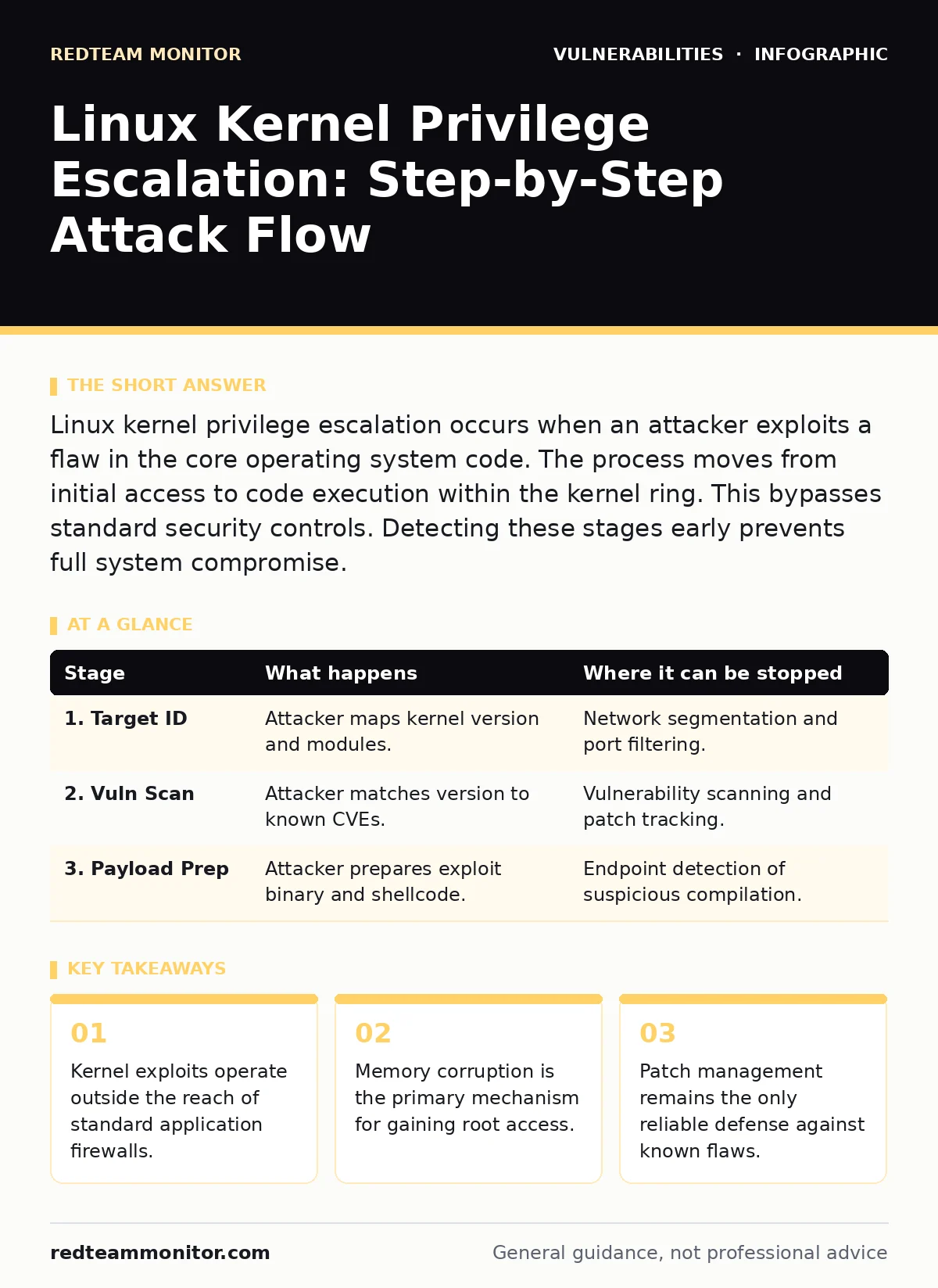
Linux kernel privilege escalation occurs when an attacker exploits a flaw in the core operating system code. The process moves from initial access to code execution within the kernel ring. This bypasses standard security controls. Detecting these stages early prevents full system compromise.
Initial Access and Foothold
An attacker must first reach the system. Most kernel exploits begin with a lower-privilege entry point. This entry point could be a web server vulnerability or a misconfigured service. The attacker gains a user-level shell. This shell has limited permissions by design. The attacker cannot simply read protected files. The attacker cannot modify system binaries. The attacker needs a bridge to the kernel. This bridge is a vulnerability in the kernel itself.
The attacker scans for running services. They look for exposed .git directories that might reveal source code. They check for default credentials on management interfaces. They analyze open ports for unusual protocols. The goal is not just access. The goal is persistence and privilege. Without a foothold, the kernel exploit cannot run. The attacker relies on the system accepting their input. The system processes this input without sufficient validation.
Identifying Kernel Vulnerabilities
The attacker identifies the specific kernel version. They determine the exact build configuration. They look for known exploits matching this version. Tools automate this reconnaissance process. The attacker checks for loaded kernel modules. Custom modules often introduce new attack surfaces. They examine enabled kernel features. Features like debugfs or ptrace can aid exploitation. The attacker builds a profile of the target. This profile dictates which exploit code to use. A mismatched exploit will crash the system. A crashed system alerts defenders immediately.
The attacker relies on incomplete patching. Some servers run older kernels for stability. Some servers disable automatic software updates. This creates a window of vulnerability. The attacker exploits this window. They look for memory corruption bugs. They look for race conditions in subsystems. They look for permission checks that fail under specific conditions. The vulnerability must allow code execution. It must allow data leak. It must bypass Kernel Page Table Isolation.
Payload Development and Preparation
The attacker selects or writes the exploit code. This code targets a specific memory flaw. The payload must be small enough to fit in buffers. The payload must be position-independent code. The payload must handle Kernel Address Space Layout Randomization. This randomization places kernel objects at random memory addresses. The exploit must leak kernel pointers. It must calculate the correct offsets. It must disable security mitigations like Stack Protector. It must bypass Control Flow Integrity checks.
The attacker prepares the shellcode. This shellcode grants root privileges. It opens a new shell session. It modifies security policies. The shellcode is encoded to avoid null bytes. Null bytes can truncate string copies. The attacker tests the exploit locally. They simulate the target environment. They verify the exploit works on the target kernel version. They ensure the exploit does not trigger panics. They prepare for failure modes. The exploit must be resilient to minor timing differences.
Stage 1: Reconnaissance and Target Selection
| Stage | What happens | Where it can be stopped |
|---|---|---|
| 1. Target ID | Attacker maps kernel version and modules. | Network segmentation and port filtering. |
| 2. Vuln Scan | Attacker matches version to known CVEs. | Vulnerability scanning and patch tracking. |
| 3. Payload Prep | Attacker prepares exploit binary and shellcode. | Endpoint detection of suspicious compilation. |
Executing the Exploit Code
The attacker runs the exploit binary. The code executes in user space initially. It prepares data structures for the kernel call. It triggers a system call that contains the flaw. This call passes malicious data to the kernel. The kernel processes this data without proper checks. The flaw allows writing to arbitrary memory. The flaw allows reading protected memory. The attacker overwrites a function pointer. The attacker overwrites a credential structure. The execution flow diverts to attacker-controlled code.
The exploit must run with precise timing. Race conditions require hitting a specific window. The attacker may need to retry the exploit. They automate the retry loop. They monitor for success indicators. A successful exploit returns a root shell. A failed exploit may crash the service. The attacker monitors logs for error messages. They adjust parameters if needed. They iterate until the exploit succeeds.
Gaining Root Privileges
The shellcode executes within the kernel ring. This ring has unrestricted access to hardware. It has unrestricted access to memory. The shellcode modifies the current process credentials. It sets the user ID to zero. It sets the group ID to zero. It clears capability masks. It disables AppArmor or SELinux enforcement. The process now believes it is root. The kernel trusts this process completely. The attacker can now read any file. The attacker can install backdoors. The attacker can hide network traffic.
The attacker creates a persistent backdoor. They may modify PAM configuration. They may add a new user account. They may install a rootkit. The rootkit hooks kernel functions. It hides processes and files. It intercepts system calls. The attacker establishes command and control. They exfiltrate sensitive data. They pivot to other systems. The initial vulnerability is just the entry point. The real damage occurs after privilege escalation.
Stage 2: Exploitation and Privilege Escalation
| Stage | What happens | Where it can be stopped |
|---|---|---|
| 4. Trigger | Attacker invokes system call with exploit. | Kernel hardening and input validation. |
| 5. Execution | Shellcode runs in kernel space. | Control Flow Integrity and KASLR. |
| 6. Escalation | Credentials modified to grant root access. | Mandatory Access Control policies. |
Defense and Interruption Points
Defenders can interrupt this flow at multiple stages. Network controls limit initial access. Vulnerability management patches known flaws. Kernel hardening mitigates exploitation techniques. Security modules enforce strict permissions. Monitoring detects anomalous behavior. Each layer adds friction for the attacker. The goal is to increase the cost of attack. The goal is to reduce the window of opportunity. No single control stops all attacks. Defense in depth is necessary.
Imagine a server running an unpatched kernel. An attacker finds a remote service. They exploit a memory corruption bug. They gain root access. They install a backdoor. They disappear before detection. Now imagine the same server with patches applied. The exploit fails. The attacker is blocked. The difference is patch management. It is the single most effective control. It closes the door entirely.
Long-Term Mitigation Strategies
Preventing kernel privilege escalation requires ongoing effort. Organizations must maintain an accurate asset inventory. They must track kernel versions across all systems. They must prioritize patching critical servers. They must disable unnecessary kernel features. They must use memory-safe programming languages for new kernel modules. This reduces the likelihood of memory corruption bugs. They must implement strict access controls. They must monitor for suspicious system calls.
Organizations should conduct attack surface management regularly. They should identify exposed services. They should remove unused modules. They should audit kernel configurations. They should test exploit mitigations. They should verify that KASLR is enabled. They should verify that Stack Protector is active. They should verify that SELinux or AppArmor is enforcing. These controls raise the bar for attackers. They make exploitation significantly harder.
Key takeaways
- Kernel exploits operate outside the reach of standard application firewalls.
- Memory corruption is the primary mechanism for gaining root access.
- Patch management remains the only reliable defense against known flaws.
Frequently asked questions
Can a kernel exploit survive a system reboot?
Yes, if the attacker installs a persistent backdoor or rootkit before rebooting. The kernel flaw itself is fixed by rebooting only if the code is not persistent.
Does SELinux prevent kernel privilege escalation?
SELinux limits what processes can do, but it does not prevent kernel memory corruption. If an exploit bypasses SELinux, it grants full access.
How do I know if my system was compromised?
Check for unknown kernel modules, unexpected root processes, and modified system binaries. Look for anomalous network connections and log gaps.
Are automatic software updates enough protection?
Automatic updates help, but they do not patch zero-day vulnerabilities. They also do not fix misconfigurations or weak application code.
How this guide was produced: written by the RedTeam Monitor editorial team with AI assistance, checked against the public references listed below, and reviewed when the facts change. See our editorial policy or report an error.